A colleague scrawls it on the whiteboard before a meeting starts: “Are there more doors in the world, or more wheels?” It sounds like a throwaway question, but it has a paper trail. In March 2022, Ryan Nixon — a New Zealand rugby referee — posted the “dumbest argument” he’d been having with friends on Twitter. It pulled in more than 220,000 votes and split the internet down the middle.[1]
The fun part isn’t that the argument has no answer. It’s that the question never defines its terms. Until you decide how far “door” and “wheel” are allowed to stretch, you can’t even start counting. So this piece starts at the building door, widens the definition one notch at a time — cars, toys, plant stomata, bacterial flagellar motors — and actually counts. The short version: the lead changes hands exactly three times. The shakiest of those three reversals isn’t the wild-sounding one about bacteria. It’s the one about a toy car.
INPUT
Setting the standard: what counts as a “wheel” — and a “door”
Before counting anything, we need a ruler, and this edition uses exactly one: Merriam-Webster. It defines wheel as “a circular frame of hard material that may be solid, partly solid, or spoked and that is capable of turning on an axle.”[2] That gives two testable conditions — ① it has to have a circular rim or disc shape, and ② it has to rotate around an axle. Something only counts as a “strict” wheel here if it clears both. Clearing just one earns a “borderline” label. Clearing neither, while still being something people casually call a wheel, earns “extended/figurative.”
| Candidate | Verdict | Basis |
|---|---|---|
| Car, motorcycle, and bicycle wheels; casters; toy wheels | Strict | Circular rim + axle rotation — self-evident |
| Gears (cogwheels), pulleys | Strict | Circular frame + axle rotation (the English names say so outright: cogwheel, pulley wheel) |
| Fans, propellers, impellers | Borderline | Rotates on an axis, but isn’t “rim-shaped” |
| Rollers (cylinders), turbine wheels | Borderline | A cylinder is a stretch as a “rim”; “wheel” here is mostly industry jargon |
| Ball bearings | Excluded | Spherical, and doesn’t turn around a fixed axle the way a wheel does |
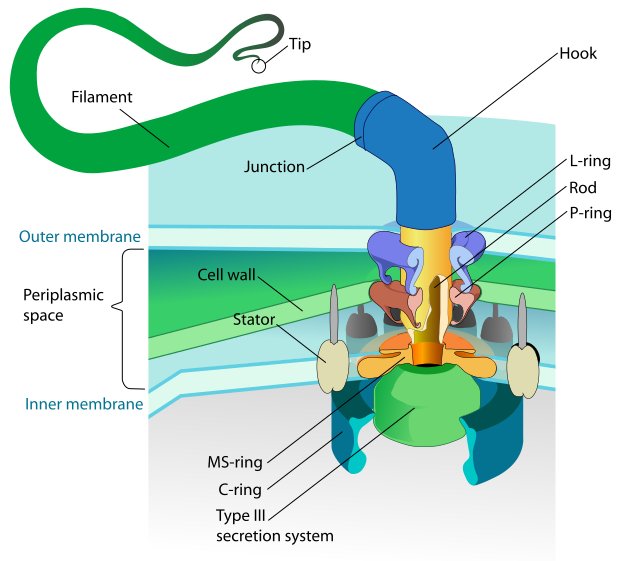
| Bacterial flagellar motor | Form and rotation only | The rotor is a ring-shaped structure (the C-ring, MS-ring) that spins 360° on a stator — it clears both shape conditions, but fails the “hard material” (i.e., manufactured) requirement the definition also demands |
The same ruler has to apply to “door,” or the comparison isn’t fair. Merriam-Webster: “a usually swinging or sliding barrier by which an entry is closed and opened; also: a similar part of a piece of furniture.”[3] Two things follow from that wording. First, cabinet and wardrobe doors are doors by definition, full stop — no separate justification needed, because the dictionary names them itself. Second, the definition is still describing something built: “barrier,” “hard material,” and the furniture clause all assume a human made the thing. A heart valve or a leaf’s stoma might functionally open and close an entry, but nobody installed it. That distinction resurfaces later. Just as stage 4’s fans fail the wheel’s strict shape test, stage 5’s valves and stomata fail the door’s strict artifact test — for a matching reason, on opposite sides of the ledger.
Shared variables: world population and households
The UN’s latest population projections put the world at roughly 8.2 billion people (central estimate).[4] The UN Population Division’s household size and composition database tracks average household size by country; the global figure sits around 4.6 and is still falling (needs-assumption — country variance is wide enough that 3.5 is a defensible conservative floor and 5+ a defensible aggressive ceiling).[5] Dividing one by the other gives the number of households.
Stage 1 variables — building and furniture doors vs. car, motorcycle & bicycle wheels
| Symbol | Meaning | Central value | Range | Confidence |
|---|---|---|---|---|
| Fixed building doors per household (interior + exterior, furniture excluded) | 6.0 | conservative 4 / aggressive 9 | needs-assumption | |
| Non-residential building correction (offices, schools, retail, etc.) | +40% | conservative +20% / aggressive +70% | needs-assumption | |
| Furniture and cabinet doors per household (drawers excluded) | 7.45 pieces | income-tier weighted average | needs-assumption | |
| Passenger cars registered/in use worldwide | 1.23 billion | central | solid — industry aggregate (OICA-based, via Hedges & Company)[6] | |
| Commercial vehicles (trucks, buses) worldwide | 411 million | central | solid[6] | |
| Motorcycles & scooters worldwide | 1.3 billion | conservative 1.0B / aggressive 1.6B | needs-assumption[7] | |
| Bicycles worldwide | 1.5 billion | conservative 1.0B / aggressive 2.5B | needs-assumption — estimates vary unusually widely[8] |
Wheels per vehicle are fixed at car 4, commercial vehicle 6 (central), motorcycle 2, bicycle 2. Only mounted, rolling wheels count; spares are excluded.
Because Merriam-Webster names furniture doors explicitly, they belong in the count from the very first stage — no separate side calculation needed. High-income households (roughly the top 20% worldwide) get 12 kitchen upper/lower cabinet doors plus 6 wardrobe, bathroom, and miscellaneous doors, for 18 pieces total. (That 18-door figure leans on North American ANSI/KCMA and NKBA kitchen cabinet configuration standards — base, wall, and tall cabinets — so if you’ve ever sat through a kitchen remodel quote using those exact category names, this is the one number in the whole article that should feel like home.)[9] Middle-tier households (45%) get 7 pieces, and lower-income households (35%) get 2. Drawers are excluded throughout — they slide and pull rather than swing or slide open, so they don’t cleanly match “barrier … closed and opened.”
Stage 2 variables — full car door count
| Symbol | Meaning | Central value | Confidence |
|---|---|---|---|
| Doors per passenger car (4 doors + hood + trunk) | 6 | solid (fixed by definition) | |
| Doors per commercial vehicle (cab doors, cargo doors, etc.) | 4 | needs-assumption |
Stage 3 variables — toys and office equipment
| Symbol | Meaning | Central value | Confidence |
|---|---|---|---|
| Cumulative Hot Wheels production (1968–present) | 6 billion cars | solid — figure cited from Mattel[10] | |
| Share of that production still in existence | 50% | contested — conservative 20% / aggressive 90%, the single largest lever in stage 3 | |
| Casters per office chair | 5 | solid (industry standard) | |
| Desk workers worldwide | 1.2 billion | needs-assumption (conservative 0.5B / aggressive 2.0B) | |
| Chairs per worker (home + office overlap) | 1.3 | needs-assumption | |
| Wheeled luggage in circulation (average 3.5 wheels) | 2.0 billion | needs-assumption | |
| Everything else (skateboards, kick scooters, shopping carts, strollers, lumped together) | 2.5 billion | needs-assumption |
Stage 4a & 4b variables — gears & pulleys (strict) vs. fans, turbines & rollers (borderline)
| Symbol | Meaning | Central value | Confidence |
|---|---|---|---|
| Strict rotating parts per vehicle (timing gears, crank/alternator/AC-compressor pulleys, tensioners) | 6 | needs-assumption | |
| Mechanical-movement watches in use × 5 gears each | 3.5 billion watches | needs-assumption | |
| Borderline rotating parts per vehicle (radiator fan, water-pump impeller, heater blower) | 3 | needs-assumption | |
| PC/laptop cooling fans (3.5 billion devices × 1.5 fans each) | — | needs-assumption | |
| Air-conditioner fans (2.0 billion units × 1.5 fans each) | — | needs-assumption |
This category has effectively no ceiling. Widen it to power drills, blenders, and industrial motors and it never stops growing, so the figures above are used purely as a computable floor.
Stage 5 variables — biological “doors” (people, animals, plants)
| Symbol | Meaning | Central value | Confidence |
|---|---|---|---|
| Heart valves per person | 4 | solid (standard anatomy)[17] | |
| Major venous valves per person (conservative, micro-valves excluded) | 21 | needs-assumption — the great saphenous vein carries roughly 10–20 valves and the small saphenous 7–13, per the literature[19]; compressed to a conservative ~10–11 per leg and doubled. No single source reports a whole-body venous valve total | |
| Major sphincters per person (esophageal, pyloric, ileocecal, internal/external anal, urethral) | 7 | needs-assumption | |
| Insects alive worldwide at any instant | contested — cited range –[15] | ||
| “Doors” per insect (18 spiracles + 10 heart ostia in the open circulatory system) | 28 | needs-assumption — original estimate | |
| Topsoil nematodes worldwide | solid — published in Nature[14] | ||
| “Doors” per nematode (anus + pharyngeal-intestinal valve + vulva) | 3 | needs-assumption — original estimate | |
| Trees worldwide | solid — published in Nature[12] | ||
| Average leaves per tree | needs-assumption (conservative / aggressive ) | ||
| Stomata per leaf | needs-assumption — stomatal density in the literature ranges roughly 5–1,000 per mm²[13]; multiplied out with an assumed leaf area |
Vertebrates (roughly fish, birds, plus mammals and livestock) are also candidates, but even generously counting valves and sphincters per animal, their total only reaches the low s — small enough to round to zero against the numbers below.
Stage 6 variables — bacterial flagellar motors
| Symbol | Meaning | Central value | Confidence |
|---|---|---|---|
| Prokaryotic cells worldwide | solid — published in PNAS (range –)[16] | ||
| Share of cells bearing flagella | 30% | contested (conservative 10% / aggressive 60%) | |
| Average flagella per cell (monotrichous 1 to peritrichous many) | 3 | needs-assumption |
FORMULA
Definitions widen one stage at a time, and each new category stays in the running total for every stage after it.
Stage 1 — Building + furniture doors (strict) vs. car, motorcycle & bicycle wheels
Doors lead by 2.18×, and — unlike a version of this calculation that leaves furniture out — that margin doesn’t wobble under pressure. Push down to a conservative 4 and down to +20%, push furniture-door weighting toward its own conservative end, and doors still hold at roughly . Push and up to their aggressive ceilings (1.6 billion motorcycles, 2.5 billion bicycles) at the same time, and wheels only reach about . Doors still win. The moment Merriam-Webster’s furniture clause enters the count, stage 1 stops being a contest.
A cross-check: the IEA estimates total global building floor area at roughly 235 billion m² (≈2.53×10¹² sq ft) as of 2016.[10] Assume one door covers 15–25 m² (about 160–270 sq ft) of floor area, and building doors falls in the same order of magnitude as the household-based estimate above — a reassuring sanity check, though this cross-check covers building doors only, not furniture.
Stage 2 — + all car doors (strict, leader unchanged)
Wheels stays at . The margin widens to 2.87×. The lead doesn’t change hands, but the moment is still a little absurd: inside a car — a wheel’s own home turf — doors (4 doors, a hood, and a trunk = 6) still outnumber wheels (4).
Stage 3 — + toys & office equipment (strict, lead change R1)
Hot Wheels / office chairs / luggage / everything else
Doors is unchanged at . Wheels overtakes by 1.13× — the first genuine lead change in this calculation (R1). And it’s a nail-biter. For readers who grew up losing these under couch cushions: Mattel says it has cast more than six billion die-cast Hot Wheels cars since 1968.[8] How many of those are still rolling around somewhere turns out to decide the entire reversal. Run the numbers and the crossover sits at a survival rate of about 29%. At 28% survival, wheels comes to — just short of doors’s , and the flip never happens. At 50% survival (the central estimate used above), wheels reaches and the flip succeeds, by 1.13×. Compare that to stage 1, which held even when both assumptions were pushed simultaneously to their limits. This reversal — the one this whole article’s headline outcome depends on — turns on a single percentage most people have never tried to estimate: how many childhood Hot Wheels are still somewhere in a landfill, a closet, or a shoebox.
Stage 4a — + gears & pulleys (strict, leader unchanged)
Doors is still . The margin is 1.87×. Even applying nothing looser than the dictionary’s own strict definition, wheels are comfortably ahead.
Stage 4b — + fans, turbines & rollers (borderline, leader unchanged)
The margin grows to 2.22×. Whether you stop at 4a or go all the way to 4b, the leader doesn’t change — stage 3 already settled it. Ball bearings still don’t clear the bar (spherical, no fixed-axle rotation), so they stay out of this calculation.
Stage 5 — Biological “doors” (extended/figurative, lead change R2)
5-1. Humans. First, test the intuition that “if you count valves and sphincters, doors win by a landslide.”
That alone already exceeds Wheels (), by 3.61×. The intuition is correct — valves and sphincters flip the lead back to doors on their own. But that’s just the opening act.
5-2. Animals. Animals vastly outnumber people, but there’s a reversal inside the reversal. Vertebrates — fish, birds, mammals, all of it — only reach the low s even under generous per-animal counting, and that rounds to zero next to what’s coming. The real contributors are invisible.
The nematode figure () is well-sourced — it comes from a global survey of 6,759 sample sites.[14] The insect figure is widely cited but far less precise.[15] The interesting detail is the insect spiracle: it’s a muscle-actuated breathing pore that actually opens and closes, arguably a better match for the dictionary sense of “door” than a heart valve is.
5-3. Plant stomata. And then one category turns everything above into a rounding error.
Human valves and sphincters () and every building and car door on Earth () both vanish into rounding error against this total. Add up every stoma on every leaf on the planet, and it outnumbers every heart valve, vein valve, and sphincter in the entire human species by ten orders of magnitude — roughly 23 billion times over.
The second genuine lead change, and an order of magnitude blowout compared to the first two reversals.
Stage 6 — Bacterial flagellar motors (closest to strict, lead change R3)
Bacterial rotors form ring structures (the C-ring, MS-ring) that spin a full 360° on a fixed stator. On shape and rotation alone, this is the closest thing in the whole article to Merriam-Webster’s strict definition. But both dictionaries this genre of argument tends to rely on describe a wheel as made of “hard material” — language that assumes something manufactured — so it’s a stretch to claim a naturally evolved structure fully clears that bar. This category, too, sits technically in figurative territory.
The third and final genuine lead change. This one doesn’t budge no matter how stingily you set the assumptions. Cut the flagella-bearing fraction () from 30% to 10% and the flagella-per-cell figure () from 3 to 1 at the same time, and wheels drops to — still eight orders of magnitude above doors ().

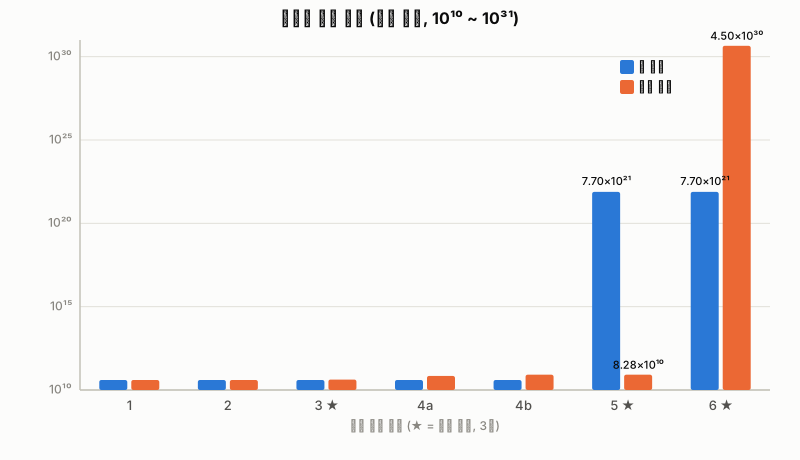
Cumulative scoreboard
| Stage | Added category | Definition tier | Cumulative doors | Cumulative wheels | Winner | Ratio | Lead change? |
|---|---|---|---|---|---|---|---|
| 1 | Building + furniture doors | Strict | Doors | 2.18× | — (baseline) | ||
| 2 | + all car doors | Strict | Doors | 2.87× | No (counterintuitive) | ||
| 3 | + toys & office equipment | Strict | Wheels | 1.13× | Yes (R1) | ||
| 4a | + gears & pulleys | Strict | Wheels | 1.87× | No (counterintuitive) | ||
| 4b | + fans, turbines & rollers | Borderline | Wheels | 2.22× | No (counterintuitive) | ||
| 5 | + biological doors (valves, animals, stomata) | Extended/figurative | Doors | × | Yes (R2) | ||
| 6 | + bacterial flagellar motors | Form & rotation only | Wheels | × | Yes (R3) |
Only three of these seven stages are genuine lead changes (3, 5, and 6). Stages 1 through 4b all fight it out within the same order of magnitude (); starting at stage 5, the numbers jump by 10 to 20 orders of magnitude at a time. And the “strict/borderline/extended” tier has nothing to do with who wins — the real irony of this table is that stage 6 (form-and-rotation-only) beats stage 5 (extended/figurative) outright.
Would a different dictionary change the outcome?
Dictionary definitions differ by language and by country, and this whole calculation is sensitive to that choice. The Korean-language edition of this piece uses Korea’s Standard Korean Language Dictionary, which requires a door to be a “fixture” (시설물) — a wording that excludes furniture doors entirely, forcing them into a separate late-stage adjustment. As a direct result, the Korean edition’s stage 1 comes out to a much thinner margin (about 1.15×) than the 2.18× margin here, because it starts without furniture doors baked in. Choosing Merriam-Webster upfront is the entire reason stage 1 in this edition is a non-contest.
There’s a narrower reading, too. The Cambridge Learner’s Dictionary defines wheel by function rather than by axle: “a circular object fixed under a vehicle that allows it to move along the ground.”[18] Apply that standard and the entire gear category disappears, pulling the wheel total back down to stage 3’s — a rerun of the stage-3 photo finish, this time against doors’ , a margin of roughly 1.13×. It’s a nice callback, though a learner’s dictionary entry isn’t quite the same caliber of source as the other two.
But there’s no reason to march through the stages in order
The cumulative ladder above has a blind spot. Because it stacks categories in sequence, there’s no way to reach a combination like “count fans out, but count the flagellar motor in.” Applying the ruler consistently, that’s actually a perfectly normal combination — fans are borderline, and the flagellar motor is about as close to strict as this article gets.
So instead of one ordered ladder, split the definition into two independent axes: how strict (dictionary-only / plus borderline / plus figurative) and how small (visible scale / down to the microscope). Multiply them and you get six combinations.
Run all six cells and a pattern emerges: doors win exactly one of six, and it isn’t close for the other five. The winning cell is “figurative allowed, microscope excluded” — count valves, stomata, and spiracles, but stop before flagellar motors, and doors take it 3.61×. Every other combination, including the two strictest and two most permissive readings, goes to wheels — by 1.87×, 2.22×, and, at microbial scale, by twenty orders of magnitude.
One caveat worth flagging: the “visible + figurative” cell only counts what stage 5 actually tallied — human valves and sphincters (). Add in the vertebrate total that got rounded to zero earlier (low s), and the door count in that cell climbs a few more orders of magnitude. It doesn’t open up any new winning cells, though — it just widens the margin in the cell doors were already winning.
OUTPUT
Three genuine lead changes, no more. Toys and office casters put wheels ahead at stage 3 (R1) — barely, and only if enough Hot Wheels have survived since 1968. Valves, spiracles, and stomata put doors back on top at stage 5 (R2) — not barely, by ninety-two billion times. And bacterial flagellar motors put wheels ahead for good at stage 6 (R3) — by over half a billion times. Stages 2 and 4 don’t flip the leaderboard, but they’re counterintuitive in their own right: doors beat wheels inside a car, and wheels lock in their advantage using nothing looser than a strict dictionary definition.
Run the full matrix, though, and the real shape of this contest shows up. Hold both sides to the same standard, and wheels win almost every way you slice it. The dictionary-strict reading favors wheels (1.87×). Adding borderline categories still favors wheels (2.22×). Allowing figurative categories on both sides still favors wheels (×). Doors win exactly one cell out of six — the one where figurative categories are allowed but the microscope stays off — and no other reading of the rules gets doors back on top.
That’s not a coincidence, it’s structural. Every place doors explode is biological — valves, spiracles, stomata — which puts it squarely in figurative territory. Merriam-Webster’s “barrier” and “hard material” both assume something manufactured, and a heart valve or a leaf pore isn’t. Hold wheels to that same standard and the flagellar motor can’t confidently clear it either — it evolved, nobody built it. Both of this article’s biggest numbers sit just outside a strict reading of their own definitions. What actually decides the contest isn’t “does it pass the definition” so much as “once you allow a metaphor, which metaphor is bigger” — and at microbial scale, the wheel side’s entry (the flagellar motor, ) beats the door side’s entry (stomata, ) by nine orders of magnitude.
All of which hangs on one single modeling call: whether the flagellar motor counts as a wheel at all. Strip it out, and what’s left is 37.3 billion doors against 82.8 billion wheels — under 2.3×, not remotely a landslide. That’s most of the reason 220,000 people split roughly down the middle over this. They weren’t really disagreeing about doors and wheels. They were just holding different dictionaries.
There’s a matching irony on the other side of the ledger. A fan blade spins on an axis but isn’t “rim-shaped,” so it fails the shape test. A bacterial flagellar motor is rim-shaped and spins, but nobody built it, so it fails the artifact test. Either way, the result is the same: judge “is this really a wheel” on shape and rotation alone, and a box fan loses to a bacterium.
And there’s one more door propped open that this article didn’t walk through: count ion channels in a cell membrane as “doors,” and the ranking could flip once more. That’s a number nobody in this piece — including Ryan Nixon’s 220,000 voters — ever tried to count.
References
[1]: Global News, “Are there more doors or wheels in the world? Debate takes over Twitter,” March 2022. https://globalnews.ca/news/8675577/doors-or-wheels-debate/ (Coverage of the March 2022 Twitter poll that started the debate; the original tweet itself is not quoted here)
[2]: Merriam-Webster, “wheel.” https://www.merriam-webster.com/dictionary/wheel
[3]: Merriam-Webster, “door.” https://www.merriam-webster.com/dictionary/door (Explicitly includes furniture doors in the definition)
[4]: UN Department of Economic and Social Affairs, World Population Prospects. https://population.un.org/wpp/
[5]: UN Department of Economic and Social Affairs, Population Division, “Database on Household Size and Composition 2022.” https://www.un.org/development/desa/pd/data/household-size-and-composition
[6]: Hedges & Company, “How Many Cars Are There in the World?” https://hedgescompany.com/blog/2021/06/how-many-cars-are-there-in-the-world/ (The ~1.23 billion global passenger car figure is consistent with OICA’s 2025 aggregate; the 411 million commercial-vehicle figure is Hedges & Company’s own estimate)
[7]: MarkLines Automotive Industry Portal, worldwide motorcycle/scooter fleet estimate (over 1.2 billion as of 2022).
[8]: NPR, “Why Hot Wheels are one of the most inflation-proof toys in American history” (Dec. 16, 2022), citing Mattel’s claim of “more than 6 billion” cars produced since 1968. https://www.npr.org/2022/12/16/1143282569/why-hot-wheels-are-one-of-the-most-inflation-proof-toys-in-american-history
[9]: ANSI/KCMA A161.1 cabinet standard (https://kcma.org/sites/default/files/2024-08/KCMA A161.1 2022 High Res.pdf) and NKBA kitchen design guidelines — standard door counts for base, wall, and tall cabinets. Cited only as the basis for the high-income kitchen-cabinet-door estimate.
[10]: IEA/Global Alliance for Buildings and Construction, Buildings Tracking Report — global building floor area of roughly 235 billion m² (2016 baseline). https://www.iea.org/energy-system/buildings
[11]: Chen, W., Carstensen, T.A., Wang, R. et al. (2022). “Historical patterns and sustainability implications of worldwide bicycle ownership and use.” Communications Earth & Environment 3, 171. https://www.nature.com/articles/s43247-022-00497-4
[12]: Crowther, T.W. et al. (2015). “Mapping tree density at a global scale.” Nature 528, 201–204. https://www.nature.com/articles/nature14967
[13]: Hetherington, A.M. & Woodward, F.I. (2003). “The role of stomata in sensing and driving environmental change.” Nature 424, 901–908. (Reports stomatal density of roughly 5–1,000 per mm²)
[14]: van den Hoogen, J. et al. (2019). “Soil nematode abundance and functional group composition at a global scale.” Nature 572, 194–198. https://www.nature.com/articles/s41586-019-1418-6
[15]: Smithsonian Institution, “Numbers of Insects (Species and Individuals).” https://www.si.edu/spotlight/buginfo/bugnos (Estimates roughly 10¹⁹ insects alive worldwide)
[16]: Whitman, W.B., Coleman, D.C., & Wiebe, W.J. (1998). “Prokaryotes: The unseen majority.” PNAS 95(12), 6578–6583. https://www.pnas.org/doi/10.1073/pnas.95.12.6578
[17]: Cleveland Clinic, “Heart Valves.” https://my.clevelandclinic.org/health/body/17067-heart-valves (Anatomical reference for the 4 heart valves; venous valve counts are not covered here and are separately estimated using [19] below)
[18]: Cambridge Dictionary (Essential British English), “wheel.” https://dictionary.cambridge.org/us/dictionary/essential-british-english/wheel (A learner’s dictionary entry, not the same caliber of source as the other two dictionaries used in this piece)
[19]: Kenhub, “Veins of the Lower Limb: Anatomy.” https://www.kenhub.com/en/library/anatomy/veins-of-the-lower-limb (Reports 10–20 valves in the great saphenous vein, 7–13 in the small saphenous vein, and 4–5 each in the popliteal and femoral veins; the whole-body major venous valve total used in this article is an original estimate based on that range, as noted in the text)