“The dishwasher uses less water” is mostly true. In an experiment in Bonn, Germany, hand-washing 12 place settings took about 103 L of water on average, while the machine cleaned the same load with roughly 15 L.[1][2] Add the cost of heating that water with a gas boiler, the electricity bill, and the carbon, though, and the story changes. Run the same machine with a full 12-setting load and it loses on cost and carbon to the “frugal hands” from a UK experiment (about 49 L per 12 settings). Against the “average hands” from the German experiment (about 103 L), it wins.[20]
So this article does not end in a one-line verdict. The winner depends on your hand-washing habit, your water-heating source, and how full you load the machine. I treat the two measurements as equal benchmarks, build a win/loss table by condition, and provide a calculator so you can change the numbers yourself.
INPUT
Unit of comparison: one place setting
The unit here is one setting: the bowl, soup bowl, plate, cutlery and cup one person uses for one meal. A machine’s “capacity for N” is read as room for N of these settings. The European standard defines a place setting as “the tableware used by one person, excluding serving dishes,” but that wording comes from a draft document that was never adopted.[3] In the US and EU, dishwasher capacity is quoted in exactly these “place settings” (a typical full-size machine is 12 to 14; a compact countertop model is about 6). Korean spec sheets say “N-person capacity” (N인용) instead. The details of the Korean KS standard behind that label could not be confirmed. LG Electronics recommends the 6-person size for 1 to 2 person households and the 12-person size for households of 3 to 4 or more, and it excludes pots and frying pans from the rated capacity.[4] So “N-person capacity = N settings” is an assumption in this article.
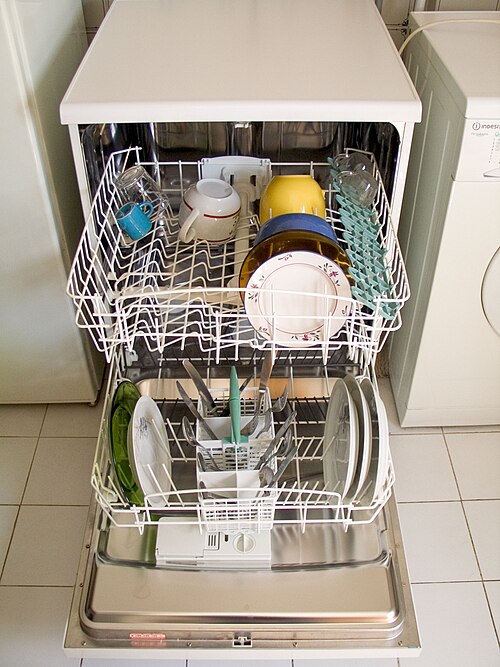

Machine consumption per run
A dishwasher uses nearly the same water and electricity per run regardless of how many settings are inside. So the per-setting figure is “consumption per run ÷ settings loaded.”
| Item | 12-setting | 6-setting | Stance |
|---|---|---|---|
| Water per run | 15 L | 10 L | central |
| Electricity per run | 1.2 kWh | 0.5 kWh | central (slightly unfavorable to the 12-setting machine) |
The 12-setting values come from five household machines tested by the Seoul city government in 2021 (their rated capacities could not be confirmed). Water was 10.8 to 17.3 L on the standard cycle and 15.0 to 21.2 L on the auto cycle, and the standard-cycle electricity reported in the press was 1.18 to 1.29 kWh.[5] The machine in the German experiment also used about 15 L (4 gallons) and about 1 kWh for 12 settings.[1] I took 15 L and 1.2 kWh as a midpoint of the two sources. For the 6-setting machine I found no public test data, so the figures are an estimate from two manufacturer spec sheets. Samsung’s 6-setting countertop model lists 0.484 kWh per standard cycle and 1.6 L per setting (9.6 L for six).[21] Cuckoo’s 6-setting model lists an annual consumption of 213 kWh, which is 0.58 kWh per run if you assume one run a day (365 per year), though that usage frequency is my assumption.[6] I used 0.5 kWh and 10 L, near the middle of that range. This is less than half the 12-setting standard-cycle figure (1.2 kWh) and varies by product, so treat it as an uncertain input. The machine’s electricity figure already includes the power used to heat water inside the machine. It takes in cold tap water and heats it itself, so it uses no hot water from the boiler.
Hand-washing: two measured benchmarks
Hand-washing habits vary too much for one representative number. So I use measurements from two different experiments as equally weighted benchmarks.
| Benchmark | Source | Water per 12 settings | Water per setting | Energy per 12 settings | Energy per setting |
|---|---|---|---|---|---|
| Frugal hands | 150 UK consumers, mean 49 L, 1.7 kWh[20] | 49 L | 4 L (49÷12=4.08, rounded) | 1.7 kWh | 0.142 kWh |
| Average hands | Bonn experiment, 113 participants, mean about 103 L[1][2] | 103 L | 8.6 L (103÷12=8.58) | about 2.7 kWh (13-setting experiment)[7] | about 0.21 kWh |
The UK experiment had 150 consumers wash a load of dishes equal to nearly the full capacity (96%) of the machine-loading standard (EN 50242).[20] I took that load to be 12 settings; the setting count itself is an assumption I could not confirm from the abstract. The German experiment involved 113 participants from seven countries, and its per-setting average is more than double the UK figure.[1] A 2006 report from the Bonn group gives 117 L (9.0 L per setting) and 2.73 kWh for 13 settings.[7] The energy figures can be checked against this article’s model. In the [FORMULA] section below, heating 8.6 L by 23 K takes about 0.23 kWh, close to the roughly 0.21 kWh measured in Bonn. For 4 L the same calculation gives 0.107 kWh, while the UK measurement is 0.142 kWh. That means the UK participants used hotter water; working backward gives a temperature rise of about 30 K. I address this gap in the sensitivity analysis.
I could not find a measurement of how much water Korean households actually use to wash dishes by hand, so I show both benchmarks. I could not open the original paper for the Bonn experiment (Stamminger et al., 2004); the figures come from a Home Energy magazine summary and secondary sources.[1][2]
Hot water
The base case is a gas boiler (Korean homes mostly use a gas boiler for both heating and hot water), with electric water heating as the comparison.
- Specific heat of water .[8] 1 L is taken as 1 kg.
- Temperature rise . I assume tap water at an average of 15°C is heated to a lukewarm dishwater of about 38°C. I found no national statistics for tap-water temperature. A news report says the Han River source water in Seoul reaches 24 to 29°C in summer, which only confirms that the winter-to-summer swing is large.[9] The slider range is 10 to 40 K.
- Boiler efficiency . Conventional gas boilers are described as 80 to 85% efficient and condensing boilers as 92% or higher.[10] I ignored heat lost in the pipes and losses when the boiler fires up. That simplification favors hand-washing.
Prices and emission factors
| Item | Value | Note |
|---|---|---|
| Electricity emission factor | 0.4173 kgCO₂e/kWh | final 2023 value[11] |
| Gas emission factor | 0.2020 kgCO₂/kWh (heat) | 56.1 kg/GJ × 0.0036 GJ/kWh[12][13][19] |
| Electricity price | 260 KRW/kWh (≈ $0.19) | estimated tier-2 marginal rate[14] |
| City gas | 89.2 KRW/kWh (heat) (≈ $0.064) | 22.5268 KRW/MJ × 1.1 (VAT) × 3.6 MJ/kWh[15] |
| Water and sewer | 0.99 KRW/L (≈ $0.0007) | water 580 + sewer 410 KRW/m³[16][17] |
| Electricity to supply and treat water | 0.0005 kWh/L | estimate[18] |
Currency note: all dollar figures in this article use an assumed rate of about 1,400 KRW per US dollar (October 2026) and are rounded. Korean prices are kept in won because they drive the calculation.
Each value is confirmed to a different degree. The electricity emission factor is a government-published figure, and the gas emission factor is an international default converted to energy units. The gas price comes from the residential (cooking and heating) rate of 22.5268 KRW/MJ in Seoul City Gas’s tariff table. I left out the monthly base charge of 1,250 KRW because it does not depend on usage. The table does not say whether VAT is included, so I added 10% on the basis that city-gas rates are normally announced excluding VAT; the 260 KRW electricity price includes VAT, and this aligns the two.[15] The electricity price was checked from a summary source rather than the utility’s tariff text. I started from the 200 to 400 kWh/month tier (214.6 KRW), then added the climate-environment charge of 9 KRW, the fuel-cost adjustment of 5 KRW, and funds and VAT, arriving at about 260 KRW.[14] This is the marginal rate for a household using 200 to 400 kWh a month. For a household under 200 kWh/month (tier 1, 120 KRW), the same method gives about 153 KRW, which cuts the electricity side of the cost by almost 40% and tilts the cost contest between the machine and electric water heating toward the machine. The 580 KRW water rate comes from an unofficial summary, and the 410 KRW sewer rate is the then-current rate reported in a June 2025 article on the Seoul increase. One summary says staged increases brought it to around 480 KRW from 2026, but I could not confirm that in an official tariff. Using 480 KRW would make 1.06 KRW/L and change the per-setting cost by less than 0.6 KRW, so the conclusion is unchanged.[16][17] What drives the later results is that, per kWh, the emission factor of electricity is about 2.1 times that of gas heat (0.4173÷0.2020), while its price is about 2.9 times (260÷89.2).
A note for readers outside Korea
Korean prices are the backbone of this calculation, so I kept them. But two Korean specifics matter for how you read the results. First, Korean electricity is billed in progressive tiers, so the marginal rate depends on how much the household uses. Second, most Korean homes heat water with a gas boiler, whereas in the US the 2020 federal housing survey found electricity (about 46% of homes) nearly level with natural gas (about 48%) as the main water-heating fuel, so the “electric hot water” rows of the tables may be the more relevant ones for you.[22] What matters for the winner is the ratio of electricity price to gas price per unit of heat. In Korea that ratio is about 2.9 (260÷89.2). The higher your local ratio, the more a gas-heated sink favors hand-washing against an electricity-powered machine; the lower it is, the more the machine gains. And if you heat water with electricity, the electric rows apply, and the machine wins on cost much more easily. US and UK tariffs differ by state, supplier and year, so I do not put a single number on them here; the US Energy Information Administration publishes average residential electricity and natural gas prices you can use to compute your own ratio.[23][24] In the calculators below, the Korean prices are built in, so use them as a template for the direction of the effect rather than as a bill forecast.
What this calculation leaves out
I did not count the purchase price of the machine, the carbon from manufacturing it, the cost of detergent and rinse aid, or the time spent washing. I mention them in one line at the end.
FORMULA
① Energy to heat the water
Converting the heat needed to warm of water by into kWh gives the following. 1 kWh is 3,600 kJ.[19]
The units are kg × kJ/(kg·K) × K = kJ, and dividing by kJ/kWh gives kWh. Heating 1 L of water by 23 K takes 0.0267 kWh, about 27 Wh.
② One setting washed by hand
First, frugal hands (4 L). For gas hot water, the gas heat needed is divided by boiler efficiency.
Cost and carbon are as follows.
With electric hot water, and the heat is electricity: , KRW, kgCO₂e.
For average hands (8.6 L), put into the same equations. With gas hot water:
With electric hot water: , KRW, kgCO₂e.
③ One setting in the machine
The machine divides its per-run consumption by the number of settings loaded, . Here is the 12-setting machine loaded with 12 settings.
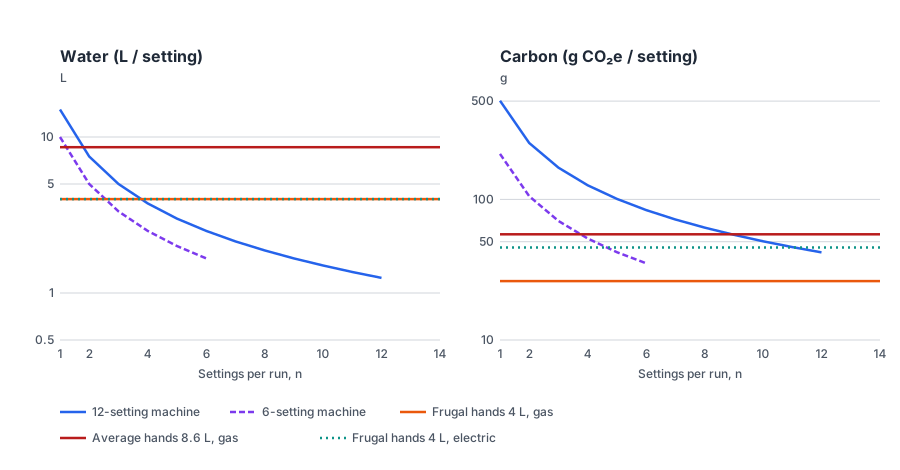
Computing nine scenarios the same way gives the table below. Carbon is in grams. Energy is gas heat for hand-washing with gas hot water (electricity for electric hot water) and electricity for the machine. Costs are in KRW; at about 1,400 KRW/$ divide by 1,400 for dollars (27.2 KRW ≈ $0.019).
| Scenario | Water (L) | Energy (kWh) | Cost (KRW) | Carbon (gCO₂e) |
|---|---|---|---|---|
| Frugal hands 4 L, gas hot water | 4.00 | 0.126 | 15.2 | 26.3 |
| Frugal hands 4 L, electric hot water | 4.00 | 0.107 | 31.8 | 45.5 |
| Average hands 8.6 L, gas hot water | 8.60 | 0.271 | 32.7 | 56.5 |
| Average hands 8.6 L, electric hot water | 8.60 | 0.230 | 68.3 | 97.8 |
| 12-setting machine, 12 settings | 1.25 | 0.100 | 27.2 | 42.0 |
| 12-setting machine, 6 settings | 2.50 | 0.200 | 54.5 | 84.0 |
| 12-setting machine, 3 settings | 5.00 | 0.400 | 109.0 | 168.0 |
| 6-setting machine, 6 settings | 1.67 | 0.083 | 23.3 | 35.1 |
| 6-setting machine, 3 settings | 3.33 | 0.167 | 46.6 | 70.2 |
④ Break-even load
The machine wins when is smaller than the hand-washing value. The break-even number of settings for each metric is as follows.
Substituting for the 12-setting machine, the numerators are: cost KRW, and carbon kgCO₂e. Against frugal hands (gas):
Against average hands (gas):
The 12-setting machine holds 12 settings. So against frugal hands with gas hot water, the cost and carbon break-evens lie outside capacity and the machine cannot win. Against average hands, the break-even falls within capacity. The full set of combinations follows; “impossible” in parentheses marks a break-even larger than the machine’s capacity.
| Machine | Hand-washing condition | Water | Energy | Cost | Carbon |
|---|---|---|---|---|---|
| 12-setting | Frugal hands 4 L, gas | 3.8 settings | 9.5 settings | 21.5 settings (impossible) | 19.2 settings (impossible) |
| 12-setting | Frugal hands 4 L, electric | 3.8 settings | 11.2 settings | 10.3 settings | 11.1 settings |
| 12-setting | Average hands 8.6 L, gas | 1.7 settings | 4.4 settings | 10.0 settings | 8.9 settings |
| 12-setting | Average hands 8.6 L, electric | 1.7 settings | 5.2 settings | 4.8 settings | 5.2 settings |
| 6-setting | Frugal hands 4 L, gas | 2.5 settings | 4.0 settings | 9.2 settings (impossible) | 8.0 settings (impossible) |
| 6-setting | Frugal hands 4 L, electric | 2.5 settings | 4.7 settings | 4.4 settings | 4.6 settings |
| 6-setting | Average hands 8.6 L, gas | 1.2 settings | 1.9 settings | 4.3 settings | 3.7 settings |
| 6-setting | Average hands 8.6 L, electric | 1.2 settings | 2.2 settings | 2.1 settings | 2.2 settings |
⑤ How much energy is in the water itself?
I estimated the electricity to produce tap water and treat sewage at 0.5 kWh/m³. This is an estimate I could not confirm against an official unit figure.[18] Compared with the energy to heat the water:
Even if the estimate is off by a factor of three, it is 6%. Most of the energy benefit of saving water comes from heating less of it; supplying the water is a small share.
⑥ A single-person household batching loads
If settings are produced per day and you collect them for days, the load is . The break-even number of days for water is:
Collecting 3 settings a day for 2 days and running 6 settings makes the 12-setting machine cost 2.5 L, 54.5 KRW and 84.0 g per setting. Converting to 1,095 settings a year (3 a day) and comparing with the two habits, on gas hot water:
| Compared with | Water | Cost | Carbon |
|---|---|---|---|
| Frugal hands (4 L) | saves about 1,640 L per year | costs about 43,000 KRW (≈ $31) more per year | emits about 63 kg more per year |
| Average hands (8.6 L) | saves about 6,680 L per year | costs about 24,000 KRW (≈ $17) more per year | emits about 30 kg more per year |
The calculations are L, KRW, and g respectively. For example, the cost difference for frugal hands is KRW. Average hands also beat a 6-setting machine load on both money and carbon.
Sensitivity
- Pre-rinse: adding 1 L of running hot water per setting takes the full 12-setting machine from 1.25 to 2.25 L of water, from 0.100 to 0.131 kWh of energy, and from 27.2 to 31.0 KRW in cost. The machine’s advantage shrinks noticeably.
- Temperature rise: at = 15 K, the cost for frugal hands is 11.3 KRW and for average hands 24.3 KRW. At 30 K they are 18.6 KRW and 40.0 KRW. On the 30 K side, which the UK measured energy (0.142 kWh) points to, average hands lose to the full 12-setting machine (27.2 KRW); on the 15 K side, they win.
- Hand-washing water: going from 4 L to 8.6 L, a factor of 2.15, takes the gas-hot-water cost from 15.2 KRW to 32.7 KRW, which exceeds the full 12-setting machine (27.2 KRW). This one assumption decides the winner on cost and carbon.
Calculator
OUTPUT
A full 12-setting machine costs 1.25 L of water, 27 KRW (about $0.02) and 42 g of carbon per setting. The result depends on who the opponent is. On water, the machine wins against either opponent (3.2 times less than the frugal hands’ 4 L, and 6.9 times less than the average hands’ 8.6 L). On cost and carbon, frugal hands with gas hot water (15 KRW, 26 g) use 1.8 and 1.6 times less than the machine, respectively. Average hands with gas hot water (33 KRW, 56 g) use 1.2 and 1.3 times more than the machine.
| Machine load | Opponent | Water | Energy (kWh) | Cost | Carbon |
|---|---|---|---|---|---|
| 12-setting, 12 settings | Frugal hands + gas | machine | machine (0.100 vs 0.126) | hands | hands |
| 12-setting, 12 settings | Frugal hands + electric | machine | machine (narrowly) | machine | machine (narrowly) |
| 12-setting, 12 settings | Average hands + gas | machine | machine | machine | machine |
| 12-setting, 12 settings | Average hands + electric | machine | machine | machine | machine |
| 12-setting, 6 settings | Frugal hands + gas | machine | hands | hands | hands |
| 12-setting, 6 settings | Frugal hands + electric | machine | hands | hands | hands |
| 12-setting, 6 settings | Average hands + gas | machine | machine | hands | hands |
| 12-setting, 6 settings | Average hands + electric | machine | machine | machine | machine |
A half-empty dishwasher loses on money and carbon to hand-washing, frugal or not, if the hot water comes from gas. That is why you fill it up. Whether your habit is frugal or not, gas costs about 2.9 times less than electricity per unit of heat, so a small amount of gas-heated water favors hand-washing against an electricity-powered machine.
For readers in places where water is commonly heated by electricity, the picture shifts toward the machine. In the electric-hot-water rows, the full machine wins every metric against both kinds of hands, because the hand-washer is now paying the electricity price too. Which row is yours depends on whether your water heater runs on gas or electricity, and on your local price ratio; that is a number on your own utility bills, not one I can assume for you.[22][23][24] The Korean conclusion “a half-empty dishwasher loses to a frugal gas-heated sink” is therefore a statement about Korean gas being cheap, not about dishwashers.
The most powerful variable in this calculation is a single one: how much water you use hand-washing. The 4 L and 8.6 L are measurements from the UK and Germany, and nobody has yet measured which one Korean households are closer to. So the answer this article can give takes the form of a question: how many liters is your dish basin?
A single-person household that collects 3 settings a day for two days and runs the 12-setting machine at 6 settings saves only water, whether its hands are frugal or average, and pays more in money and carbon. Per year, that is a trade of 1.6 to 6.7 tonnes of water saved for 24,000 to 43,000 KRW (roughly $17 to $31) and 30 to 63 kg of carbon spent. Whether the two days of plates piling up in the sink are included in that trade, I leave you to decide.
Some things are missing from this result. In the German experiment, half of the hand-washing participants did not meet the cleanliness standard.[1] The machine’s advantage in cleaning more thoroughly is not in the tables above. In the UK experiment, consumers spent an average of 60 minutes on a hand-washing session and 9 minutes loading and unloading the machine.[20] That time is not in the tables either. The purchase price and the manufacturing carbon of the machine are also not counted. A question that takes three minutes at the faucet has now acquired a stack of tables, so please forgive the omissions.
References
[1]: Home Energy magazine, “Is a Machine More Efficient Than the Hand?” (May/June 2004), summary of the Stamminger study. Cited in Green Building Advisor, “All About Dishwashers,” https://www.greenbuildingadvisor.com/article/all-about-dishwashers
[2]: Candy, “Is it true that the dishwasher uses less water than washing by hand?” (cites about 103 L for 12 settings hand-washed in the Bonn study; secondary source), https://www.candy-home.com/en_GB/blog/is-it-true-that-the-dishwasher-uses-less-water-than-washing-by-hand
[3]: Swedish Energy Agency, annex to draft household dishwasher energy-labelling regulation (definitions of place setting and rated capacity; unadopted draft), https://www.energimyndigheten.se/globalassets/energieffektivisering_/jag-ar-saljare-eller-tillverkare/dokument/produkter-med-krav/diskmaskiner-hushall/bilaga-utkast-ny-energimarkningsforordning-diskmaskiner-hushall-171030.pdf
[4]: LG Electronics Newsroom (Korea), guide to choosing dishwasher capacity (6-person vs. 12-person; Korean-language page), https://www.lge.co.kr/story/newsroom/177801
[5]: Seoul Media Hub, “Dishwashers popular as people stay home: comparing washing performance and time by product” (December 2021; Korean-language page), https://mediahub.seoul.go.kr/archives/2003559
[6]: Cuckoo 6-person dishwasher sales page (annual consumption 213 kWh from the energy-efficiency label; usage-frequency basis not confirmed; a reseller page, so a secondary source; Korean-language page), https://rentre.kr/product/1600006114/프리미엄-식기세척기-6인용-자동문열림-글라스도어/product-reviews
[7]: Bosch Home, “Dishwasher vs handwashing” (SOFW Journal 3/2006, citing the Bonn study: 13 settings, 117 L, 2.73 kWh; manufacturer material), https://www.bosch-home.com/ae/en/specials/dishwasher-vs-handwashing
[8]: NIST Chemistry WebBook, Water (liquid heat capacity), https://webbook.nist.gov/cgi/cbook.cgi?ID=C7732185
[9]: Seoul Shinmun, “Rising Han River water temperature puts tap-water management on alert” (August 10, 2026; Korean-language page), https://m.go.seoul.co.kr/news/publicnews/local_govern/news_local/2026/08/10/20260810019003
[10]: “Staying warm while cutting costs: condensing boilers and carbon mats in season” (conventional boilers 80 to 85%, condensing 92% or higher; a manufacturer-centered article, so the central value of 0.85 is the author’s assumption; Korean-language page), https://v.daum.net/v/20231212160447223?f=p
[11]: Kukinews, “National electricity emission factor for 2023 finalized” (Ministry of Climate, Energy and Environment, December 18, 2025; 0.4173 tCO₂eq/MWh; Korean-language page), https://www.kukinews.com/article/view/kuk202512180131
[12]: Natural gas CO₂ emission factor 56.1 kg/GJ (Korea table, IPCC default on a net calorific value basis), https://zenodo.org/records/7540262/files/Table7_KOR.csv
[13]: IPCC, 2006 IPCC Guidelines for National Greenhouse Gas Inventories, Vol. 2 Ch. 2 Stationary Combustion (natural gas 56,100 kg/TJ), https://www.ipcc-nggip.iges.or.jp/public/2006gl/pdf/2_Volume2/V2_2_Ch2_Stationary_Combustion.pdf. The 0.2020 kg/kWh figure is the author’s conversion (56.1 × 0.0036).
[14]: Summary of residential electricity rate tiers (tier 2 at 214.6 KRW/kWh etc.; official tariff text not checked; Korean-language page) https://wikidocs.net/blog/@goodhosup/27591/ and a report on the fuel-cost adjustment freeze https://www.kukinews.com/article/view/kuk202606220018. The marginal rate of 260 KRW is the author’s calculation: 214.6 + 9 (climate-environment) + 5 (fuel-cost adjustment), plus a 3.7% fund charge and 10% VAT.
[15]: Seoul City Gas, rate table (residential cooking and heating 22.5268 KRW/MJ, residential base charge 1,250 KRW/month, unit-price table effective October 1, 2026; the table does not state whether VAT is included, and the 10% addition is the author’s assumption; Korean-language page), https://www.seoulgas.co.kr/mobile/payment/gasPayTable
[16]: Money Today, “Seoul sewer rates to rise 9.5% a year for five years; progressive residential tiers abolished” (current 410 KRW/m³; Korean-language page), https://www.mt.co.kr/estate/2025/06/05/2025060517372939901
[17]: Summary of Seoul water rate of 580 KRW/m³ (unofficial; official tariff not checked; the same source lists the 2026 sewer rate as 480 KRW/m³; Korean-language page), https://glasswallet.com/calculate/water-bill/rate-structure
[18]: Author’s estimate. Electricity for tap-water production and supply plus sewage treatment is taken as 0.3 to 0.7 kWh/m³ with a central value of 0.5; no official Korean unit figure was found.
[19]: NIST Special Publication 811, Guide for the Use of the International System of Units, https://www.nist.gov/pml/special-publication-811
[20]: Berkholz, P., Stamminger, R., Wnuk, G., Owens, J., Bernarde, S., “Manual dishwashing habits: an empirical analysis of UK consumers,” International Journal of Consumer Studies 34(2), 235-242 (2010) (150 UK participants, mean 49 L, 1.7 kWh, 60 minutes; machine 13 L, 1.3 kWh, 9 minutes; checked via the abstract summary, setting count not confirmed), https://www.cbsm.com/articles/33333-manual-dishwashing-habits-an-empirical-analysis-of-uk-consumers
[21]: Samsung Electronics Korea, Bespoke countertop dishwasher for 6 (DW30FB300CW0) specifications (standard cycle 484.0 Wh per run, 1.6 L of water per setting, wash time 95 minutes; Korean-language page), https://www.samsung.com/sec/support/model/DW30FB300CW0/
[22]: U.S. Energy Information Administration, 2020 Residential Energy Consumption Survey (RECS), State Water Heating table (main water-heating fuel, all US homes: electricity about 46%, natural gas about 48%; the 2024 survey’s full data is not yet released), https://www.eia.gov/consumption/residential/data/2020/state/pdf/State Water Heating.pdf
[23]: U.S. Energy Information Administration, Electric Power Monthly, average price of electricity to the residential sector, https://www.eia.gov/electricity/monthly/
[24]: U.S. Energy Information Administration, Natural Gas Prices, residential price (quoted per thousand cubic feet; convert to kWh of heat to compare with electricity), https://www.eia.gov/dnav/ng/ng_pri_sum_dcu_nus_m.htm