Have you ever been made to do something pointless-looking, over and over? In Joshua chapter 6, the people circle the city walls once a day for six days, and on the seventh day, seven times.[1] The circling itself carries no siege engine, no tactical payoff. Scripture frames the repetition as obedience to a command — an act of faith, full stop.
Faith can’t be put on a scale. It’s an inner state with no unit of measure. But what that faith actually produced — forty thousand people’s worth of footsteps over six days and one very long seventh, and the metabolic energy those footsteps burned — is a physical quantity. It can be measured in distance, in time, and, eventually, in joules (J, the SI unit of energy).
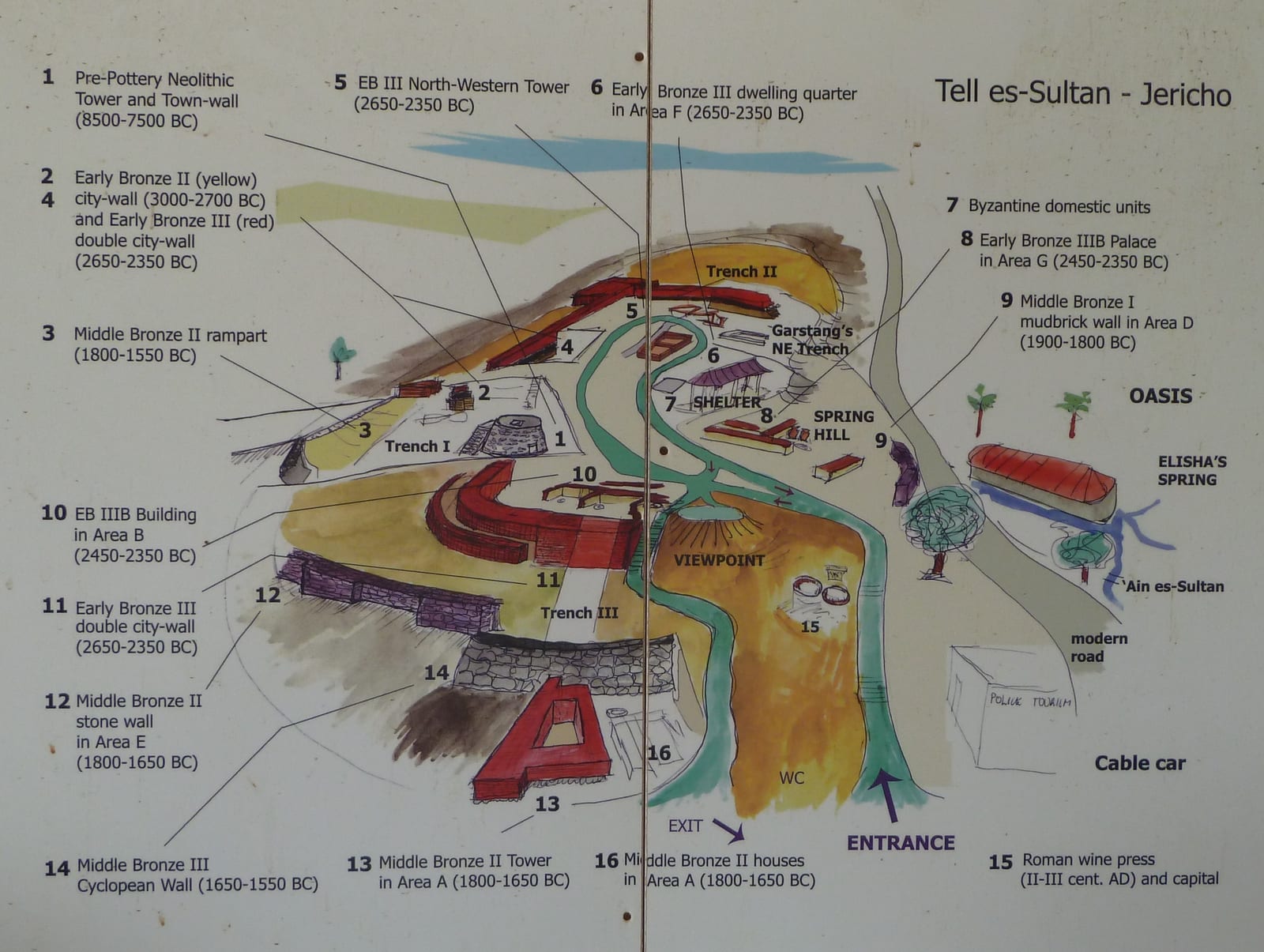
This piece doesn’t rule on whether the obedience was “worth it,” or whether the event happened as described. It doesn’t touch the archaeological reality of Tell es-Sultan (the site most archaeologists identify with biblical Jericho) or the historicity of the conquest narrative. It takes the biblical account as a given — a premise, not a claim — and asks exactly one question using geometry, physics, and exercise physiology: when this act of repetition was carried out in the body, how much energy did it cost?
It helps to picture this less like a road trip and more like a NASCAR oval. What matters isn’t distance covered in a straight line — it’s how many times a short track gets relapped. A 500-mile stock-car race is really nothing more than a couple hundred laps of a track two or three miles around; the total mileage only looks impressive once you multiply it out. Run the numbers below and the army circling Jericho turns out to be doing something structurally similar — just on foot, over a week, instead of a Sunday afternoon at Daytona.
INPUT
How big were the walls, really — reverse-engineering a radius from excavated area
Nobody measured Jericho’s perimeter directly. Instead, we work backward from the area archaeologists have actually excavated. Tell es-Sultan was inscribed as a UNESCO World Heritage Site in 2023, and the official nomination file includes hard numbers. It describes the site as an “oval-shaped tell” with a total area of roughly 5.93 hectares (about 14.7 acres).[2] But that figure is the maximum footprint of the entire mound — 29 stacked occupation layers spanning the Neolithic through the Bronze and Iron Ages — not the perimeter of any single wall from the period Joshua’s narrative is set in.
We need to narrow the time window. Bryant Wood’s synthesis of Kathleen Kenyon’s 1952–1958 excavations puts the Middle Bronze Age walled city’s interior at roughly 5–6 acres (about 2.02–2.43 ha), with the full defensive footprint — including the sloped outer revetment beyond the wall — running about double that, 10–12 acres (about 4.05–4.86 ha).[3] Kenyon’s original excavation report, Digging Up Jericho (1957), also notes that the mound is an irregular oval, not a true circle.[4]
Put the three sources together and the area estimates span roughly 2.0 to 5.9 ha. This piece focuses on “the footprint the wall itself enclosed” — bigger than the inner city (2.0–2.4 ha) but smaller than UNESCO’s full-mound figure (5.9 ha) — and adopts a central value of 3.8 ha. Approximating the shape as a circle, the area formula gives:
For a conservative bound, we use the inner-city floor (2.0 ha, m ≈ 262 ft); for an aggressive bound, UNESCO’s full-mound ceiling (5.9 ha, m, rounded to 140 m ≈ 459 ft). The calculator below lets you slide this radius freely between 60 and 160 m.
One simplification needs flagging up front. The real tell is an ellipse, not a circle. If we set the long-to-short axis ratio at roughly 1.5–1.8 and re-derive the perimeter at the same area using the Ramanujan approximation for an ellipse, the result runs about 3–7% longer (central estimate ~5%) than the circular model. That’s a small effect next to the offset assumption we cover below (which swings results by tens to hundreds of percent) — small enough that it doesn’t change the conclusion.

How far back from the wall did they walk — the offset distance
The biblical text never says how many meters from the wall the army marched. That single missing number turns out to control the entire result. Walk right up against the wall and you’re inside archery range the whole time. The classic experimental-archaeology literature on the ancient Near Eastern composite bow (built from laminated wood, horn, and sinew — far more range and power than a simple wooden self-bow) distinguishes carefully between effective range and maximum range.[5] A University of Liverpool PhD thesis on New Kingdom Egyptian composite bows puts the effective range for accurate, aimed shots at about 80 m, and the maximum range at which an arrow is still dangerous at roughly 250–300 m.[6]
Those two figures anchor three scenarios:
- 0 m offset (hugging the wall): marching right up against the fortification. Tactically closer to suicide, but the scenario that most closely matches the plain reading of the biblical text.
- 75 m offset (clearing effective range): pulled back past the range at which archers could aim accurately.
- 300 m offset (clearing maximum range): pulled back to a distance arrows simply can’t reach at all — roughly the length of three American football fields.
All three are worked through explicitly below; the full range (0–300 m) is available continuously on the calculator slider.
Force size — 40,000 men
Joshua 4:13 records the number who crossed the Jordan and marched onto the plains of Jericho as “about forty thousand, prepared for war.”[7] The text itself hedges with “about,” which is the author’s own admission that this is an approximation, not a census figure. This piece treats 40,000 as a fixed constant; the 20,000–40,000 range is available only in the calculator.
Marching speed — three paces
The metabolically most efficient walking speed on flat ground — the pace at which the body spends the least energy per unit distance — is reported by a classic experimental physiology study at roughly 4.4–4.5 km/h (about 2.7–2.8 mph).[8] This piece adopts that as the “normal walking” case. But it’s unlikely a religious procession moved at that pace. A ritual column keeping formation, led by trumpets and the Ark, moves considerably slower than ordinary walking. To account for that, we also work through a “procession pace” of 3.0 km/h (1.86 mph) and a much slower “ceremonial crawl” of 2.0 km/h (1.24 mph). Neither of the latter two comes from Scripture or any independent source — they’re the author’s own illustrative assumptions, explicitly flagged as such. The central value used in the main calculation is 3.0 km/h.
Body weight per soldier
A study reconstructing average male stature across the Bronze Age Near East and Europe from 6,098 skeletal specimens puts Bronze Age adult male height at roughly 167 cm — noticeably shorter than the modern adult male average (mid-170s cm).[9] Scaling body weight roughly in proportion to height naturally yields a lower figure than modern reference weights. FAO/WHO/UNU’s energy-requirement guidelines use two adult male reference weights side by side, 65 kg and 70 kg.[10] Given the shorter Bronze Age stature, this piece adopts the lower of the two, 65 kg (≈143 lb), as the central value, with a range of 55–80 kg (≈121–176 lb).
Walking energy cost coefficient
Walking burns energy in proportion to both body weight and distance covered. The American College of Sports Medicine’s standard walking metabolic equation sets the horizontal-movement oxygen cost at 0.1 mL of O₂ per kg of body weight per meter walked, on flat ground.[11] Converted to calories (roughly 5 kcal per liter of O₂), that works out to about 0.5 kcal/kg/km — a laboratory-treadmill floor value. Real outdoor terrain is uneven, footwear differs, and there’s often a load to carry, all of which push actual consumption higher. A 2021 field study measuring real outdoor walking reported oxygen consumption of about 981 mL O₂ per kg of body weight over roughly 6.4 km of unloaded walking.[12] Converted, that’s about 0.76 kcal/kg/km — nearly 50% higher than the lab figure. This piece splits the difference, reflecting something close to a fully equipped soldier’s load, adopting 0.65 kcal/kg/km as the central value with a range of 0.5–0.75 kcal/kg/km.
There’s a more precise model available. The Pandolf equation (Pandolf et al., 1977) is the standard model in military exercise physiology, predicting march energy expenditure from load weight, terrain factor, and grade.[13] But it has more variables than a blog calculation needs. This piece adopts the simpler net-cost model and leaves the Pandolf equation as a pointer for “if you want to go more precise, start here.”
FORMULA
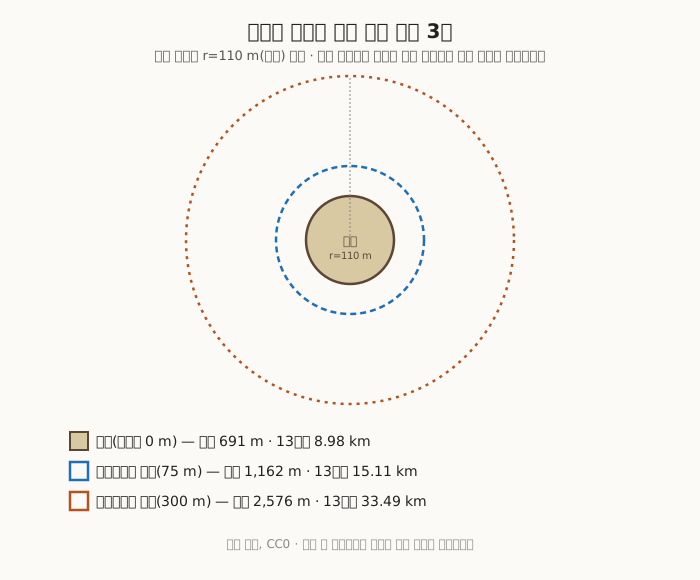
Step 1 — effective perimeter by offset scenario
The effective radius is the wall radius plus the offset, and the perimeter is that times .
Substituting m into the three scenarios:
A single offset assumption swings the perimeter dramatically. 75 m is 68% of the radius (110 m), so it grows the perimeter by 68%; 300 m is 273% of the radius, so it grows the perimeter by 273% — nearly 3.7×. That’s a far bigger swing than the area uncertainty flagged in [INPUT] (roughly ±27% on the radius). In this piece, the single variable that moves the result the most isn’t the size of the city — it’s “how far back did they walk.”
Step 2 — total distance per person (13 laps)
Each person circles once daily for six days, then seven times on the seventh — 13 laps total.
The 300 m offset scenario comes close to a full marathon — 42.195 km, or 26.22 miles. Simply retreating far enough to clear archer range pushes one person’s cumulative distance to about 79% of a marathon.
Worth isolating the seventh day on its own, as a sanity check on whether it’s even physically possible within a single day:
(≈3.01 / 5.06 / 11.20 mi, respectively)
Step 3 — time required
Time is distance divided by speed.
For the hugging (0 m offset) scenario, at a total 13-lap distance of 8.98 km:
| Speed | Time required |
|---|---|
| 4.5 km/h (2.8 mph, normal walking) | 2.00 hr |
| 3.0 km/h (1.86 mph, procession pace, central value) | 2.99 hr (≈3.0 hr) |
| 2.0 km/h (1.24 mph, ceremonial crawl) | 4.49 hr |
For the max-range-avoidance (300 m offset) scenario, at a total 13-lap distance of 33.49 km:
| Speed | Time required |
|---|---|
| 4.5 km/h | 7.44 hr |
| 3.0 km/h | 11.16 hr |
| 2.0 km/h | 16.74 hr |
The interesting case is the seventh day taken alone. Combine max-range avoidance with the slowest pace (2.0 km/h) and the seven laps (18.03 km) alone take about 9.02 hours — a genuinely tight fit within a single daylight period. The hugging scenario, by contrast, finishes comfortably within a day at any of the three speeds. One assumption — the offset — is the difference between “easily doable in a day” and “cutting it close.”
Step 4 — energy consumed per person
Multiply distance (km) by body weight (kg) and the cost coefficient (kcal/kg/km).
Checking units: — it works out. Substituting kcal/kg/km and kg:
The per-person energy in the hugging scenario (380 kcal) is roughly the calorie count of a fast-food cheeseburger; the max-avoidance scenario (1,415 kcal) is more than half of a typical recommended daily intake. All from walking — and the offset assumption alone spreads the calorie cost across nearly a 4× range.
Step 5 — total force energy, converted to joules (J)
Multiply the per-person value by 40,000.
Calories are a nutrition unit, not a physics standard. To call this figure a genuine “physical quantity,” we need to convert to joules, the SI unit of energy. One kilocalorie is defined as exactly 4,184 J.[14]
These three numbers are the core figures this piece set out to find: the physical energy cost of 40,000 people’s act of obedience to a command. Calling this number “the size of the obedience” comes with a condition — we’ll return to that below.
The same figure translates into TNT-equivalent terms, and it happens that TNT conversion uses the exact same constant: “1 g of TNT releases exactly 4,184 J.”[14] That means 1 kcal = 1 g TNT-equivalent, and 1 metric ton (10⁶ g) of TNT equals one million kcal.
Something important has to be flagged here. This tonnage is just the soldiers’ metabolic walking energy, translated into TNT-explosion units to get a sense of scale — it is not energy that actually exploded. Human bodies are not munitions depots. This calculation says nothing whatsoever about why or how the walls actually came down. The same caveat applies to the GJ figures. They answer “how much energy was released through the physical act of walking,” not “how large was the faith.” Faith itself doesn’t appear anywhere in this calculation.
Step 6 (bonus) — the column itself is longer than the wall
One last twist worth calculating. If 40,000 people lined up in a single column, how long would that column itself be? Let column width (number of files marching abreast) be and the spacing between files be :
This variable (column width) has no archaeological basis — it’s a purely illustrative assumption. Assume 10 files abreast with 1 m of spacing between them:
Compared with the hugging scenario’s wall perimeter (691 m), this column is about 5.8× longer. Even against the max-avoidance perimeter (2,576 m), it’s still about 1.55× longer. Widen the formation to 20 files abreast to compress the column ( km) and it’s still 2.9× the hugging-scenario perimeter — and while it finally becomes shorter than the max-avoidance perimeter (about 0.78×), it’s not by much. However you arrange the formation, the conclusion holds: a column of 40,000 people is far longer than Jericho’s wall. This was never a group of people who could have formed a single unbroken ring around the city.
OUTPUT
Lay the three scenarios side by side:
| Scenario | Perimeter | 13-lap distance (per person) | Energy of obedience (GJ) | (for reference) kcal / TNT |
|---|---|---|---|---|
| Hugging the wall (0 m) | 691 m | 8.98 km (5.58 mi) | 63.5 GJ | 15.18M kcal · ≈15.2 t |
| Clearing effective range (75 m) | 1,162 m | 15.11 km (9.39 mi) | 106.8 GJ | 25.54M kcal · ≈25.5 t |
| Clearing max range (300 m) | 2,576 m | 33.49 km (20.81 mi) | 236.8 GJ | 56.60M kcal · ≈56.6 t |
Take the simplest reading of the biblical text — marching right up against the wall — and the people of Jericho walked out roughly 63.5 GJ (≈63.5 billion joules) worth of obedience. That’s the total energy their bodies released over six days plus one very long seventh of foot-worn marching. Assume instead that they marched far enough back to respect archer range, and the number climbs to 106.8 GJ, up to 236.8 GJ at the far end. Either way, the order of magnitude holds — obedience, in this account, left a physical footprint measured in tens to hundreds of gigajoules.
Two things need to be said plainly in front of this number. First, faith itself can’t be weighed. What we measured is the act faith produced — footsteps, and the metabolic energy those footsteps burned — not the state of mind called faith. 63.5 GJ isn’t the size of the obedience; it’s the physical trace obedience left as it passed through a body. Second, converting that energy into TNT-equivalent terms yields a figure in the 15–57 ton range, but that’s a scale metaphor, nothing more. A human body is not a munitions depot, and metabolic energy is a fundamentally different physical quantity from explosive energy. Nowhere in this calculation is there an explanation for why or how the walls actually fell.
It’s also worth being upfront about why this piece doesn’t land on one single number. The offset distance — how far back from the wall the army actually marched — is a pure guess with no basis in Scripture, and that one variable alone stretches the result by up to 3.7×. It moves the outcome far more than either the uncertainty in the city’s size or the approximate nature of “about forty thousand” — and yet no source tells us what that value actually was. Still, two conclusions hold regardless of where the offset lands. Push it to 300 m and one person’s marching distance reaches 79% of a marathon (42.195 km / 26.2 mi). Line up 40,000 people in a column, even at a compact 10 files abreast, and that column is longer than the wall’s perimeter under every single scenario (5.8× the hugging-scenario perimeter, 1.55× the max-avoidance perimeter). The image of the army wrapping the city in a single unbroken ring doesn’t even survive the arithmetic. In the end, the most honest answer to “exactly how large was the physical footprint of this obedience” isn’t one number — it’s a range, somewhere between 63.5 GJ and 236.8 GJ.
References
[1]: Joshua 6:3-4 (KJV) — “And ye shall compass the city, all ye men of war, and go round about the city once. Thus shalt thou do six days… and the seventh day ye shall compass the city seven times.”
[2]: UNESCO World Heritage Centre (2023). Ancient Jericho/Tell es-Sultan, Nomination Documentation, https://whc.unesco.org/document/205764 — total site area approximately 5.93 ha, oval-shaped tell, height approximately 21 m.
[3]: Wood, B.G. (1990). “Did the Israelites Conquer Jericho? A New Look at the Archaeological Evidence.” Biblical Archaeology Review, 16(2), 44-58. — Middle Bronze Age city area estimates drawing on Kenyon’s excavation data (inner city 5-6 acres, full defensive footprint 10-12 acres).
[4]: Kenyon, K.M. (1957). Digging Up Jericho. London: Ernest Benn. — the original excavation report, recording the mound’s irregular, oval shape.
[5]: McEwen, E., Miller, R., & Bergman, C.A. (1986). “Experimental Approaches to Ancient Near Eastern Archery.” World Archaeology, 18(2), 178-195. — the classic experimental-archaeology study of ancient Near Eastern composite bows.
[6]: Cook, S.L. (2018). Variability and Change in Ancient Egyptian Archery Technology. PhD Thesis, University of Liverpool. https://livrepository.liverpool.ac.uk/3028153/ — effective/maximum range estimates for Egyptian composite bows.
[7]: Joshua 4:13 (KJV) — “About forty thousand prepared for war passed over before the LORD unto battle, to the plains of Jericho.”
[8]: Ralston, H.J. (1958). “Energy-speed relation and optimal speed during level walking.” Internationale Zeitschrift für Angewandte Physiologie Einschliesslich Arbeitsphysiologie, 17(4), 277-283. — identifies the economical walking speed (about 4.4 km/h) that minimizes total metabolic cost.
[9]: Rosenstock, E., Ebert, J., & Martin, R. (2019). “Human stature in the Near East and Europe ca. 10,000–1000 BC: its spatiotemporal development in a Bayesian errors-in-variables model.” Archaeological and Anthropological Sciences, 11, 6501-6524. — based on 6,098 skeletal specimens, estimates Bronze Age average male stature at about 167 cm.
[10]: FAO/WHO/UNU (2004). Human Energy Requirements: Report of a Joint FAO/WHO/UNU Expert Consultation. FAO Food and Nutrition Technical Report Series 1, Rome. — reference body weights (65 kg, 70 kg) used in adult male energy requirement calculations.
[11]: American College of Sports Medicine. ACSM’s Guidelines for Exercise Testing and Prescription. — the standard metabolic equation for level walking (horizontal-movement oxygen cost of 0.1 mL/kg/m, converting to about 0.5 kcal/kg/km).
[12]: Weyand, P.G., Ludlow, L.W., Nollkamper, J., & Buller, M.J. (2021). “Real-world walking economy: can laboratory equations predict field energy expenditure?” Journal of Applied Physiology. — measured outdoor walking oxygen consumption (about 981 mL O₂/kg over 6.4 km, converting to about 0.76 kcal/kg/km).
[13]: Pandolf, K.B., Givoni, B., & Goldman, R.F. (1977). “Predicting energy expenditure with loaded backpacking using a new approach.” Journal of Applied Physiology, 43(4), 577-581. — the standard equation for predicting loaded-march energy expenditure (not adopted in the main text, referenced for further reading).
[14]: NIST (2008). Special Publication 811: Guide for the Use of the International System of Units (SI), Appendix B.8. — the conventional TNT-equivalence definition (1 g TNT = 4,184 J = 1 kcal).