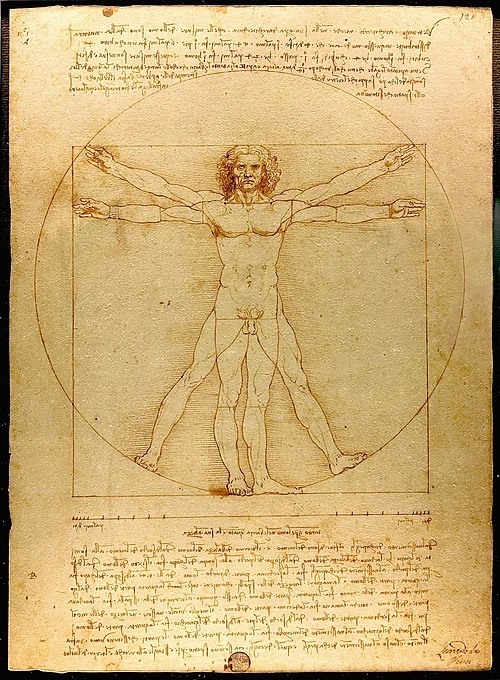
“You are what you eat.” The German philosopher Feuerbach said it in 1850, presumably not expecting anyone to take it quite this literally. But run the numbers and the phrase turns out to be less poetic metaphor and more biochemical fact — with one caveat: completion takes a while.
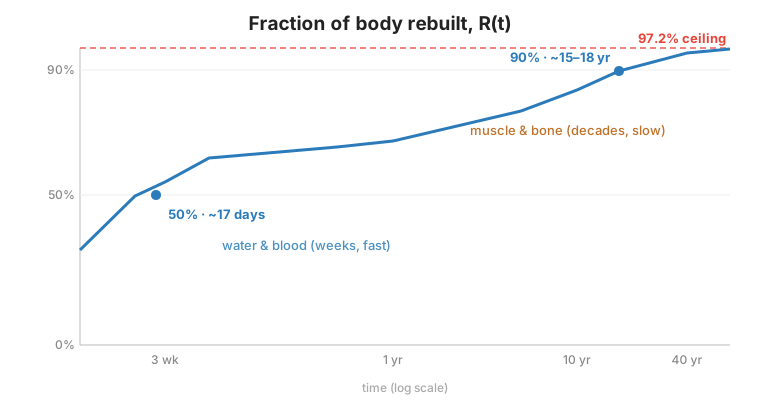
The reversal comes in two layers. First, the fast part: half your body (50%) is replaced with new raw material in as little as two to three weeks. Most of that is water and blood. Second, the slow part: getting to 90% takes decades, because muscle and bone are in no hurry. And the neurons making up roughly 2.8% of your total body mass — the ones reading this sentence right now — were assembled before you were born and will never be replaced.
Today’s hamburger is being incorporated into your body at this very moment. Let’s calculate how quickly that process fills you up — and how many burgers it takes to get there.

This article is a calculation for fun, not medical advice. For actual health decisions, please consult a qualified professional.
INPUT
Variable 1: Reference body mass and water content
The average adult male body mass in South Korea (ages 20–60) was approximately 71.5 kg per the 2022 Korea National Health and Nutrition Examination Survey.[1] We use 70 kg as a round figure that also aligns with international references. This is a central estimate.
Separating out water:
About 60% of the human body is water.[2] Water turns over on a timescale of days. Whole-body water turnover is roughly 8–10% per day,[3] which in an exponential-decay model gives a water replacement half-time of days (≈ 0.027 years). (Back-calculated from ~42 L total body water and a daily exchange of ~3–4 L.) That means 90% of your body water is replaced within about 23 days.
In the turnover model that follows, water (60%) gets its own exponential term; the remaining structural mass (40%, 28 kg) is broken down tissue by tissue.
Variable 2: Tissue fractions and replacement half-times
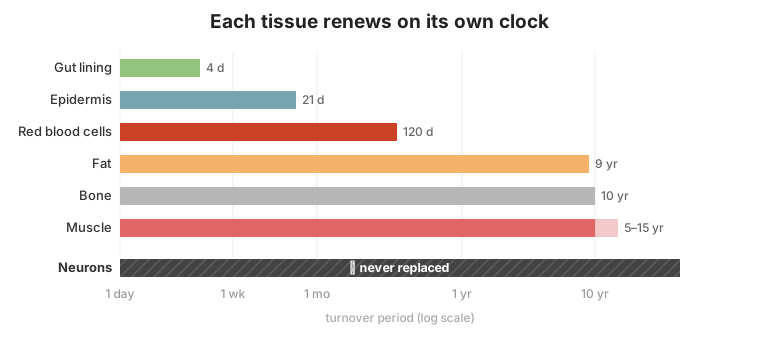
We decompose the 28 kg structural mass by tissue. The fractions sum to exactly 1.000 — verified in-text.[4]
| Tissue | Symbol | Mass (g) | Structural fraction | Half-time | Renewable? | Confidence |
|---|---|---|---|---|---|---|
| Skeletal muscle | 11,200 | 0.400 | 5–15 yr | Yes | Key uncertainty | |
| Adipose (fat cells) | 4,200 | 0.150 | 9 yr | Yes | Solid | |
| Bone | 4,200 | 0.150 | 10 yr | Yes | Solid | |
| Red blood cells | 1,680 | 0.060 | 120 days | Yes | Solid | |
| Other tissue (gut wall, lung, vascular endothelium, etc.) | 3,920 | 0.140 | 5 yr (assumed) | Yes | Needs assumption | |
| Epidermis (stratum corneum) | 560 | 0.020 | 21 days | Yes | Solid | |
| Small-intestine epithelium | 280 | 0.010 | 4 days | Yes | Solid | |
| Brain / spinal cord (neurons) | 1,512 | 0.054 | ∞ (lifetime) | No | Solid | |
| Cardiac muscle | 336 | 0.012 | Near-lifetime | No (approx.) | Solid | |
| Ocular lens (both eyes) | 112 | 0.004 | ∞ (lifetime) | No | Solid | |
| Total | 28,000 | 1.000 | — | — |
check: ✓
The 40% skeletal muscle figure comes from DEXA (dual-energy X-ray absorptiometry, the gold standard for body composition) measurements on adult males.[4] The 15% fat fraction is an average for adult men; you can adjust it in the calculator below.
Variable 3: The non-renewable fraction — “the 2.8% paradox”
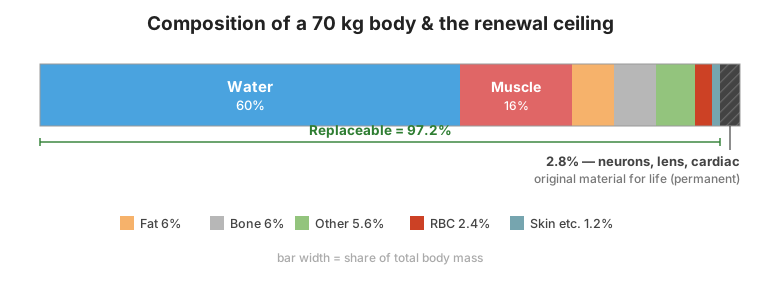
Non-renewable tissues (neurons, cardiac muscle, ocular lens) as a share of total body mass:
No diet, no matter how long you follow it, will ever replace this 2.8%.[5][6][7] The neurons alone account for 1,512 g — assembled in utero, they have been processing your thoughts ever since.
The maximum achievable replacement ceiling is . Note that this 2.8% is measured against total body mass (70 kg). If you use structural mass (28 kg, i.e. excluding water) as the denominator instead, the non-renewable fraction becomes and the ceiling drops to 93.0% — but the headline uses the more intuitive total-body-mass basis.
Variable 4: Half-time ranges
| Tissue | (optimistic) | (conservative) | Key reference |
|---|---|---|---|
| Water | 10 days | 10 days | Yamada et al. 2022 — large-scale doubly-labeled water study[3] |
| Small-intestine epithelium | 4 days | 5 days | Clevers 2013[8] |
| Epidermis | 14 days | 28 days | Weinstein & Frost 1968[9] |
| Red blood cells | 115 days | 125 days | Franco 2012[10] |
| Adipose cells | 5 yr | 10 yr | Spalding et al. 2008, central value 9 yr[11] |
| Bone | 8 yr | 12 yr | Raggatt & Partridge 2010[12] |
| Skeletal muscle | 5 yr | 15 yr | Spalding 2005 ¹⁴C range; dominant uncertainty[13] |
| Other tissue | 3 yr | 7 yr | Weak assumption; low sensitivity |
The 5–15 year range for muscle is the dominant sensitivity driver for this article’s headline range. That’s a direct consequence of muscle being the largest single fraction ().
FORMULA
Step 1: The turnover model — why tissues differ
Cell replacement in each tissue follows an exponential-decay curve. The fraction of “original material” still present after years is ; the fraction replaced with new material is .
Why do tissues turn over at different rates? The answer is their cell-division cycle.
- Small-intestine epithelium ( days): Front-line exposure to food, stomach acid, and digestive enzymes — the harshest environment in the body, hence the fastest turnover.
- Red blood cells ( days): Circulate hundreds of thousands of times through capillaries and physically wear out. They also lack a nucleus, so they cannot self-replicate.
- Adipose cells ( years): Store and release energy in a relatively stable mechanical environment — slow and steady.
- Skeletal muscle cells (–15 years): The cell itself (myonuclei, myofibers) turns over far more slowly than the protein inside it (which cycles on a scale of days to weeks).[13] An extra gym session does not speed up cell replacement. The turnover clock is set by biological programming, not by nutritional input.
- Neurons (): Adult neocortical neurons are essentially not generated after the developmental period.[5] They are repaired across a lifetime, but never replaced.
Step 2: Whole-body replacement function
Water now gets its own exponential term rather than being treated as instantly replaced. This corrects a bug in simpler models where 50% targets yielded zero or negative times.
Where:
- : water’s share of total body mass
- yr: water turnover half-time[3]
- : structural mass as a share of total body mass ()
- : each tissue’s fraction within structural mass (summed over renewable tissues only)
Renewable tissue fractions sum to:
Convergence ceiling:
No diet ever crosses this ceiling. The exact figure shifts slightly with body fat percentage (as the fat and muscle fractions redistribute), but the non-renewable core — neurons, cardiac muscle, ocular lens — is fixed and is what anchors the ceiling.
Important note: (you start at zero). Older models that treated water as instantaneously replaced set , which caused sub-60% targets to collapse to zero or negative times. The corrected model handles any target normally.
Step 3: Reversal 1 — “half your body in a few weeks”
We back-calculate when (50% replacement).
At low targets the water term dominates. Water alone:
0.049 yr × 365 days = about 17.9 days (water alone). Adding blood, intestinal epithelium, and epidermis, the full-model back-calculation puts 50% replacement at roughly 2–3 weeks (~17 days).
Intuition check for English-speaking readers: The popular belief that “the body renews itself slowly” is reasonable in everyday terms — you don’t feel different week to week. But when you measure body composition by mass, more than half of it is water, and water refreshes in three weeks. The Yamada et al. 2022 doubly-labeled water study — 5,604 participants across 23 countries — confirmed average daily water turnover of ~3.2 L/day for an adult male of this size, which is exactly what this 10-day half-time is built on.[3] The fast half exists, and it is literally half of you.
Step 4: Debunking the “7-year myth”
The folk claim that “the body completely renews every 7 years” comes from misreading the fast tissues. Reaching 95% replacement in each tissue requires roughly :
| Tissue | Time to 95% | Multiple of 7 years | |
|---|---|---|---|
| Water | 10 days | ~30 days | 0.011× |
| Intestinal epithelium | 4 days | 12 days | 0.005× |
| Epidermis | 21 days | 63 days | 0.024× |
| Red blood cells | 120 days | 360 days | 0.14× |
| Adipose cells | 9 yr | 27 yr | 3.9× |
| Bone | 10 yr | 30 yr | 4.3× |
| Skeletal muscle (conservative) | 15 yr | 45 yr | 6.4× |
“Seven years” captures the fast-cycling tissues but completely ignores muscle (), the single largest fraction in the body. It’s a bit like timing a cross-country road trip by only counting the pit stops.
Step 5: Reversal 2 — “90% takes a very long time”
We back-calculate when . At this level, fat, bone, and muscle must be substantially replaced — that takes decades. There’s no closed-form inverse, so we use bisection.
Standard adult (15% body fat, conservative yr):
, (baseline).
Verification at yr:
At yr, — just shy of 90%. Bisection gives –18 yr.
Optimistic scenario ( yr):
Optimistic scenario: ~10 years to 90% (bisection: yr).
Step 6: Scenario comparison
| Scenario | Muscle | Body fat | Time to 90% | Plausibility |
|---|---|---|---|---|
| Optimistic (5 yr, 15% fat) | 5 yr | 15% | ~10 yr | Optimistic lower bound |
| Conservative (15 yr, 15% fat) | 15 yr | 15% | ~18 yr | Supported by mainstream literature |
| Conservative + aging (15 yr, age 50) | 15 yr+ | 15% | ~20 yr+ | Conservative upper bound |
Headline: For a typical adult, optimistic ~10 years, conservative ~18 years. In every scenario, neurons, the ocular lens, and cardiac muscle (~2.8%) are never replaced.
One counter-intuitive side note: higher body fat can actually speed up overall replacement. Adipose cells ( yr) turn over faster than skeletal muscle ( yr). If fat makes up a larger fraction, the slow-muscle drag shrinks and the body renews faster overall — not by exercising more, but by having proportionally less of the slowest tissue.
Step 7: How many burgers?
Once you have the time, the burger count is straightforward. Eating burgers per day for years:
Conservative scenario ( yr), 5 burgers/day:
Optimistic scenario ( yr):
To rebuild 90% of your body, you need roughly 18,000–33,000 burgers at 5 per day. (Why 5? An adult male’s reference intake of ~2,500 kcal/day divided by one Big Mac at 567 kcal[14] gives , rounded up to 5.)
One important point: eating 1 burger a day versus 10 does not change the cell turnover rate (). The biological replacement clock is driven by cell-division programming, not nutritional throughput. The burger count is merely a way of tallying up the meals eaten along the way — not a lever you can pull to speed the process up.
Step 8: Age correction
Cell turnover slows with age.
- Bone: After age 40, osteoclasts (bone-resorbing cells) begin to outpace osteoblasts (bone-forming cells), extending the remodeling cycle.[15]
- Epidermis: Keratinocyte replacement slows from ~21 days in young adults to 35–40 days in older skin.[16]
- Muscle: Satellite cells (the stem cells that repair and regenerate muscle fibers) decline in activity with age.[17]
: epidermis 0.15, bone 0.10, muscle 0.05. These are qualitative corrections; individual variation is substantial.
OUTPUT
Half your body (50%) is replaced with new raw material in roughly 2–3 weeks. Mostly water and blood. The next half — going from 50% to 90% — takes another 10–18 years. Mostly muscle and bone. At 5 burgers a day, that works out to somewhere between 18,000 and 33,000 burgers.
And the last 2.8% — the neurons in your brain, your cardiac muscle, your ocular lens — is never replaced. Feuerbach said “you are what you eat,” but his aphorism has a permanent exception clause: the part of you doing the reading. The neurons processing these words were assembled before you took your first breath. They have never eaten a single thing.
Eat clean and you are, eventually, built from clean materials. Eat junk and you are built from junk. It just takes 10–18 years to see the renovation through. Your brain, however, did not sign up for the program. It is keeping the original blueprints.
References
[1]: Korea Disease Control and Prevention Agency (KDCA), “2022 Korea National Health and Nutrition Examination Survey (KNHANES IX-1)”, 2023. https://www.kdca.go.kr/board/board.es?mid=a20501010000&bid=0015
[2]: Watson, P. E. et al., “Total body water volumes for adult males and females estimated from simple anthropometric measurements”, The American Journal of Clinical Nutrition, 33(1), 27–39, 1980. Adult total body water fraction ~60% (males). https://doi.org/10.1093/ajcn/33.1.27
[3]: Yamada, Y. et al., “Variation in human water turnover associated with environmental and lifestyle factors”, Science, 378(6622), 909–915, 2022. Doubly-labeled water measurements across 23 countries (n = 5,604). Mean adult daily water turnover ~3.2 L/day (30 yr male, 70 kg). Against ~42 L total body water, daily exchange rate ~7.6%, giving a water replacement half-time of ~10–13 days. https://doi.org/10.1126/science.abm8668
[4]: Heymsfield, S. B. et al., “Human body composition: advances in models and methods”, Annual Review of Nutrition, 17, 527–558, 1997. DEXA-based adult male body composition: ~40% muscle, ~15% fat, ~15% bone. https://doi.org/10.1146/annurev.nutr.17.1.527
[5]: Bhardwaj, R. D. et al., “Neocortical neurogenesis in humans is restricted to development”, PNAS, 103(33), 12564–12568, 2006. Adult neocortical neurons are essentially not generated after the developmental period. https://doi.org/10.1073/pnas.0605177103
[6]: Bergmann, O. et al., “Evidence for cardiomyocyte renewal in humans”, Science, 324(5923), 98–102, 2009. Annual cardiomyocyte turnover rate <1%; only a tiny fraction is ever replaced over a lifetime. https://doi.org/10.1126/science.1164680
[7]: Wride, M. A., “Lens fibre cell differentiation and organelle loss: many paths lead to clarity”, Philosophical Transactions of the Royal Society B, 366(1568), 1219–1233, 2011. Mechanism of lifelong retention of lens nuclear fiber cells. https://doi.org/10.1098/rstb.2010.0324
[8]: Clevers, H., “The intestinal crypt, a prototype stem cell compartment”, Cell, 154(2), 274–284, 2013. Small-intestine epithelial cell turnover cycle: 4–5 days. https://doi.org/10.1016/j.cell.2013.07.004
[9]: Weinstein, G. D. & Frost, P., “Abnormal cell proliferation in psoriasis”, Journal of Investigative Dermatology, 50(3), 254–259, 1968. Epidermal keratinocyte turnover ~21 days (normal skin). https://doi.org/10.1038/jid.1968.36
[10]: Franco, R. S., “Measurement of red cell lifespan and aging”, Transfusion Medicine and Hemotherapy, 39(5), 302–307, 2012. Mean red blood cell lifespan: 120 days. https://doi.org/10.1159/000342232
[11]: Spalding, K. L. et al., “Dynamics of fat cell turnover in humans”, Nature, 453, 783–787, 2008. ¹⁴C dating of adipose cells; mean adipocyte lifespan ~9 years. https://doi.org/10.1038/nature06902
[12]: Raggatt, L. J. & Partridge, N. C., “Cellular and molecular mechanisms of bone remodeling”, Journal of Biological Chemistry, 285(33), 25103–25108, 2010. Bone remodeling cycle ~10 years. https://doi.org/10.1074/jbc.R109.041087
[13]: Spalding, K. L. et al., “Retrospective birth dating of cells in humans”, Cell, 122(1), 133–143, 2005. ¹⁴C radiocarbon dating of cell birth dates; analysis of muscle cell (myonuclei) turnover rates. Protein turnover (days–weeks) is distinct from cell-level turnover (years–decades). https://doi.org/10.1016/j.cell.2005.08.017
[14]: McDonald’s official nutrition information (2024). Big Mac: 567 kcal, 25.5 g protein. https://www.mcdonalds.com/us/en-us/product/big-mac.html
[15]: Parfitt, A. M., “Osteonal and hemi-osteonal remodeling: the spatial and temporal framework for signal traffic in adult human bone”, Journal of Cellular Biochemistry, 55(3), 273–286, 1994. Bone remodeling cycle and age-related changes; osteoclast dominance after age 40. https://doi.org/10.1002/jcb.240550303
[16]: Ghadially, R. et al., “The aged epidermal permeability barrier”, Journal of Clinical Investigation, 95(5), 2281–2290, 1995. Slowing of keratinocyte replacement in aged skin (21 days → 35+ days). https://doi.org/10.1172/JCI117919
[17]: Conboy, I. M. & Rando, T. A., “Heterochronic parabiosis for the study of the effects of aging on stem cells and their niches”, Cell Cycle, 11(12), 2260–2267, 2012. Age-related decline in muscle satellite cell activity. https://doi.org/10.4161/cc.20437