A first-year anatomy professor is said to open with this line: “The human digestive tract is one long tube running from mouth to anus. Everything inside it is, technically, outside your body.” The room goes quiet. That tube expels a measurable quantity of material every single day. Add it up over a lifetime — how much is there? And how much of the energy you ate is still sitting in what you flushed away?
We calculate how much fuel a human engine burns versus how much it discards.
This article is for entertainment purposes only and does not constitute medical, legal, or dietary advice. Digestive function varies enormously between individuals; these calculations are not a diagnostic tool.
INPUT
Variable 1: Daily stool mass by diet type
Stool mass is most strongly influenced by dietary fiber intake. The landmark quantitative reference is a large literature review by Cummings (1992), published in Gut, which mapped the relationship between fiber intake and stool output.[1]
| Diet type | Daily stool mass | Notes |
|---|---|---|
| Low-fiber (refined foods) | 128 g/day | Lower bound of Western low-fiber diet |
| Standard (mixed diet) | 200 g/day | Calculation baseline, central estimate |
| High-fiber (whole grains, vegetables) | 340 g/day | Approaching the upper end of WHO fiber recommendations |
| Vegan (plant-based) | 470 g/day | High-fiber vegan cohort |
We use 200 g/day as the default. This is a central estimate — individual values can vary by ±50% or more depending on the person, diet composition, and gut microbiome.
Variable 2: Stool water content and dry stool mass
Fresh stool is approximately 75% water by mass.[1] Dry stool mass is therefore 25% of the wet weight.
For the standard diet:
This value is the critical intermediate for the energy calculation.
Variable 3: Energy content of dry stool
Livesey and Elia (1995), writing in the American Journal of Clinical Nutrition, directly measured the caloric content of dry stool using a bomb calorimeter.[2] The measured range was 3.5–5.5 kcal/g; 4.4 kcal/g is the central value for adults on a standard mixed diet. High-protein diets push this toward 5.5 kcal/g; plant-dominant diets toward 3.5 kcal/g. This variable has moderate sensitivity — it moves the final result by roughly ±25%.
Variable 4: Daily energy intake
The WHO/FAO joint report Human Energy Requirements (2004) puts adult women at roughly 1,700–2,100 kcal/day and adult men at 2,200–2,500 kcal/day for moderate activity levels.[3] We use 2,000 kcal/day as an average adult baseline. Central estimate.
Variable 5: Life expectancy and life-stage scaling factors
The WHO World Health Statistics 2023 reports a global average life expectancy of 73.4 years; the United States average is approximately 77 years (CDC, 2022).[4] We use years as our baseline — a reasonable round number between the global average and longer-lived high-income countries.
Stool output at each life stage is expressed as a multiplier relative to the adult baseline (α₂ = 1.0). Direct large-cohort measurements are sparse outside the adult range; the values below are estimates.
| Stage | Age | Factor α | Basis |
|---|---|---|---|
| α₀ | 0–2 | 0.20 | Infants on milk/puréed food; small gut capacity; estimated |
| α₁ | 3–12 | 0.55 | Pediatric gut capacity roughly 50% of adult; estimated |
| α₂ | 13–70 | 1.00 | Adult reference (Cummings 1992) |
| α₃ | 71+ | 0.80 | Reduced gut motility in older adults; estimated [5] |
α₀, α₁, and α₃ are estimates drawn from general descriptions in pediatric and geriatric medicine texts. Even if these factors shift by ±50%, the α₂ adult stage contributes over 80% of the lifetime total, so the final sum is robust to those assumptions.
Variable 6: Household electricity reference
The US Energy Information Administration (EIA) reports that the average American household consumed approximately 10,500 kWh of electricity in 2022.[6a] For comparison, the Korean average was approximately 3,900 kWh/year in the same year.[6b] Both figures appear in the Output section.
FORMULA
Step 1: Daily fecal energy loss
Converting wet stool → dry stool → energy loss, with explicit units throughout.
A standard-diet adult loses 220 kcal per day in stool.
Step 2: Digestive energy efficiency η (Method B: direct bomb calorimetry)
Eleven percent of ingested energy exits in stool; 89% is absorbed and used by the body.
Step 3: Cross-check — WHO/FAO ME/GE ratio
The WHO/FAO 1985 report describes the ratio of Metabolisable Energy (ME) to Gross Energy (GE) as approximately 97–98% for standard mixed diets.[7] That is higher than our 89%.
The gap comes down to fiber content. The 97–98% figure was derived from Western reference diets dominated by refined carbohydrates and animal protein — diets with roughly 15–20 g/day of dietary fiber. Higher fiber intake means more undigested organic matter reaching the colon, lowering the practical efficiency. The 200 g/day stool assumption implies a diet with more fiber than those Western reference diets, so 89% sits comfortably within the plausible range.
The Atwater factor method (Method C) — using 4.0 kcal/g for carbohydrates and protein, 9.0 kcal/g for fat — is the system behind nutrition labels worldwide.[8] It also predicts roughly 90–95% efficiency for standard diets, broadly consistent with Method B.
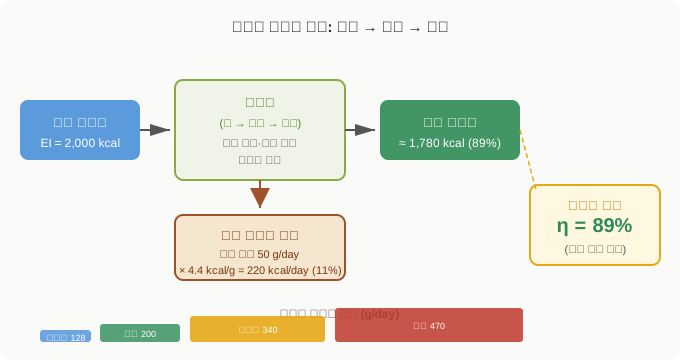
Step 4: Digestive efficiency by diet type
| Diet type | (g/day) | Dry stool (g/day) | Fecal energy (kcal/day) | Efficiency |
|---|---|---|---|---|
| Low-fiber | 128 | 32.0 | 140.8 | 93.0% |
| Standard (baseline) | 200 | 50.0 | 220.0 | 89.0% |
| High-fiber | 340 | 85.0 | 374.0 | 81.3% |
| Vegan | 470 | 117.5 | 517.0 | 74.2% |
Diet type is the dominant variable. Low-fiber and vegan differ by about 19 percentage points. Measured by caloric efficiency alone, low-fiber diets look like the better-engineered engine. What that engine does to blood sugar, gut microbiome, and long-term health is an entirely different calculation.
Step 5: Lifetime stool output
Applying life-stage factors α to each interval. Baseline: g/day, years.
Breaking it down by stage:
The α₂ adult stage (58 years) accounts for 80.7% of the total. Lifetime stool output is effectively set by what you eat as an adult.
Step 6: Lifetime wasted energy
The same life-stage scaling applies to fecal energy loss. The effective day-count weighted by α:
where kcal/day (standard diet, adult baseline).
Converting to kilowatt-hours (1 kWh = 860.42 kcal thermochemical; rounded to 860 below):
Step 7: Animal comparison — Kleiber’s Law
Kleiber’s Law, established by Max Kleiber in a 1932 paper in Hilgardia,[9] states that the basal metabolic rate (BMR) of endotherms (mammals and birds) scales with body mass to the 0.75 power:
where is body mass in kg and 70 is the empirical mammalian constant.
Since stool output roughly tracks metabolic rate, this lets us compare species on a common scale.
| Animal | Body mass (kg) | Estimated BMR (kcal/day) | Ratio to human |
|---|---|---|---|
| Mouse | 0.02 | ~1/455 | |
| Human | 70 | 1.0 (baseline) | |
| African elephant | 4,000 | ~21× |
derivation: , , , so kcal/day.
: , , , so kcal/day (rounding artifact; the precise formula value is 35,208 kcal/day). Christiansen (2004) measured the actual BMR of African elephants at roughly 40,000–50,000 kcal/day (central value ~49,500 kcal/day),[10] about 40% above the Kleiber prediction. The discrepancy reflects factors the law simplifies away: thermoregulation strategy, organ proportions, and social activity levels.
Per-unit-mass metabolic rate is more intuitive. Since :
- Mouse (0.02 kg): kcal/kg/day
- Human (70 kg): kcal/kg/day
- Elephant (4,000 kg): kcal/kg/day
A mouse burns about eight times more energy per kilogram than a human does. The stool-per-kilogram ranking follows the same order: mouse > human > elephant. Small animals run hotter, and hotter engines produce more waste relative to their size.
Kleiber’s Law applies only to endotherms. Plug a lizard (~0.3 kg) into the formula and you get kcal/day. A real lizard’s BMR is closer to 2–5 kcal/day — roughly one-fifth to one-tenth of a same-sized mammal’s, because ectotherms outsource their thermoregulation to the sun. Their stool output is correspondingly smaller.
OUTPUT
Summary based on the standard diet (200 g/day), 2,000 kcal/day intake, and 80-year life expectancy:
| Metric | Result |
|---|---|
| Lifetime stool mass | 5,249 kg (≈ 5.2 metric tons / 5.8 US tons / 11,600 lb) |
| Digestive energy efficiency | 89.0% |
| Lifetime wasted energy | 6,713 kWh |
| Energy comparison (US) | ≈ 0.64 years (~8 months) of average US household electricity [6a] |
| Energy comparison (Korea) | ≈ 1.7 years of average Korean household electricity [6b] |
An adult African elephant weighs roughly 4–6 metric tons.[10] Over a lifetime, a human deposits roughly one elephant’s worth of material in the bathroom — 75% of which was water to begin with.
The 89% efficiency figure is substantially better than an internal combustion engine (thermal efficiency roughly 20–40%). And the missing 11% isn’t really “undigested food” — a large share of it is dietary fiber that was never intended to be digested. Someone eating a vegan diet sees efficiency drop to 74%; a person on a highly refined low-fiber diet reaches 93%. By the numbers alone, the low-fiber diet runs the cleaner engine. Whether that engine is better for the person sitting in it falls well outside the scope of this calculation.
References
[1]: Cummings, J.H. (1992). “Dietary fibre and large bowel function.” Gut, 33(Suppl), S11–S13. https://doi.org/10.1136/gut.33.Suppl.S11 — Quantitative relationship between dietary fiber intake and stool mass; 75% water content figure.
[2]: Livesey, G., & Elia, M. (1995). “Estimation of energy expenditure, net carbohydrate utilization, and net fat oxidation and synthesis by indirect calorimetry: evaluation of errors with special reference to the detailed composition of fuels.” American Journal of Clinical Nutrition, 62(5 Suppl), 1000S–1020S. https://doi.org/10.1093/ajcn/62.5.1000S — Dry stool energy content 3.5–5.5 kcal/g; central value 4.4 kcal/g.
[3]: FAO/WHO/UNU (2004). Human Energy Requirements: Report of a Joint FAO/WHO/UNU Expert Consultation. FAO Food and Nutrition Technical Report Series 1. Rome: FAO. https://www.fao.org/3/y5686e/y5686e.pdf — Adult energy requirement reference values (EI range 1,700–2,500 kcal/day).
[4]: World Health Organization (2023). World Health Statistics 2023: Monitoring Health for the SDGs. Geneva: WHO. https://www.who.int/publications/i/item/9789240074323 — Global average life expectancy 73.4 years; US CDC figure (~77 years) used alongside for context.
[5]: Morley, J.E. (2007). “The aging gut: physiology.” Clinics in Geriatric Medicine, 23(4), 757–767. https://doi.org/10.1016/j.cger.2007.06.002 — Reduced gut motility in older adults; basis for α₃ = 0.80 estimate.
[6a]: U.S. Energy Information Administration (2023). Electric Power Monthly. Washington, DC: EIA. https://www.eia.gov/energyexplained/use-of-energy/electricity-use-in-homes.php — Average US household electricity consumption approximately 10,500 kWh/year (2022). Used for English-edition energy comparison: 6,713 kWh ÷ 10,500 kWh/yr ≈ 0.64 yr ≈ ~8 months of US household electricity.
[6b]: Korea Energy Economics Institute (2023). 2023 Energy Statistics Yearbook. https://www.keei.re.kr — Average Korean household electricity consumption approximately 3,900 kWh/year (2022).
[7]: FAO/WHO/UNU (1985). Energy and Protein Requirements: Report of a Joint FAO/WHO/UNU Expert Consultation. WHO Technical Report Series 724. Geneva: WHO. https://apps.who.int/iris/handle/10665/39527 — ME/GE ratio 0.97–0.98 for standard Western mixed diet.
[8]: Atwater, W.O., & Benedict, F.G. (1902). “Experiments on the metabolism of matter and energy in the human body.” USDA Office of Experiment Stations Bulletin, 109. — Original source for Atwater factors (protein and carbohydrate 4.0 kcal/g, fat 9.0 kcal/g).
[9]: Kleiber, M. (1932). “Body size and metabolism.” Hilgardia, 6(11), 315–353. https://doi.org/10.3733/hilg.v06n11p315 — Metabolic rate ∝ body mass^0.75; empirical constant 70 kcal/day.
[10]: Christiansen, P. (2004). “Body size in proboscideans, with notes on elephant metabolism.” Zoological Journal of the Linnean Society, 140(4), 523–549. https://doi.org/10.1111/j.1096-3642.2004.00113.x — Elephant body mass 4,000–6,000 kg; measured metabolic rates; Kleiber’s Law validation.
[11]: Daan, S., Masman, D., & Groenewold, A. (1990). “Avian basal metabolic rates: their association with body composition and energy expenditure in nature.” American Journal of Physiology, 259(2), R333–R340. — Confirms that ectotherm (lizard) BMR is roughly 1/5–1/10 that of a same-sized endotherm.