Part 2 of a 4-part series on plastic — Part 1: How Much Plastic Will You Eat in a Lifetime?
Somewhere in 2592, an oceanographer pulls a sediment core from the seafloor. Buried in the sample is something almost structurally intact. Analysis confirms: PET polymer. Manufactured 2026. Five hundred and sixty-six years old — and the molecular backbone of polyethylene terephthalate (PET, the clear plastic used for water bottles) is still identifiable.
This is not science fiction. It is what the most conservative estimates actually predict.
Which raises a question worth calculating: if someone had dropped a plastic bottle into the ocean during the year the Spanish Armada sailed — 1588 — would it be gone by now?
The short answer is no. The longer answer is the rest of this article.
INPUT
Variable 1: Mass of a single PET bottle
Based on a standard 500 mL water bottle. According to the Plastics Europe 2022 materials database and NAPCOR (National Association for PET Container Resources) reports, the standard mass range for a 500 mL PET bottle is 20–30 g, with a central value of approximately 25 g.[1] This is the central estimate used throughout.
Variable 2: PET density
The crystalline density of polyethylene terephthalate (PET) is 1.38–1.40 g/cm³; the amorphous (randomly arranged) form is 1.33 g/cm³.[2] This article uses 1.38 g/cm³, the central value for the semi-crystalline PET used in standard beverage containers.
For reference, here are the key densities across common polymer types:
| Polymer | Abbreviation | Density (g/cm³) | Common uses |
|---|---|---|---|
| Polyethylene terephthalate | PET | 1.38 | Water bottles, textiles |
| High-density polyethylene | HDPE | 0.95 | Detergent bottles, pipes |
| Polypropylene | PP | 0.90 | Straws, food packaging |
| Polystyrene | PS | 1.05 | Foam cups, takeout containers |
| Polylactic acid | PLA | 1.24 | “Biodegradable” containers, cutlery |
Variable 3: Estimated complete degradation time
This is the most uncertain variable in this article. To be direct about it: even NOAA’s Marine Debris Program officially states that no one knows exactly how long plastics last in the marine environment.[3] Plastic has only been mass-produced commercially since the 1950s. No study has ever measured complete plastic degradation in real time. Every current estimate is extrapolated from accelerated aging experiments — laboratory tests using elevated heat and UV exposure to artificially speed up degradation, then projecting the results across centuries.
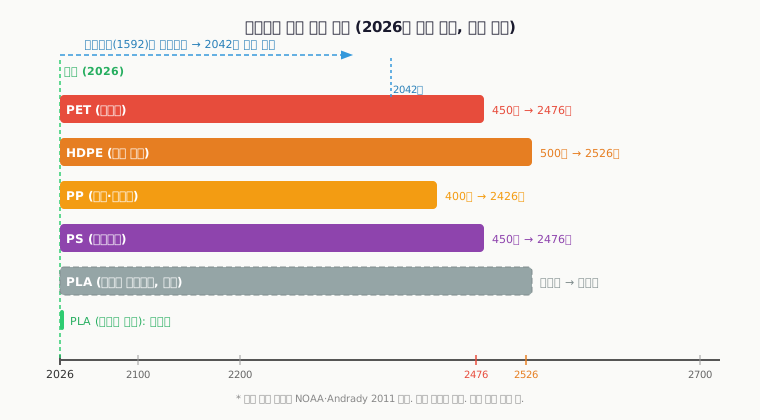
Andrady (2011), reviewing polymer degradation estimates in the Marine Pollution Bulletin, placed PET at approximately 450 years as the central estimate.[4] That said, figures in the literature range from “a few decades” to “over a thousand years” depending on assumptions.
| Polymer | Estimated marine degradation (years) | Projected year of full breakdown (discarded 2026) |
|---|---|---|
| PET | ~450 | 2476 |
| HDPE | ~500 | 2526 |
| PP | ~400 | 2426 |
| PS | ~450 | 2476 |
| PLA (marine) | hundreds–thousands | uncertain |
| PLA (industrial compost facility) | months–years | — |
One row deserves attention: PLA (polylactic acid — a plant-derived “biodegradable” plastic made from corn starch or sugarcane). In the controlled conditions of an industrial composting facility — high heat, high humidity — PLA breaks down within months. Drop it in the ocean, and it behaves almost identically to conventional plastic, persisting for centuries.[5] The “biodegradable” label is conditional on ending up in the right facility.
Variable 4: Environmental correction factor
Degradation speed depends heavily on environment. Photo-oxidation — the reaction in which UV energy breaks polymer chains in the presence of oxygen — is the most powerful accelerant. Buried in a landfill, UV is blocked and oxygen supply is limited, slowing degradation by several times. Royer et al. (2018) provided experimental data on the difference in degradation rates between marine surface and landfill conditions.[6] Note: this correction factor is derived from scarce experimental data and should be treated as an order-of-magnitude estimate.
Variable 5: Particle size (fragmentation reference size)
When Thompson et al. (2004) introduced the term “microplastics” in Science, they defined the threshold at 5 mm or smaller.[7] This article works across four size categories: 5 mm (visible fragments) down to 1 μm (micrometers — roughly the size of bacteria, near the nanoplastic boundary).
Variable 6: Historical reference point
In the summer of 1588, Philip II of Spain launched the Spanish Armada — 130 ships sent to invade England. It is one of the most consequential military campaigns in European history, and the event that fixed 1588 into every British history classroom. From that year to 2026, 438 years have elapsed.
PET’s estimated decomposition time is 450 years. The gap between them is 12 years. That is the point of this calculation.
FORMULA
Step 1: Fragmentation particle count — with dimensional analysis
This article adopts Model A (cubic fragmentation): the PET bottle breaks into uniform cubes with side length . This model is chosen because it is transparent and straightforward to analyze for sensitivity.
Dimensional analysis (unit check). Verify the formula by tracking units alone:
Numerator and denominator cancel exactly; is a pure number.
Model B (spherical) for comparison: Real plastic fragments are not cubes — they are irregular. If we assume spheres of diameter (radius ), the volume per particle is , which is smaller than for a cube, so the particle count is correspondingly larger:
The spherical assumption yields roughly 1.91× more particles — approximately double. This article uses the cubic Model A for calculation transparency.
Step 2: Particle counts by size — substituting values
Base values: ,
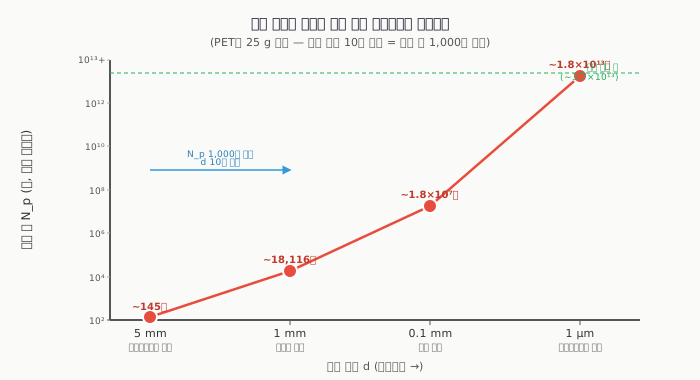
cm (5 mm — upper bound of the microplastic definition):
Visible to the naked eye.
cm (1 mm):
Sand-grain scale. About 18,000 fragments — this is also the widget’s default value.
cm (0.1 mm):
About 18 million. Invisible without a microscope.
cm (1 μm — near the nanoplastic boundary):
About 18 trillion.
Laid out side by side, the pattern is stark:
| Particle size | (cm³) | (cubic model) | Intuitive comparison |
|---|---|---|---|
| 5 mm (0.5 cm) | 0.125 | ~145 | Countable by hand |
| 1 mm (0.1 cm) | 0.001 | ~18,116 | Sand-grain scale |
| 0.1 mm (0.01 cm) | 10⁻⁶ | ~1.81×10⁷ | Roughly the mosquito population of a mid-sized city park in summer |
| 1 μm (10⁻⁴ cm) | 10⁻¹² | ~1.81×10¹³ | About half the number of cells in the human body (~3.7×10¹³) |
Step 3: The core sensitivity — the law
is inversely proportional to the cube of :
When particle size decreases by a factor of 10:
Every time particle size drops by one order of magnitude, fragment count rises by three orders of magnitude — one thousand times more. Across the full range from 5 mm to 1 μm:
125 billion times more particles. A single PET bottle, fully fragmented to nanoplastic scale, produces 125 billion times more individual pieces than the same mass at the microplastic threshold — and those pieces scatter across a correspondingly wider area.
Step 4: Timeline calculations
Two formulas give the complete decomposition date and the post-death residual period:
The Spanish Armada calculation:
In the summer of 1588, England lit signal fires along its coast to warn of the incoming fleet. If a PET bottle had been dropped into the English Channel that year, it would still be intact today — with 12 years remaining.
Breakdown timelines for a bottle discarded today (2026):
| Environment | Correction factor | Total degradation time | Projected complete breakdown |
|---|---|---|---|
| Beach/surface (UV-accelerated) | 0.5 | 225 years | 2251 |
| Marine (baseline) | 1.0 | 450 years | 2476 |
| Landfill (buried, UV-blocked) | 5.0 | 2,250 years | 4276 |
For context: 2476 is further from today than the year Columbus reached the Americas (1492) is from us. The landfill figure of 4276 is further away than the fall of the Western Roman Empire.
Post-death residual period ( years, marine baseline):
A bottle discarded into the ocean today will still be drifting — or sinking — for 400 years after a reader with 50 years left to live has died.
Step 5: Two meanings of “breaks down”
Plastic “decomposition” conflates two distinct processes:
- Fragmentation: Physical abrasion, photo-oxidation, and hydrolysis (the reaction in which water molecules cleave polymer chains) reduce particle size. The polymer molecular backbone remains intact throughout.
- Mineralization: Microbial action converts polymer carbons into CO₂ and H₂O. The polymer structure is completely eliminated.
The degradation timelines cited from NOAA and Andrady (2011) refer primarily to fragmentation.[4] Mineralization — true molecular elimination — takes substantially longer, or for some polymers is effectively unmeasurable.[8] This means every year in the timeline table above is likely an optimistic (short) estimate. The plastic may look degraded; the polymer chains are still there, just smaller and more dispersed.
OUTPUT
Key results in one place:
| Scenario | Result |
|---|---|
| Spanish Armada (1588) bottle — marine decomposition complete | 2038 (12 years away) |
| Bottle discarded today (2026), marine baseline | 2476 |
| Bottle discarded today (2026), landfill | 4276 |
| Fragment count at 1 mm (25 g PET) | ~18,116 particles |
| Fragment count at 1 μm (25 g PET) | ~1.81×10¹³ particles |
| Post-death residual (50 yr life expectancy, marine) | 400 years |
In 1588, England scrambled its defenses against the most powerful naval force Spain had ever assembled. If a PET bottle had gone into the English Channel that summer, it would still be there now — with twelve years left on the clock. The calculation is not a geological abstraction; it is a countdown.
And “decomposition,” as Step 5 establishes, is the more flattering word. What actually happens is fragmentation: the bottle becomes 18,000 sand-grain pieces, then 18 million invisible specks, then — at the 1 μm nanoplastic boundary — roughly 18 trillion particles. That final count is approximately half the number of cells in the human body. The material does not disappear. It redistributes into smaller and smaller pieces across wider and wider volumes of water, and eventually into food chains.
Where those fragments end up — and what they do once inside a living organism — is the subject of the next article in this series.
References
[1]: NAPCOR & APR (2022). 2021 Report on Post-Consumer PET Container Recycling Activity. National Association for PET Container Resources. https://napcor.com/reports-resources/ — Standard mass of 500 mL PET bottles: 20–30 g, central value 25 g.
[2]: Brandrup, J., Immergut, E. H., & Grulke, E. A. (Eds.) (1999). Polymer Handbook (4th ed.). Wiley-Interscience. — PET density: amorphous 1.33 g/cm³, crystalline 1.455 g/cm³, semi-crystalline 1.38 g/cm³. HDPE 0.941–0.965 g/cm³, PP 0.899–0.920 g/cm³, PS 1.04–1.065 g/cm³, PLA 1.21–1.25 g/cm³.
[3]: NOAA Marine Debris Program (2023). How Long Does Marine Debris Last? National Oceanic and Atmospheric Administration. https://marinedebris.noaa.gov/info/plastic.html — “There is currently no definitive answer on how long plastic lasts in the marine environment.”
[4]: Andrady, A. L. (2011). Microplastics in the marine environment. Marine Pollution Bulletin, 62(8), 1596–1605. https://doi.org/10.1016/j.marpolbul.2011.05.030 — PET ~450 years, HDPE ~500 years, PP ~400 years; figures noted as estimates.
[5]: Lam, C. S., Ramanathan, S., Carbery, M., et al. (2018). A Comprehensive Analysis of Plastics and Microplastic Legislation Worldwide. Water, Air, & Soil Pollution, 229(12), 1–19. https://doi.org/10.1007/s11270-018-4052-z — Comparison of PLA degradation in marine vs. industrial composting conditions.
[6]: Royer, S. J., Ferrón, S., Wilson, S. T., & Karl, D. M. (2018). Production of methane and ethylene from plastic in the environment. PLOS ONE, 13(8), e0200574. https://doi.org/10.1371/journal.pone.0200574 — Degradation rate comparison between UV-exposed marine surface and UV-blocked conditions; UV exposure accelerates gas production by orders of magnitude.
[7]: Thompson, R. C., Olsen, Y., Mitchell, R. P., et al. (2004). Lost at Sea: Where Is All the Plastic? Science, 304(5672), 838. https://doi.org/10.1126/science.1094559 — Original definition of “microplastics” and the 5 mm threshold.
[8]: PlasticsEurope (2022). Plastics – the Facts 2022: An Analysis of European Plastics Production, Demand and Waste Data. https://plasticseurope.org/knowledge-hub/plastics-the-facts-2022/ — Polymer property data; notes absence of quantitative benchmarks for complete mineralization.
[9]: Geyer, R., Jambeck, J. R., & Law, K. L. (2017). Production, use, and fate of all plastics ever made. Science Advances, 3(7), e1700782. https://doi.org/10.1126/sciadv.1700782 — Cumulative global plastics production and fate statistics by polymer type.
[10]: Andrady, A. L., & Neal, M. A. (2009). Applications and societal benefits of plastics. Philosophical Transactions of the Royal Society B, 364(1526), 1977–1984. https://doi.org/10.1098/rstb.2008.0304 — Photo-oxidation rates and environmental dependencies by polymer type.
[11]: Jambeck, J. R., Geyer, R., Wilcox, C., et al. (2015). Plastic waste inputs from land into the ocean. Science, 347(6223), 768–771. https://doi.org/10.1126/science.1260352 — Land-based ocean plastic input estimates; degradation and residence characteristics by environment.