At the grocery store, one cluster of Shine Muscat grapes costs about the same as two clusters of Campbell Early. That price gap doesn’t mean Shine Muscat is picked at a tastier moment, though. The day a fruit hits peak sugar content and the day it delivers the best value for money are two different dates on the calendar — and in some years, the two rankings flip entirely.

What decides how fast a fruit ripens isn’t the calendar — it’s heat. Trees don’t count days. What actually sets the pace of the chemical reaction that turns starch into sugar inside a fruit’s cells is the cumulative warmth that has built up since the flower opened. Horticulturists call this running total Growing Degree Days (GDD) — the sum, day by day, of how far the daily average temperature rises above a threshold called the base temperature. Starting from the bloom date and adding up GDD one day at a time until it crosses a target value lets us back-calculate the date a fruit hits “peak” — not from a calendar, but from a physical quantity.
This article runs seven varieties through that method: two grapes (Campbell Early and Shine Muscat, a premium seedless variety popular across East Asia), two peaches (nectarine and Baekdo, a white-flesh Korean peach cultivar), one citrus (Satsuma mandarin, called onju mandarin in Korea), one persimmon (Fuyu, the same sweet, non-astringent cultivar sold in US grocery stores every fall), and one strawberry (Seolhyang, Korea’s dominant commercial cultivar). We work Campbell Early’s entire pipeline — bloom date to harvest — using real average-temperature data, then compare the rest in a results table built the same way. At the end, we sneak in a case that breaks the whole premise: greenhouse-forced strawberries, where nature doesn’t hold the thermometer — a grower’s boiler valve does. A calculator further down the page extends the same logic to sub-varieties this article’s main text doesn’t have room for — Kyoho grapes, Kingsberry strawberries, greenhouse mandarin, Hallabong, Cheonhyehyang, and Daebong/hongsi (astringent persimmon) — so you can check, right now, whether any of five fruit families (grapes, strawberries, persimmons, citrus, peaches) is actually in season.
The GDD/base-temperature model underpinning this whole calculation isn’t a Korea-specific tool. The 10°C base temperature used internationally for grapes was established by UC Davis in 1944 and is still the standard the world’s wine and table-grape regions use today.[1] The 12.8°C base temperature for citrus is likewise an international standard shared by California navel-orange country and citrus-growing regions elsewhere.[9] The formulas in this article aren’t a national quirk — they’re the same accounting method orchards use worldwide.
INPUT
1. Base Temperature — Each Variety’s Own “Zero Point”
Every crop has a temperature floor below which growth effectively stops counting, no matter how long it lingers there. For grapes, the international standard is the Winkler Index (a grape-growing heat-accumulation classification UC Davis established in 1944), which sets the base temperature at 10°C (50°F).[1] This article adopts that same international figure for both Campbell Early and Shine Muscat (needs-assumption — we could not confirm a separate base temperature specifically published by Korea’s Rural Development Administration for Campbell Early).
Peaches are a different story. A 2022 study out of Clemson University that analyzed floral-bud-break data across 52 peach cultivars reported apparent base temperatures scattered widely, from −1.85°C to 8.69°C.[7] This article adopts 7°C, a value in the upper-middle of that range, as the shared base temperature for both nectarine and Baekdo peach — not a figure published by Korea’s RDA, but an assumption pulled from the international academic literature, with a confidence level somewhere between needs-assumption and contested.
For citrus, we adopt 12.8°C (55°F), the standard the New South Wales (Australia) state agriculture department uses to calculate citrus heat units.[9] California navel-orange growers use, in practice, essentially the same figure.
Persimmon is a different story again. Korea’s Rural Development Administration runs a Fruit Growth & Quality Management System that publishes GDD reference data for five crops — apples, pears, peaches, grapes, and citrus — and persimmon simply isn’t one of them.[22] We couldn’t find a persimmon base temperature reported anywhere else in the domestic or international literature either. This article leans on the fact that persimmon’s bloom window (late May) and ripening window (September–November) both fall in roughly the same warm-season band as grapes, and provisionally borrows the grape figure of 10°C as a stand-in — not a measured value for the crop itself, but an analogy borrowed from a crop with a similar growing calendar, so we’re flagging the confidence level as contested. (For readers outside Korea: Fuyu, the non-astringent persimmon sold at most US and European grocery stores, is the same cultivar this article tracks — its harder-to-find cousin Hachiya, an astringent type that needs to fully soften before eating, is the rough American analog of the Daebong/hongsi variety mentioned in the calculator below.)
| Variety | Base temp | Basis | Confidence |
|---|---|---|---|
| Campbell Early / Shine Muscat | 10°C (50°F) | Winkler Index (international standard)[1] | solid (international) / needs-assumption (Korea-specific application) |
| Nectarine / Baekdo peach | 7°C (44.6°F) | Adopted within the Bielenberg & Gasic 2022 range[7] | contested |
| Satsuma mandarin | 12.8°C (55°F) | NSW DPI citrus heat-unit standard[9] | needs-assumption |
| Persimmon (Fuyu and astringent types) | 10°C (50°F), provisional | No dedicated literature — analogized from the grape figure[22] | contested |
A parallel case, for readers outside Korea: that same 12.8°C (55°F) citrus threshold is the backbone of heat-unit tracking for California navel oranges, whose GDD literature is far more extensive in English than Korea’s. Take Fresno, in the Central Valley — a June average of roughly 24°C (75°F) clears the citrus base by 11.2°C, so a single June day there banks about 11.2 GDD, in the same ballpark as Jeju’s peak-season accumulation for Satsuma mandarin later in this article. (This is a back-of-envelope illustration using the same standard base temperature, not a sourced literature value for navel-orange GDD totals — treat it as a sanity check, not a citation.) The grape side of this method has an even more direct American analog: Napa Valley sits in Winkler Region II–III, classified using the exact same 10°C/50°F base temperature this article applies to Campbell Early and Shine Muscat.[1] Different continent, same thermometer math.
2. Regional Normal Temperatures — KMA 1991–2020 Averages
This article uses monthly average temperatures (the Korea Meteorological Administration’s 1991–2020 normal values) for two regions: Daegu, representing the Gyeongbuk/Chungbuk corridor that accounts for roughly 70% of Korea’s grape acreage,[3] and Jeju, the country’s main citrus-growing region.[6] All four non-citrus varieties — Campbell Early, Shine Muscat, nectarine, and Baekdo peach — use Daegu as their stand-in region. In reality, individual growing areas like Gimcheon, Yeongdong, and Cheongdo each run a few tenths of a degree apart, so treating Daegu as the regional proxy is an explicit simplification (needs-assumption).
| Month | Jun | Jul | Aug | Sep | Oct | Nov |
|---|---|---|---|---|---|---|
| Daegu (°C) | 23.4 | 26.3 | 26.7 | 22.1 | 16.2 | 9.4 |
| Jeju (°C) | 21.7 | 26.2 | 27.2 | 23.3 | 18.6 | 13.3 |
| Month | Apr | May |
|---|---|---|
| Daegu (°C) | 14.5 | 19.7 |
| Jeju (°C) | 14.2 | 18.3 |
3. Bloom Date and Target Days-to-Maturity
Grape bloom dates spread from the south (Sacheon, South Gyeongsang — May 25) to the north (Yanggu, Gangwon — June 7), depending on the growing region.[2] This article adopts June 1 as the central value. Peaches conventionally bloom in early April, so we use April 5; Satsuma mandarin blooms around May 25, per Jeju agricultural extension data. For persimmon, a South Jeolla cultivar trial in Yeongam County found several varieties — Danhong, All Flesh, Fantasy — all reaching full bloom around May 29, with the dominant commercial cultivar Fuyu blooming roughly two days later, around May 31.[19] This article adopts May 29 as persimmon’s bloom date.
Campbell Early’s target days-to-maturity comes from an actual figure reported in a Korean academic journal: the minimum maturation period needed to hit commercial-grade quality is 90 days (stretching to 100–110 days in the colder Gangwon region).[2] This is the single most solidly sourced days-to-maturity figure in this article.
For Shine Muscat, we use a figure cited by Korean agricultural media — cultivation data showing the variety reaches 18°Brix or higher around 120 days after full bloom.[4] For the remaining three varieties (nectarine, Baekdo peach, and Satsuma mandarin), we could not confirm a target days-to-maturity figure in the literature at all. Instead, we take the conventionally cited harvest dates (nectarine around June 20, Baekdo peach around August 10,[8] Satsuma mandarin around November 15[10][11]) as central values and back-solve for a target GDD from there. That means the target GDD for these three isn’t a “literature value” — it’s a value reverse-engineered from a conventional harvest date plus normal-year temperatures, and we want that distinction on the record (needs-assumption).
4. Sugar Content (Brix) Range and the Saturation-Curve Constant
Sugar accumulation traces a saturation curve: it climbs fast early on, then flattens as the fruit approaches full ripeness. This article takes the unripe sugar level () and the target ripe sugar level () for each variety from published literature and retail grading standards, and fixes the curve’s bend-rate constant at 3 — a value chosen, not derived, so that the saturation curve reaches roughly 95% of its maximum right at the moment the target GDD is hit. We want to be explicit that this constant-3 shortcut is a qualitative approximation, not a regression fit to any published curve.
Shine Muscat’s is 18.5, back-calculated from its shipping-grade standard (18 Brix or higher qualifies as premium grade).[5] The other varieties use ranges pulled from grading standards and consumer taste-panel benchmarks.
5. Price — Retail as the Baseline, Wholesale Converted
Comparing value for money requires putting every variety on the same footing — the retail price a consumer actually pays. Both grape varieties have directly reported October 2025 retail prices in the Korean press, so we use those as-is.[14] Peach and citrus prices, on the other hand, are only available as wholesale figures (intermediary-dealer sale prices) from Garak Market, Seoul’s main wholesale produce market,[8][12] so we convert them to retail using the average distribution-cost ratio the Korea Agro-Fisheries & Food Trade Corporation (aT) publishes for agricultural products — 47.5%.[16] The theoretical multiplier works out to , but for simplicity this article rounds to a 1.9× wholesale-to-retail markup (an error of roughly 0.2–0.3%, which doesn’t change any variety’s rank). Seolhyang strawberry’s retail price is likewise directly reported — it spiked in the winter of 2025 after a heat wave — so we use it as-is.[15]
| Variety | Price (₩/kg) | Price (USD/kg) | Basis | Method |
|---|---|---|---|---|
| Campbell Early | 7,900 | ≈$5.72 | Oct 2025 retail (2kg for ₩15,800 / ≈$11.45)[14] | direct |
| Shine Muscat (2025) | 6,650 | ≈$4.82 | Oct 2025 retail (2kg for ₩13,300 / ≈$9.64)[14] | direct |
| Shine Muscat (2020) | 17,000 | ≈$14.41 | Oct 2020 retail (2kg for ₩34,000 / ≈$28.81)[14] | direct (historical comparison) |
| Nectarine | 2,909 | ≈$2.11 | Garak Market wholesale, ₩1,531/kg[8] | ×1.9 conversion |
| Baekdo peach | 2,462 | ≈$1.78 | Garak Market wholesale, ₩1,296/kg[8] | ×1.9 conversion |
| Satsuma mandarin | 6,551 | ≈$4.75 | Dec 2024 wholesale, ₩3,448/kg[12] | ×1.9 conversion |
| Seolhyang strawberry | 22,700 | ≈$16.45 | Winter 2025 retail (+13% YoY)[15] | direct |
This price table uses single-point-in-time observations, not multi-year averages, as representative values — so it carries real volatility (needs-assumption). The converted peach and citrus retail prices in particular are estimates built by multiplying by an average distribution-cost coefficient, which is worth keeping in mind.
FORMULA
Step 1 — Defining GDD, and Solving Campbell Early End to End
A day’s GDD only counts the amount by which that day’s average temperature exceeds the base temperature. Any day that falls below the base temperature counts as zero (to keep the running total from going negative).
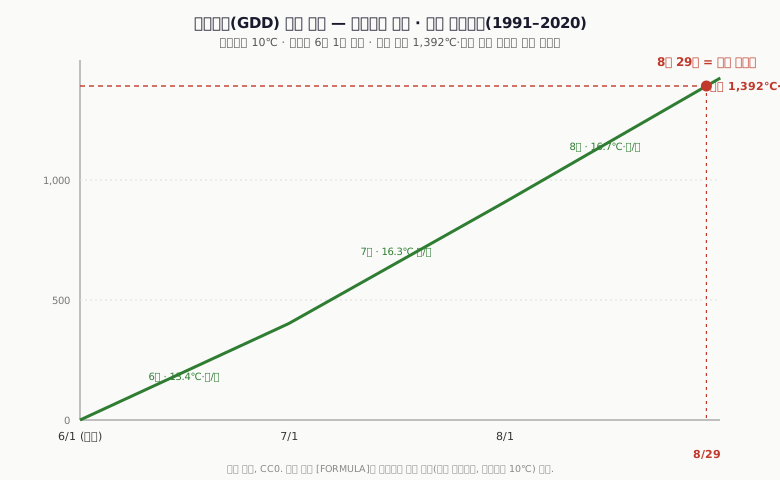
For Campbell Early (), starting from the June 1 bloom date, we compute the monthly daily-average GDD using Daegu’s normal temperatures.
We accumulate June (30 days) and July (31 days) first, in full-month blocks.
We back-solve the target GDD by plugging the literature’s “90-day maturation” figure into this temperature path. Accumulating through August 29 (the 90th day after bloom) gives:
We adopt this 1,392°C·days as Campbell Early’s target cumulative GDD () — in other words, a value this article derives by combining the conventional “90-day” figure with Daegu’s normal temperatures. It lines up with the direction we’d expect: Campbell Early’s season is commonly cited as mid-August through early September, meaning the calculation isn’t wildly out of step with common knowledge.
Step 2 — Plugging In the Sugar-Content (Brix) Saturation Curve
By definition, at the target date , , so the exponential term becomes and the saturation curve reaches about 95% of its maximum. Setting Campbell Early’s unripe-to-ripe range at and (an assumed upper bound — a bit of headroom above the “14 Brix or higher” shipping standard the trade commonly cites) gives:
That lands almost exactly on the trade’s commonly cited “14 Brix or higher” benchmark — not a coincidence, but a direct result of choosing to land in that range. Worth restating: this saturation curve isn’t a predictive model. It’s a qualitative approximation calibrated to reproduce a conventionally known endpoint.
Step 3 — Reversal #1: How Many Days Does 1°C Pull the Harvest Forward?
Let’s rerun the same calculation with +1°C added to Daegu’s normal temperatures across the board. That makes June 14.4, July 17.3, and August 17.7 °C·days/day.
The amount still needed to reach the 1,392°C·day target is °C·days. Dividing by August’s daily accumulation rate (17.7):
So the target is reached roughly 24 days after August 1 — August 24 (re-running day by day pins it down exactly to August 24, the 85th day after bloom). That’s 5 days earlier than the original normal-temperature scenario’s August 29 (day 90).
This direction matches what actual grape-harvest observation studies report about warming pulling harvests earlier. One summer that’s just 1 degree warmer than normal can move Campbell Early’s harvest date up by nearly a week. The season itself doesn’t shift wholesale — the cumulative total just crosses the threshold a few days sooner — but the felt change is not small.
Step 4 — The Rest: Same Method, Different Base Temperatures and Regions
Shine Muscat, nectarine, Baekdo peach, Satsuma mandarin, and Fuyu persimmon are all worked through exactly the same process as Steps 1–2 (accumulate monthly normal temperatures → back-solve target GDD → plug into the saturation curve). We only present the results table here, since the underlying logic is identical to Campbell Early’s. For persimmon, we substitute Daegu’s temperatures for the actual production hub (North Gyeongsang growing areas like Sangju) as a regional stand-in — the same simplification we made for the grapes (needs-assumption) — and back-solve the target date from a bloom date of 5/29 to 11/5, the start of the late-cultivar harvest window (late October to mid-November) that Nongsaro reports.[18] We don’t run the Brix saturation curve for persimmon this time, since we couldn’t confirm the curve constant or grading-standard range specific to the fruit — just the GDD figures and dates.
| Variety | Region · base temp | Bloom date | Target days-to-maturity | Target GDD (back-solved) | Predicted peak date | Predicted Brix |
|---|---|---|---|---|---|---|
| Campbell Early | Daegu · 10°C | 6/1 | 90 days (literature)[2] | 1,392°C·days | 8/29 | 14.7 |
| Shine Muscat | Daegu · 10°C | 6/1 | 120 days (literature)[4] | 1,764°C·days | 9/28 | 18.0 |
| Nectarine | Daegu · 7°C | 4/5 | 77 days (back-solved) | 917°C·days | 6/20 | 12.7 |
| Baekdo peach | Daegu · 7°C | 4/5 | 128 days (back-solved) | 1,876°C·days | 8/10 | 14.6 |
| Satsuma mandarin | Jeju · 12.8°C | 5/25 | 175 days (back-solved) | 1,670°C·days | 11/15 | 11.7 |
| Fuyu persimmon | Daegu (regional stand-in) · 10°C (provisional) | 5/29 | 160 days (back-solved) | 2,009°C·days | 11/5 | not calculated |
The interesting part is Satsuma mandarin’s November. Jeju’s November normal temperature is 13.3°C — only 0.5°C above the 12.8°C base temperature. That means November banks a daily GDD of just 0.5°C·days, about 1/27th to 1/29th of the midsummer rate (Jeju’s July at 13.4, August at 14.4 °C·days). The common notion that citrus “ripens slowly” isn’t a poetic exaggeration — it’s a literal description of the fact that the season’s temperature has dropped right to the base-temperature floor, effectively stalling the GDD clock.
Persimmon’s clock doesn’t just slow down — it stops outright. Daegu’s November normal temperature (9.4°C) sits below the 10°C base temperature this article provisionally adopted for persimmon. So November’s entire monthly GDD contribution is exactly zero, and the 2,009°C·day target in the table above is, in effect, identical to whatever had accumulated by October 31. Pure GDD accumulation, on its own, can’t explain Nongsaro’s own field record that Fuyu persimmon’s actual harvest window runs almost three weeks, from late October through mid-November.[18] Whatever keeps the fruit on the tree through that stretch is probably something other than heat — frost timing, sunlight, storage behavior are all plausible candidates — but nothing in the literature this article checked lets us quantify which one. So the calculator further down uses a simpler, more practical shortcut for every variety, persimmon included: instead of re-running the full GDD math, it just shifts each variety’s conventionally known season window by the measured temperature-deviation sensitivity.
Step 5 — Sugar-Acid Ratio: A Literature Value, Not a Calculation
The sugar-acid ratio (Brix divided by acid content — a measure of the balance between sweetness and tartness) is governed by a separate physiological process, organic acid breakdown, that GDD alone can’t quantitatively derive. Rather than build a derived formula, this article reports the literature value directly.
Jeju’s agricultural extension service publishes a worked example: a mandarin with 13.7 Brix and 1.19% acid content has a sugar-acid ratio of:
That source reports a 10–13:1 sugar-acid ratio as the range tasters find most balanced.[10][11] We couldn’t find comparably specific sugar-acid-ratio standards in the literature for grapes, peaches, or strawberries — only the qualitative trend that acid drops and sugar rises as ripening proceeds.[17] For those three varieties, this article explicitly leaves the sugar-acid ratio as “undetermined — insufficient literature.” Manufacturing evidence that doesn’t exist is worse than admitting we don’t know.
Step 6 — Reversal #2: The Sweetest Variety Isn’t the Best Value (And the Answer Flips Every Year)
The value score divides Brix by price per kg (in units of ₩1,000):
| Variety | Brix | Price (₩/kg) | Value (Brix per ₩1,000) |
|---|---|---|---|
| Baekdo peach | 14.6 | 2,462 | 5.93 |
| Nectarine | 12.7 | 2,909 | 4.37 |
| Shine Muscat (2025) | 18.0 | 6,650 | 2.71 |
| Campbell Early | 14.7 | 7,900 | 1.86 |
| Satsuma mandarin | 11.7 | 6,551 | 1.79 |
| Shine Muscat (2020) | 18.0 | 17,000 | 1.06 |
| Seolhyang strawberry | 11.5 (assumed) | 22,700 | 0.51 |
By sugar content alone, Shine Muscat (18.0) wins by a landslide. But its value ranking depends entirely on when you’re asking: calculated at its 2020 premium-era price, it drops to 5th place out of 6 — worth only about 57% of Campbell Early’s value score. Back then, Shine Muscat was a brand-new premium cultivar that sold for more than double today’s Campbell Early price.[14] (Caveat: this comparison holds Campbell Early’s price fixed at its 2025 level while only Shine Muscat’s price moves across eras — we couldn’t confirm what Campbell Early itself cost back in 2020. So this isn’t “what the two varieties actually cost side by side in 2020,” it’s a controlled comparison isolating how much the ranking shifts purely from Shine Muscat’s own price swing.)
But a surge in planted acreage through 2024–2025 tipped the market into oversupply, and Shine Muscat’s retail price crashed for three straight years.[14] Recalculated at October 2025 prices:
Same variety, same sugar content — but the value ranking jumped from 5th to 3rd, overtaking even Campbell Early. The GDD axis (sugar content) is set by a variety’s own physiology. The value axis (price) is set by that year’s planted acreage and supply. These two axes run on completely different clocks, and looking at only one of them can’t tell you the full story of what “in season” really means.
Meanwhile, there’s a winner that doesn’t budge at either point in time. Both nectarine and Baekdo peach hold the 1st- and 2nd-place value spots in 2020 and again in 2025.
Step 7 — Reversal #3: Nature’s Clock vs. the Greenhouse’s Clock — Seolhyang Strawberry
All six varieties covered so far (two grapes, two peaches, one citrus, one persimmon) grow in open fields. The tree or vine takes whatever weather that year hands it, and GDD is simply the record of that weather. Seolhyang strawberry is different. Most strawberries sold in Korea are grown under forced cultivation (a technique using heated, insulated greenhouses to pull the harvest earlier than the plant’s natural bloom timing would allow).[13]
Agricultural extension data shows Seolhyang is typically transplanted in mid-September, with the first harvest starting around mid-December.[13] Target management temperatures inside the greenhouse are reportedly about 25°C by day and 5–6°C by night.[13] Simplifying that into a single daily average:
If we assume a strawberry base temperature somewhere around 5°C — similar to the values commonly used for other Rosaceae fruits like apples and pears — the greenhouse’s daily GDD accumulation rate is:
What happens if we apply that same base temperature to an open field over the same period, using Seoul’s normal temperatures? November’s normal is 7.5°C, December’s is 0.2°C.
In an open field, the GDD clock effectively stops in December (temperatures drop below the base temperature, so the daily increment hits zero). But strawberries in the greenhouse keep banking 10.5°C·days every single day of that same December. A clock that nature would have stopped by now is instead being kept running by a boiler and a ventilation system.
This calculation is purely illustrative — the precise base temperature for strawberries, the target cumulative GDD, and the exact management-temperature profile all fall outside the literature this article was able to confirm (every figure here is an assumption or qualitative approximation). But the structure itself is clear. For the six open-field varieties, peak date hinges on “what the weather did that year.” Seolhyang’s peak date hinges far more on “what temperature the greenhouse operator dialed in.” Both use the same number — GDD — but who decides that number is a completely different story.
At Campbell Early’s (variety 1) default settings — 0°C temperature deviation, 90 days elapsed — the widget shows “Days remaining: 0 · Sugar content: 14.7 Brix,” matching the Step 1–2 calculation above exactly. Dial days elapsed down to 85 and, at normal temperatures (0°C deviation), there are still roughly 5 days remaining — but bump the temperature deviation to +1°C and that same 85th day already reads “Days remaining: 0.” That’s the 5-day pull-forward calculated in Step 3, reproduced right on the slider.
OUTPUT
At Daegu’s normal temperatures, Campbell Early grapes hit their target GDD of 1,392°C·days on day 90 after bloom — August 29 — with a projected sugar content of 14.7 Brix. Push the temperature just 1°C above normal and that date moves to roughly August 24, about 5 days earlier. A single degree of warming might sound trivial, but for an orchard, it means moving an entire shipping schedule up by nearly a week.
By sugar content alone, Shine Muscat is the runaway winner among all six varieties, at 18.0 Brix. But its value-for-money ranking gives opposite answers depending on when you ask. Back in 2020, when it was still a premium new cultivar, it ranked 5th of 6 — worth just 57% of Campbell Early’s value score. By 2025, with prices crashed from oversupply, it jumped to 3rd, overtaking Campbell Early. The conventional wisdom that “the sweetest variety can’t also be the best deal” needs a more precise rewrite: value for money isn’t set by sugar content at all — it’s set by that year’s harvest and supply. And through all of this churn, nectarine and Baekdo peach quietly hold onto 1st and 2nd place in value at both points in time, which makes it a little strange that nobody calls peaches the value champion of Korean fruit.
The deepest reversal comes second-to-last. For the six open-field varieties, nature runs the GDD clock — hot years pull the date forward, cold years push it back, and no one gets a vote. Seolhyang strawberry is different: a greenhouse operator runs that same clock with a boiler valve. GDD accumulation that would have stopped dead in December in the open field keeps climbing at 10.5°C·days a day inside the greenhouse. Half of what we call “in season” turns out to have less to do with the season than with wherever someone happened to set the thermostat dial.
Persimmon goes one step further. Under the base temperature this article provisionally adopted (10°C), Daegu’s November normal temperature (9.4°C) doesn’t even clear that floor, so the GDD clock stops completely. And yet Fuyu persimmon keeps getting harvested for nearly three weeks, from late October through mid-November. The fact that persimmon keeps ripening even after the heat has stopped counting is less a fun fact than an honest failure report on this article’s own calculation tool — it isn’t universal. Whatever the model can’t explain is better left written down as “we don’t know” than quietly papered over.
The value rankings were already calculated back in Step 6, so let’s put this second calculator to different work: a more practical question — “if I actually walk into a grocery store right now, what’s genuinely at peak season?” It loads the real sub-varieties sold on Korean shelves under five fruit families (grapes, strawberries, persimmons, citrus, peaches) and judges, for whatever month you pick, whether each one is just starting, at its peak, winding down, or plain out of season. The temperature-deviation slider applies the same “~5 days earlier per +1°C” sensitivity measured for Campbell Early grapes in Step 3 to every other variety as a flat approximation (needs-assumption) — actual sensitivity almost certainly varies by variety, but we couldn’t confirm individual figures, so one shared coefficient stands in for all of them. Wherever price or sugar-content literature came up empty — both persimmon sub-varieties, for instance — the card says so plainly instead of guessing.
This calculator’s season windows are built on Korea’s Northern-Hemisphere temperate climate — worth flagging explicitly for readers elsewhere. That’s why we added a hemisphere toggle: switch to “Southern Hemisphere” and the calendar shifts by exactly six months, so a variety that peaks in August–September on the Korean (Northern-Hemisphere) reading flips to a February–March peak south of the equator (which lines up with the real-world fact that Chile’s and Argentina’s grape harvests actually run roughly February through April). The temperature-deviation slider now also displays each category’s own growing-season normal temperature, so a number like “+1°C” comes with a sense of what temperature range it’s actually landing on — grapes (Daegu’s August–September normal, 24.4°C), peaches (Daegu’s June–August normal, 25.5°C), persimmons (Daegu’s October–November normal, 12.8°C), citrus (Jeju’s November–December normal, 10.9°C), and strawberries (average greenhouse management temperature, 15.5°C — these are greenhouse-grown, not open-field).[23]
At the defaults (Grapes category, this month, 0°C deviation), if it’s July when you’re reading this, Campbell Early, Kyoho, and Shine Muscat all read “Out of season,” each with a different days-to-peak figure showing underneath. Switch the category to “Citrus” and something interesting happens — even at the height of summer, only the greenhouse mandarin card lights up green. Contrary to the common assumption that open-field Satsuma mandarin defines citrus season, the variety actually in season at that point in the year is the greenhouse-grown one. Push the temperature deviation up to +3°C and Campbell Early flips forward to “Starting” — the direct result of applying the “roughly 5 days earlier per +1°C” sensitivity calculated in Step 3, scaled up five times. Switch the category to “Persimmons” and both cards carry a “data unconfirmed” note in their subtext — an honest admission that this article genuinely could not confirm persimmon’s GDD base temperature or price data, not something papered over.
Flip the hemisphere toggle to “Southern Hemisphere” while leaving the category on “Grapes,” and the verdict reverses completely — in August–September (the Northern-Hemisphere peak), all three cards flip to “Out of season,” while Campbell Early and Kyoho light up green instead, one after the other, in February–March. The season has simply been shifted by half a year; the calculation logic underneath hasn’t changed at all. Nudge the temperature-deviation slider now and you get more than just a number — it also shows what that deviation actually lands on, as in “growing-season average for grapes: ~24.4°C → 26.9°C.” A number like “+2.5°C” feels completely different depending on the category — set greenhouse strawberries’ management temperature (15.5°C) next to peaches’ midsummer normal (25.5°C) and the gap becomes obvious immediately.
References
[1]: Amerine, M.A.; Winkler, A.J., “Composition and quality of musts and wines of California grapes,” Hilgardia, 15(6), 493–673, 1944 — the original source for grape-growing heat-accumulation classification (the Winkler Index), establishing the 10°C base temperature. See also Wikipedia’s “Winkler index” entry for a summary. https://en.wikipedia.org/wiki/Winkler_index
[2]: Paper published via the Korea Citation Index (KCI), “Correlation Analysis Between Fruit Quality of the Grape Cultivar ‘Campbell Early’ and Climatic Factors” (translated from the Korean-language original), surveying 13 major production regions in southern Korea — bloom dates ranging May 25–June 7, minimum maturation period of 90 days (100–110 days in the Gangwon region). https://www.kci.go.kr/kciportal/ci/sereArticleSearch/ciSereArtiView.kci?sereArticleSearchBean.artiId=ART001570686
[3]: Farmers Newspaper (농민신문/Nongmin Ilbo), “Grape Region Magnifier” — reports Campbell Early accounts for roughly 70% of Korea’s total grape acreage, and that Shine Muscat’s growing season runs about a month longer than Campbell Early’s. https://www.nongmin.com/article/360244
[4]: Nongupin News (농업인신문), coverage of Shine Muscat cultivation — reports the variety reaches 18°Brix or higher around 120 days after full bloom. https://www.nongupin.co.kr/news/articleView.html?idxno=91269
[5]: Farmers Newspaper (농민신문), coverage of Shine Muscat shipping-grade standards — 18 Brix or higher qualifies as premium grade, 16 Brix or higher as first grade. https://www.nongmin.com/article/20200730325158
[6]: Wikipedia’s “Daegu” and “Jeju City” articles, climate data tables (citing the Korea Meteorological Administration’s 1991–2020 climate normals). Source data is also available via KMA’s Climate Data Open Portal. https://ko.wikipedia.org/wiki/대구광역시 , https://data.kma.go.kr/normals/table.do
[7]: Bielenberg, D.G.; Gasic, K., “Peach [Prunus persica (L.) Batsch] Cultivars Differ in Apparent Base Temperature and Growing Degree Hour Requirement for Floral Bud Break,” Frontiers in Plant Science, 13, 801606, 2022 — reports apparent base temperatures ranging −1.85 to 8.69°C across 52 peach cultivars. https://doi.org/10.3389/fpls.2022.801606
[8]: Garak Market auction prices (linked via the Agricultural Products Trading Information system, nongnet.or.kr) — Baekdo peach, 10kg premium grade, ₩12,961 (≈$9.39); nectarine, 5kg lower grade, ₩7,655 (≈$5.55) (observed June 2026). https://www.nongnet.or.kr/front/M000000260/micro/daily.do?itemCode=0604 — Representative harvest windows (nectarine mid-June to early July; Baekdo peach mid-to-late August in southern regions) cross-checked against Farmers Newspaper https://www.nongmin.com/news/NEWS/ECO/CMS/340269/view and the Seoul Milk blog http://www.seoulmilkblog.co.kr/archives/41359 .
[9]: New South Wales Department of Primary Industries (Australia), “Calculating heat units for citrus” — establishes 12.8°C (55°F) as the standard citrus base temperature. https://www.dpird.nsw.gov.au/agriculture/horticulture/citrus/content/crop-management/harvest-factsheets/calculating-heat-units (Some sources report 13°C instead — that figure is also needs-assumption; see the table above.)
[10]: Jeju Special Self-Governing Province Agricultural Research & Extension Services, sugar-acid ratio calculation and worked example for mandarin (13.7 Brix, 1.19% acid → sugar-acid ratio 11.5) and acidity grading standards. https://agri.jeju.go.kr/agri/communication/hardship.htm?act=view&seq=57038
[11]: Jejudomin Ilbo and inews24, coverage of mandarin sugar-content grading standards (extra-early season: 8 Brix+, regular season: 9 Brix+, greenhouse/winter-stored: 10 Brix+). https://www.jejudomin.co.kr/news/articleView.html?idxno=314013
[12]: Press coverage citing Jeju Agricultural Products Supply & Demand Management Center data — mandarin wholesale price trends (5kg basis), November 2024–January 2025; approximately ₩17,238/5kg (≈$12.49) in December 2024. https://jasdc.or.kr/tangerine/price/average/month.htm
[13]: Nongsaro (the Rural Development Administration’s agricultural technology portal) and Jeju Agricultural Technology Center, strawberry cultivation manual — Seolhyang transplant timing (mid-September), first harvest (mid-December), greenhouse management temperatures (approximately 25°C by day, 5–6°C by night). https://agri.jeju.go.kr/files/ebook/technology/2305023/e-book.html
[14]: Busan Ilbo, “Shine Muscat, once called the ‘Hermès of fruit,’ is now cheaper than Campbell Early and Kyoho” — reports an October 2025 retail price of about ₩13,300 (≈$9.64) for 2kg (Campbell Early: ₩15,800/2kg, ≈$11.45, matching the figures used in this article). https://www.busan.com/view/busan/view.php?code=2025111610342409583 — Note: this article only broadly reports early-2020s pricing as “₩30,000–50,000-range.” We cross-checked the specific October 2020 figure of about ₩34,000 (≈$28.81 at 2020’s ~₩1,180/USD average) against Nate News, “‘It used to cost over ₩30,000…’ Shine Muscat has become the cheapest grape” (reporting 2kg clusters selling for around ₩35,000 starting in 2020). https://news.nate.com/view/20251117n09648
[15]: Seoul Economic Daily, “These days, is a strawberry basket of 20 really ₩50,000?” — reports Seolhyang strawberry retail prices around ₩22,700/kg (≈$16.45) in winter 2025, up more than 13% year-over-year (due to delayed transplanting and reduced output from heat waves and heavy rain). https://www.sedaily.com/article/20005357
[16]: Ministry of Agriculture, Food and Rural Affairs (Korea), “Building an Efficient Distribution Structure to Form Reasonable Agricultural Prices” — states that “2020’s major agricultural-product distribution cost came to 47.5%” (broken down as 8.5% shipping, 10.8% wholesale, 28.2% retail margin, i.e., 18.1% profit + 29.4% direct cost + 12.0% indirect cost = 47.5%). https://mafra.go.kr/bbs/mafra/69/419515/artclView.do — (During pre-publication validation, we found an earlier Munhwa Ilbo link pointed to an unrelated 1999 article citing a different figure — a 1998 distribution margin of 52.2% — and replaced it with this primary government source.)
[17]: Rural Development Administration (Korea), “Guidelines for Optimal Peach Harvest Timing and Post-Harvest Management” — peach ripeness indicators (skin color change) and the tendency for acidity to decrease as ripening progresses. https://www.rda.go.kr/middlePopOpenPopNongsaroDBView.do?no=1178
[18]: Rural Development Administration (Korea), Nongsaro (agricultural technology portal), persimmon work-schedule guide — early cultivars (Seochon-josaeng) harvested mid-to-late September, mid-season cultivars (Sangseo-josaeng, Idu) early-to-late October, late cultivars (Fuyu, Charang) late October through mid-November. Also specifies the average temperature thresholds needed during ripening (15°C or higher in October, 9°C or higher in November). https://www.nongsaro.go.kr/portal/ps/psb/psbl/workScheduleDtl.ps?menuId=PS00087&cntntsNo=30656
[19]: Nongupin News (농업인신문), “Persimmon: In Search of New Cultivars” — results from a South Jeolla, Yeongam County cultivar comparison trial: several varieties (Danhong, All Flesh, Fantasy) reached full bloom around May 29, with the dominant Fuyu cultivar blooming roughly two days later. https://www.nongupin.co.kr/news/articleView.html?idxno=201806
[20]: Daebong persimmon (an astringent variety)'s harvest window (mid-October through late November) and its tendency to gain 2–3 Brix in sugar content after the first frost — we couldn’t confirm a primary government or academic source for this, so this article draws on multiple farm-information outlets instead (needs-assumption). Purunhaneul, “Daebong Persimmon Harvest Timing and How to Make Hongsi” https://furune.info/222 ; Berrykind, “Post-Harvest Ripening Tips for Daebong Persimmon” https://berrykind.co.kr/article/beka-zone/8/5738/ — Nongsaro (RDA’s technology portal) only covers astringent-persimmon storage techniques and doesn’t specify exact harvest dates. https://www.nongsaro.go.kr/portal/ps/psb/psbb/farmUseTechDtl.ps?menuId=PS00072&farmPrcuseSeqNo=100000152212
[21]: Farmers Newspaper (농민신문), “Citrus Season — How Do Hallabong, Cheonhyehyang, and Hwanggeumhyang Differ?” — reports shipping windows for Hallabong and Cheonhyehyang (Cheonhyehyang from late February; greenhouse mandarin from early summer). https://www.nongmin.com/article/20251202500355
[22]: Rural Development Administration (Korea), National Institute of Horticultural & Herbal Science, Fruit Growth & Quality Management System — confirms the system only provides GDD and weather data for five crops (apple, pear, peach, grape, citrus), with persimmon not among them. This is the basis for this article’s provisional borrowing of the grape base temperature (10°C) as a stand-in for persimmon. https://fruit.nihhs.go.kr/main/aws/accuTemp.do
[23]: The second calculator’s “growing-season normal temperature” figures were calculated directly from the same source as footnote [6] (the Korea Meteorological Administration’s 1991–2020 normals, data.kma.go.kr), using Daegu’s and Jeju’s monthly data — grapes (Daegu’s August–September average, (26.7+22.1)/2 = 24.4°C), peaches (Daegu’s June–August average, (23.4+26.3+26.7)/3 ≈ 25.5°C), persimmons (Daegu’s October–November average, (16.2+9.4)/2 = 12.8°C). Jeju’s December normal temperature isn’t in footnote [6]'s table, so we derived it separately — working backward from a Jejudomin Ilbo report citing “Jeju’s average temperature in December 2023 was 9.4°C, +1.0°C above the (1991–2020) normal,” we get a normal of 8.4°C, and averaging that with Jeju’s November normal (13.3°C) gives citrus (Jeju’s November–December average, 10.9°C). https://www.jejudomin.co.kr/news/articleView.html?idxno=221391 — Strawberries are greenhouse-grown rather than open-field, so instead we use 15.5°C, the straight average of footnote [13]'s greenhouse management temperatures (approximately 25°C by day, 5–6°C by night).