Let's Calc

Absurd questions, taken seriously.

How much energy does the rush-hour subway squeeze out of your ribcage? If a paycheck literally fell from the sky, how would the IRS classify it? Let's Calc runs everyday absurd questions through math, physics, economics, law, and statistics — and shows the working.

Explore by Category

Latest Calculations

How Much Would the Great Pyramid Cost to Build Today? Three Scenarios — and the Real Measure of Pharaonic Power

How Much Would the Great Pyramid Cost to Build Today? Three Scenarios — and the Real Measure of Pharaonic Power

Three parallel calculations on what the Great Pyramid would cost in today's money: modern heavy equipment runs ~$1.5B; ancient hand-quarrying at global construction wages runs ~$22B; the grain rations Khufu actually paid convert to as little as $253M. But how much he 'underpaid' swings from 1× to 87× depending on how you value ancient labor — and the figure that doesn't move is the real measure of his power: locking 2.75% of the workforce onto one building for a generation.

How Many Times Must You Use a Tote Bag to Break Even?

How Many Times Must You Use a Tote Bag to Break Even?

A cotton tote bag has a much larger production footprint than a plastic bag. The break-even point is 52–131 uses under GWP alone, or up to 7,100 uses if ozone depletion is factored in. Average real-world use? About 51 times. And individual savings amount to roughly one 89-billionth of the annual global production growth in carbon terms. Two reversals, one calculation.

If the Spanish Armada Had Dropped a Plastic Bottle, Would It Be Gone by Now?

If the Spanish Armada Had Dropped a Plastic Bottle, Would It Be Gone by Now?

A PET bottle tossed into the English Channel during the Spanish Armada (1588) would still be intact today — with 12 years left on the clock. PET takes roughly 450 years to degrade in marine conditions, and that timeline gets much worse in a landfill. We calculate polymer breakdown timelines, the cube-law fragmentation math that turns one bottle into 18 trillion particles, and why NOAA still can't give you a definitive answer.

Your One Ton of Plastic: How Much of Humanity's Plastic Is Actually Yours?

Your One Ton of Plastic: How Much of Humanity's Plastic Is Actually Yours?

Since 1950, humanity has produced roughly 8.3 billion tonnes of plastic. Split evenly by world population, that comes to over a tonne per person — yet only 9% was ever recycled, and 886 kg of your share is sitting in a landfill or the ocean right now. We run the numbers and show how much the recycling rate actually matters.

One Elephant's Worth: How Much Stool Does a Human Produce in a Lifetime?

One Elephant's Worth: How Much Stool Does a Human Produce in a Lifetime?

Over a lifetime, a human produces roughly 5,249 kg of stool — about the weight of an adult African elephant. We calculate what fraction of your daily calories exits unused, why a vegan diet scores 74% digestive efficiency while a low-fiber diet hits 93%, and what Kleiber's Law tells us about why mice produce more waste per kilogram than elephants.

What Happens When You Buy Every Lottery Combination? A Full Cost-Benefit Analysis

What Happens When You Buy Every Lottery Combination? A Full Cost-Benefit Analysis

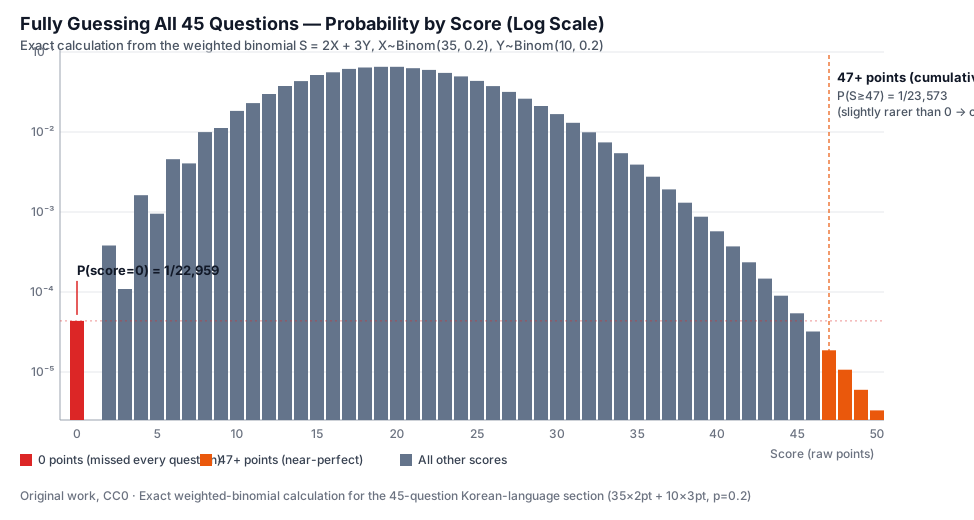
Buying all 8.1 million Korean Lotto combinations costs about ₩8.1 billion (~US$6.0M). Even winning the jackpot solo doesn't cover it in a typical draw. Buying half looks like a 50/50 coin flip — but the loss when you miss is 3× the gain when you hit. We work out exactly when it becomes theoretically profitable and how big a Powerball jackpot you'd need.

About Let's Calc

Let's Calc takes everyday absurd questions and oddball hypotheticals seriously. Each post draws on math, physics, economics, law, or statistics, and follows the signature [INPUT] / [FORMULA] / [OUTPUT] format — assumptions stated, working shown, punchline at the end.

Read more about us →