There is a question someone always asks in an architectural history class: “What would it cost to build that today?” The professor usually waves a hand and says “tens of billions, at least” before moving on. This article does not wave its hand. It runs three parallel calculations and gives you the actual numbers.
The Great Pyramid of Khufu — completed around 2560 BC — is the largest ancient structure ever built. Height: 146.5 m. Base: 230.4 m × 230.4 m. Total volume: roughly 2.58 million m³. It held the record as the tallest human-made structure on Earth for approximately 3,800 years, until the Eiffel Tower was erected in 1889.[1]
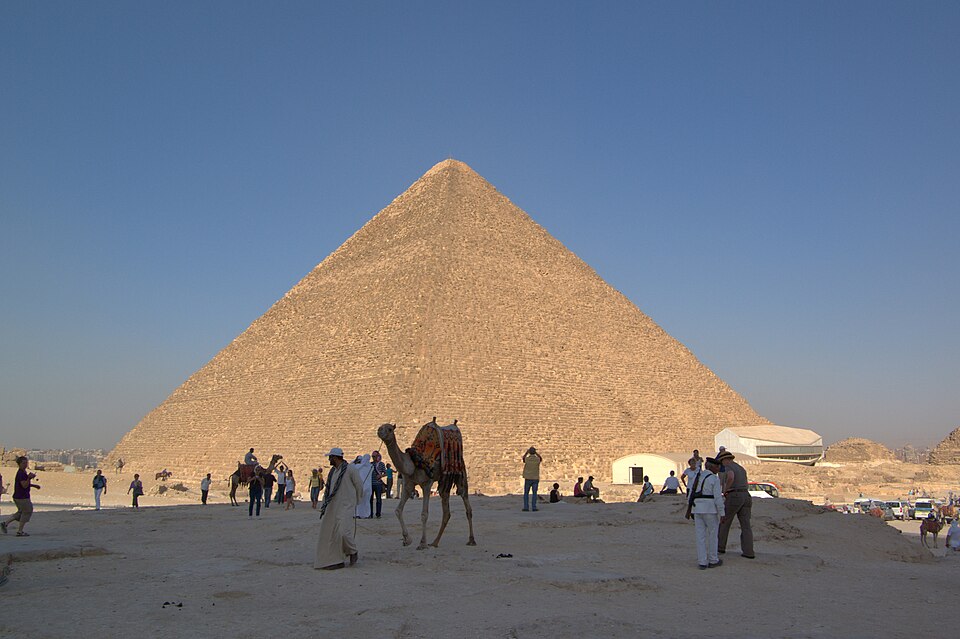

Three scenarios, run side by side:
- Scenario A: Modern heavy equipment, turnkey contract — the cheapest way to build it today
- Scenario B: Ancient methods replicated (hand-quarrying, sledge transport) + current global construction wages
- Scenario C: Authentic ancient conditions — corvée laborers paid only in grain rations
And lining those three numbers up reveals where pharaonic power actually lay.
INPUT
Physical Parameters of the Pyramid
Variable 1: Total volume
Based on archaeologist Mark Lehner’s field measurements, the total volume of the Great Pyramid is approximately 2.583 × 10⁶ m³, including internal passages, the burial chamber, and void spaces.[1]
Variable 2: Block count and average block mass
The Egyptian Supreme Council of Antiquities estimates approximately 2.3 million stone blocks.[1] Most were quarried on-site from local limestone; the average block mass is roughly 2.5 t.[2] Limestone density is approximately 2.3 t/m³; the granite used in the King’s Chamber and structural elements runs about 2.7 t/m³. Granite accounts for an estimated 1–2% of total volume.[2]
(Lehner gives total mass as approximately 5.9 × 10⁶ t, which reconciles with an average block mass of 2.565 t. This article uses 2.5 t for convenience.[1])
The granite used in the King’s Chamber was quarried at Aswan and transported approximately 800 km down the Nile by boat.[2] Because granite represents less than 2% of total volume, its freight premium adds less than 3% to total cost and is folded into the transport surcharge in Scenario A.
Scenario A — Modern Heavy-Equipment Turnkey Cost
Variable 3: Modern unit cost for stone construction
For large-scale stone structures using modern excavators, cranes, and blasting equipment, the direct unit cost for cut/quarried stone masonry runs roughly $300–600/m³ on global benchmarks (RS Means dimension-stone and heavy-masonry assemblies).[3] This article adopts a midpoint of $400/m³. Precision stonework or specialized equipment can push the figure higher.
Variable 4: Long-distance transport surcharge
Additional costs for raw-material logistics (granite shipment, site delivery) are assumed at 15% of direct cost.[3]
Variable 5: Indirect cost ratio
Site management, design, safety, and project supervision are estimated at 30% of direct cost, consistent with standard construction cost-accounting practice.[3]
Scenario B — Ancient Methods + Current Global Construction Wages
Variable 6: Workforce size
Excavations at the Giza plateau since the 1990s have uncovered a substantial workers’ village — bakeries, medical treatment records, and burial grounds.[4] Based on this physical evidence, Mark Lehner and Zahi Hawass estimate a permanent workforce of 20,000–25,000, with a rotational peak of up to 40,000 during the agricultural off-season when Nile flooding made farmwork impossible.[4] Herodotus’s figure of 100,000 is treated by modern archaeology as a rhetorical exaggeration.[1] This article uses the midpoint: 22,000 workers.
The workers’ village findings directly undercut the “slave labor” narrative that has persisted in popular imagination. The medical records document healed fractures and evidence of amputations that were performed and survived — care not typically extended to disposable workers. Beer and bread rations were logged. Workers received burial rites.[4] The academic consensus now describes the workforce as primarily corvée laborers (compulsory state service, structurally similar to a military draft) plus a core of skilled paid artisans. Scenario C’s comparison rests on the observation that the labor was compensated in kind (grain), not in a cash market wage — and that it was compulsory, not that the ration itself was meager.
Variable 7: Construction period
Lehner’s estimate is 20 years.[1] This is consistent with the average reign length of Old Kingdom pharaohs.
Variable 8: Working days per year
The standard for modern construction projects is 250 days/year (5-day work weeks, excluding public holidays and weather delays).[3] Direct comparison with ancient schedules is impossible, but this article uses it as a consistent baseline for cost comparison purposes.
Variable 9: Daily wage for a construction laborer
Per the US Bureau of Labor Statistics Occupational Employment Statistics (2024), construction laborers earn a mean wage of roughly $25/hour; at a fully-considered eight-hour day that is about $200/person-day.[5] This article adopts $200/person-day as a global-market construction labor rate. (Skilled stonemasons earn considerably more, which would only push the heritage-rebuild figure higher.)
Scenario C — Forced Corvée on Grain Rations
Variable 10: Daily grain ration per worker
The Reisner Papyrus, held at the Museum of Fine Arts Boston, records food disbursements to laborers during the Old Kingdom.[6] Lehner cites it to estimate a daily ration of approximately 10 kg of grain (a mixture of barley and emmer wheat) per worker.[1] This figure covers both the laborer’s own meals and a family subsistence allowance — effectively a wage paid in kind. It is a conservative midpoint estimate.
Variable 11: International wheat price
Based on FAO/USDA cereal price statistics (2024 annual average), international wheat futures traded at approximately $230/t.[7] This is used as a modern equivalent for the barley/emmer grain ration. Note that this is slightly elevated relative to the 2010s average (~$200/t), reflecting some post-2022 carry-through.
Power Index — Ancient Egyptian Population and Working-Age Population
Variable 12: Ancient Egyptian total population
Estimates for Egypt’s population around 2560 BC range from 1.5 million to 3 million.[8] This article uses a midpoint of 2 million. The uncertainty here is large enough that the calculator widget below lets you move the slider and see what happens.
Variable 13: Working-age population fraction
Given ancient Egypt’s low life expectancy at birth (roughly 25–35 years) and high infant mortality, the fraction of the population in the 15–60 working-age bracket was substantially lower than in modern societies. This article uses a midpoint estimate of 40%.[8]
FORMULA
Step 1: Establish pyramid scale
2.3 million blocks averaging 2.5 t each. Unit check:
Step 2: Scenario A — Modern heavy-equipment turnkey cost
Substituting:
Unit check:
This is a lower bound. Precision tolerances, the complex internal chamber architecture, and phased-opening costs would push the figure toward $2–6 billion. Adding 5–10 years of financing costs (interest, discount rate) lifts that another 20–40%. The $1.54B figure is firmly a floor.
How long would it take? People often assume “decades, even with modern technology” — but that just borrows the 20-year figure from the ancient hand-labor scenarios (B and C). By volume alone, modern civil engineering handles this scale in a few years. The Hoover Dam placed roughly 2.48 million m³ of concrete (almost exactly the Great Pyramid’s 2.58 million m³) in about two years of pours (five years total).[13] The pyramid isn’t a single pour, though — it requires precisely setting 2.3 million blocks one at a time, so 5–10 years is the more realistic logistics estimate. Either way, the modern timeline is a different order of magnitude from the ancient 20 years.
The workforce scales down too. Hoover Dam employed an average of about 3,500 workers (peak ~5,200).[13] Pencil the pyramid in at a similar ~5,000 workers × 7 years ≈ 35,000 person-years, and that’s roughly 1/12 of the ancient 440,000 person-years. That is the other face of the 14× cost gap: machines substitute for exactly that much labor. (In the calculator below, choosing “Modern technology” fixes the workforce and timeline to this modern crew — because modern construction is a question of equipment, not population mobilization.)
To put $1.54 billion in American terms: it is roughly the construction cost of a mid-sized NFL stadium (Mercedes-Benz Stadium in Atlanta came in at approximately $1.5B in 2016), or about one-third the cost of Allegiant Stadium in Las Vegas. The Great Pyramid would be an expensive project — but not one that would shock a modern infrastructure budget office.
Step 3: Scenario B — Person-years and global wage cost
A person-year is the unit of labor equivalent to one person working for one full year. Ten people working for five years equals 50 person-years.
Wage cost:
Scenario B is fourteen times more expensive than Scenario A. The reason is not subtle: modern heavy equipment exists precisely to substitute capital for labor. The ancient cost of moving stone was almost entirely the cost of human muscle-hours — not materials. Had ancient Egypt possessed tower cranes and hydraulic excavators, the pyramid would have been dramatically cheaper to build, not more expensive.
Step 4: Scenario C — Forced corvée at grain-ration cost
Total person-days are identical to Step 3.
Total grain required:
Unit check:
Converting to modern wheat price:
Step 5: How You Value the Wage — Anywhere from 1× to 87×
Here is the trap. How much the pharaoh “underpaid” his labor depends entirely on how you convert that 10 kg grain ration into today’s money — and the answer swings more than 80-fold.
Method 1 — wholesale commodity (lower bound): price the 10 kg at the international wheat futures rate, and the daily ration is worth $2.30. On that basis:
The pharaoh got the same labor for roughly 1/87th of its market wage cost.
Method 2 — standard of living (upper bound): but pharaonic Egypt was a pre-coinage grain economy, and 10 kg/day was a generous, household-supporting ration. Measured against the best-documented Egyptian wage records (the skilled artisans of Deir el-Medina), it sits at or above the skilled-worker level — a comfortably middle-tier living for its society. Price that living standard as a modern living wage and the worker’s compensation approaches what the same labor earns today (Scenario B). On that basis the ratio is about 1× — no “underpayment” at all.
Why the gulf? The 87× divides a modern wage (numerator) by a modern wheat price (denominator) — two different yardsticks. Value ancient labor at the price of today’s dirt-cheap grain and of course it looks like almost nothing.
So the “exploitation premium” lives somewhere between 1× and 87×, and the most dramatic figure is the least trustworthy. The real engine of pharaonic power was not a starvation wage — the workers were treated decently by the standards of their day — but the scale of compulsion we turn to next.
Step 6: Power Index — labor force capture rate
This figure is sensitive to the population estimate. At the low-end population (1.5 million): . At the high end (3 million): . The midpoint of 2.75% sits in the middle of that range. The widget slider below lets you explore the full span.[8]
What this number represents: the capacity to hold 2.75% of your entire country’s working-age population (range: 1.83–3.67%) committed to a single building project for a full generation — 20 years. This is a measure of power that requires no GDP figures and no monetary units to express.
Step 7: Megaproject comparison
The table below compares the pyramid against roughly comparable modern and historical projects on a person-years basis.
| Project | Cost | Est. person-years | Notes |
|---|---|---|---|
| Great Pyramid — Scenario B | $22.0B | 440,000 person-yr | Baseline (22,000 workers × 20 yr, continuous) |
| Apollo Program (1961–1973) | $25.4B (1973 USD)[9] | ~400,000 person-yr[9] | Peak single-year employment basis (1966: ~400,000 × 1 yr); cumulative basis: ~2 million person-yr† |
| Panama Canal (US construction, 1904–1914) | ~$11B (2024 USD)[10] | ~250,000 person-yr (est.)[10] | Closest labor-scale parallel — but every worker drew a wage |
| Channel Tunnel (1988–1994) | ~$21B (2024 USD)[11] | ~80,000 person-yr (est.)[11] | Cost-comparable modern megaproject |
| Burj Khalifa | $1.5B USD[12] | ~50,000 person-yr[12] | Modern supertall benchmark |
†The Apollo figure of “~400,000 person-years” in the table reflects peak single-year employment (approximately 400,000 workers in 1966, counted as one year). The pyramid’s 440,000 person-years is a continuous cumulative figure — 22,000 workers maintained for 20 years. These are different accounting methods. Calculated on the same cumulative basis — roughly 200,000 average workers over 10 years of peak effort — Apollo reaches approximately 2 million cumulative person-years.[9] Reading the table numbers alone as “pyramid ≈ Apollo” substantially underestimates what the Apollo program actually was.
The critical distinction: even adjusting for the person-year accounting mismatch, Apollo’s peak single-year capture rate against the 1960s US labor force (~72 million) was 0.56%. The pharaoh’s 2.75% (range: 1.83–3.67%) was several times more concentrated. And the US paid market wages. Comparing Apollo on the full cumulative 2-million person-year basis only reinforces the point: every one of those person-years was voluntary, contracted labor.
3-Scenario Summary
| Scenario | Cost (USD) | Duration | Key assumption |
|---|---|---|---|
| A. Modern heavy equipment, turnkey | $1.54B (upper: ~$6B) | 5–10 yr | $400/m³ unit cost |
| B. Heritage rebuild (ancient methods + global wages) | $22.0B | 20 yr | $200/person-day |
| C. Forced corvée (grain rations) | $253M | 20 yr | Wheat at $230/t |
| Wage-to-market ratio (B/C) | — | — | 1× – 87× (depends on valuation) |
OUTPUT
Three numbers, placed side by side, change the question you end up asking.
| Cost | |
|---|---|
| Rebuild with modern machinery | approx. $1.5B |
| Ancient methods, current global labor costs | approx. $22B |
| What Khufu paid in grain (wholesale wheat, lower bound) | approx. $253M |
Modern heavy equipment is fourteen times cheaper than ancient hand labor — that gap is exactly what machinery does: it substitutes capital for muscle.
So what is that $253M? It is not proof that Khufu paid a pittance. It is the grain ration priced at today’s dirt-cheap wheat — the lower bound. Value the same ration by the living standard it actually bought, and the worker’s pay climbs toward a modern wage while the “discount” shrinks from 87× toward 1×. In other words, how badly the pharaoh underpaid his labor depends on how we price ancient work — and the answer moves more than 80-fold.
What does not move is this: the capacity to lock 2.75% of an entire nation’s working-age population (range 1.83–3.67%) onto a single building for a full generation. Even the Apollo Program, at its single-year peak, mobilized only 0.56% of the US workforce — and every one of those workers signed a contract and drew a paycheck.
Pharaonic power was never about the discount. It was about the command — the ability to bind a nation’s labor to one monument for twenty years on nothing more than a royal order.
Scale that 2.75% labor-capture rate to the United States’ working-age population of roughly 210 million, and the equivalent is about 5.8 million people — comparable to the entire employed workforce of the greater Los Angeles metropolitan area. Locked onto one building, for one generation. That is the number worth holding in mind the next time you look at a photograph of Giza.
References
[1]: Lehner, M. (1997). The Complete Pyramids. Thames & Hudson. pp. 108–119. — Volume, block count, total mass, workforce, construction period baseline figures.
[2]: Arnold, D. (1991). Building in Egypt: Pharaonic Stone Masonry. Oxford University Press. — Stone sourcing, granite usage fraction, quarrying and transport methods, Aswan haul distance.
[3]: RS Means (2024). Building Construction Cost Data — dimension-stone and heavy-masonry assemblies. — Cut/quarried stone masonry unit cost roughly $300–600/m³; indirect cost ratio ~30%; 250 working-day-per-year standard (5-day weeks).
[4]: Hawass, Z. (2004). The Pyramid Builders: A Workforce in Harmony. AERA (Ancient Egypt Research Associates) excavation report. — Workers’ village remains, medical records, bread-and-beer ration logs, burial treatment.
[5]: U.S. Bureau of Labor Statistics (2024). Occupational Employment and Wage Statistics — Construction Laborers (47-2061). https://www.bls.gov/oes/current/oes472061.htm — Mean wage ~$25/hour; ~$200/person-day at a fully-considered eight-hour day.
[6]: Reisner Papyrus (Old Kingdom worker food-disbursement record). Collection of the Museum of Fine Arts Boston, accession numbers 11.1484–11.1486. Cited via Lehner (1997) p. 225. — Basis for grain ration estimate.
[7]: FAO / USDA (2024). Cereal Price Statistics — Wheat Monthly Average Price 2024. https://www.fao.org/worldfoodsituation/foodpricesindex/en/ — International wheat futures price $230/t.
[8]: McEvedy, C. & Jones, R. (1978). Atlas of World Population History. Penguin Books. / Butzer, K.W. (1976). Early Hydraulic Civilization in Egypt. University of Chicago Press. — Egypt population estimate 1.5–3 million at 2560 BC; working-age fraction 40%.
[9]: NASA (1973). Apollo Program Budget Summary. NASA Historical Reference Collection. / Bilstein, R. (1989). Stages to Saturn. NASA SP-4206. — Total Apollo budget $25.4B (1973 USD); peak employment approximately 400,000 (1966).
[10]: McCullough, D. (1977). The Path Between the Seas: The Creation of the Panama Canal, 1870–1914. Simon & Schuster. / Panama Canal Authority historical records. — US construction 1904–1914; cost ~$352M (1914) ≈ ~$11B in 2024 USD; peak workforce ~45,000. Person-years (~250,000) estimated from average employment over the decade; not an official cumulative figure.
[11]: Anguera, R. (2006). “The Channel Tunnel — an ex post economic evaluation.” Transportation Research Part A: Policy and Practice, 40(4). / Eurotunnel construction records. — Built 1988–1994; final cost ~£9–10B (≈ $21B in 2024 USD); peak workforce ~13,000. Person-years (~80,000) estimated from workforce over the build period.
[12]: Emaar Properties / Skidmore, Owings & Merrill (2010). Burj Khalifa Construction Facts. https://www.burjkhalifa.ae / SOM project page: https://www.som.com/projects/burj-khalifa/ — Construction cost approximately $1.5B USD; construction period 2004–2010 (6 years); peak workforce approximately 12,000.
[13]: U.S. Bureau of Reclamation. Hoover Dam: Frequently Asked Questions and Answers. https://www.usbr.gov/lc/hooverdam/faqs/concrete.html — Hoover Dam used roughly 3.3 million yd³ (~2.48 million m³) of concrete, poured 1933–1935, with total construction spanning 1931–1936; average employment ~3,500, peak ~5,200. Used here as a benchmark: modern technology completed a volume nearly identical to the Great Pyramid’s (2.58 million m³) in about two years of pours (five years total). The modern labor estimate in the text (~5,000 workers × 7 years ≈ 35,000 person-years) is an order-of-magnitude figure based on this case, not a precise value.