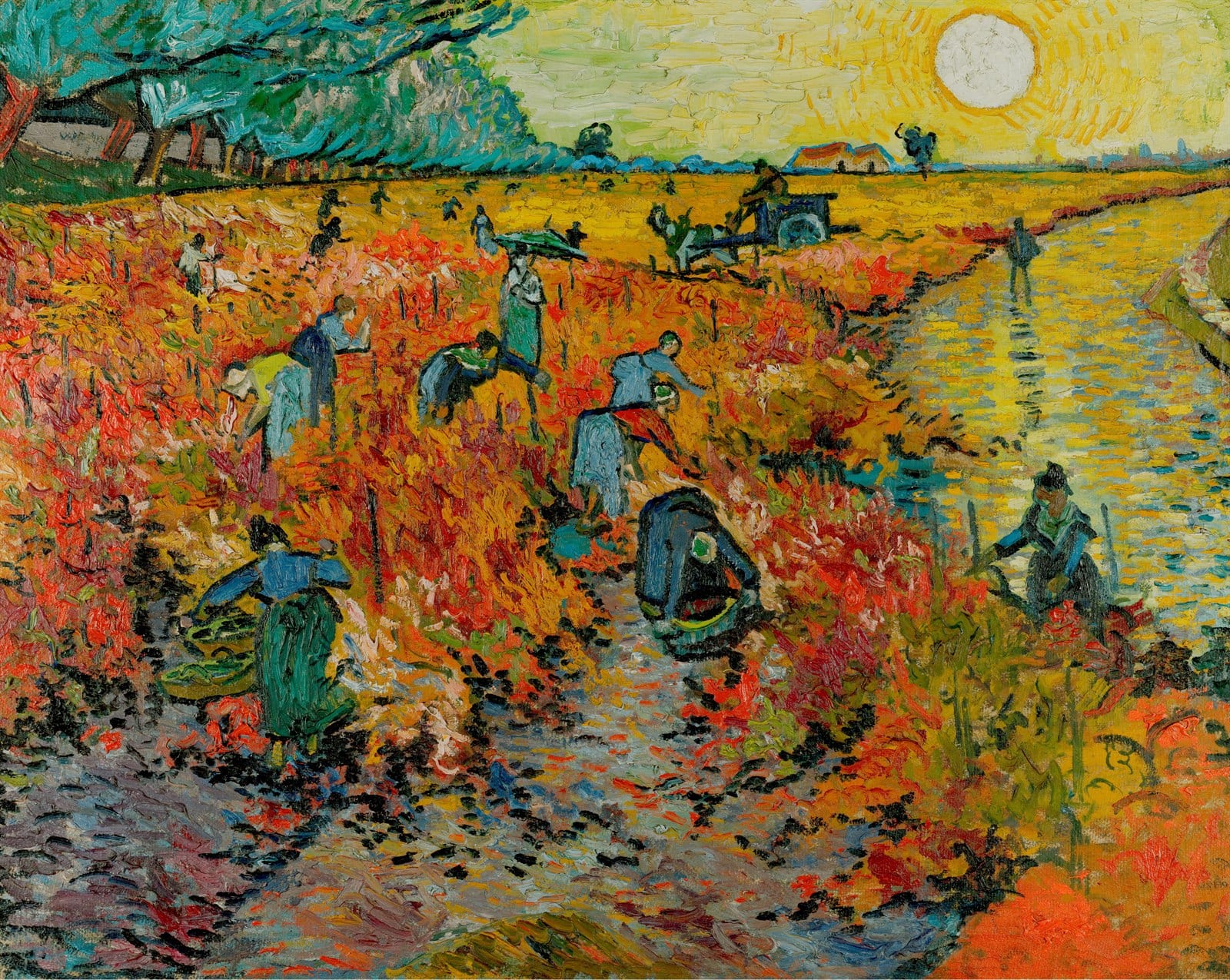
In February 1890, a Belgian painter named Anna Boch picked a canvas off the wall at an exhibition in Brussels. She paid 400 francs for it — roughly what ten moderately priced restaurant dinners would cost in Paris at the time.[1] The artist was Vincent van Gogh, and that transaction stands as the only confirmed sale of his work during his lifetime.
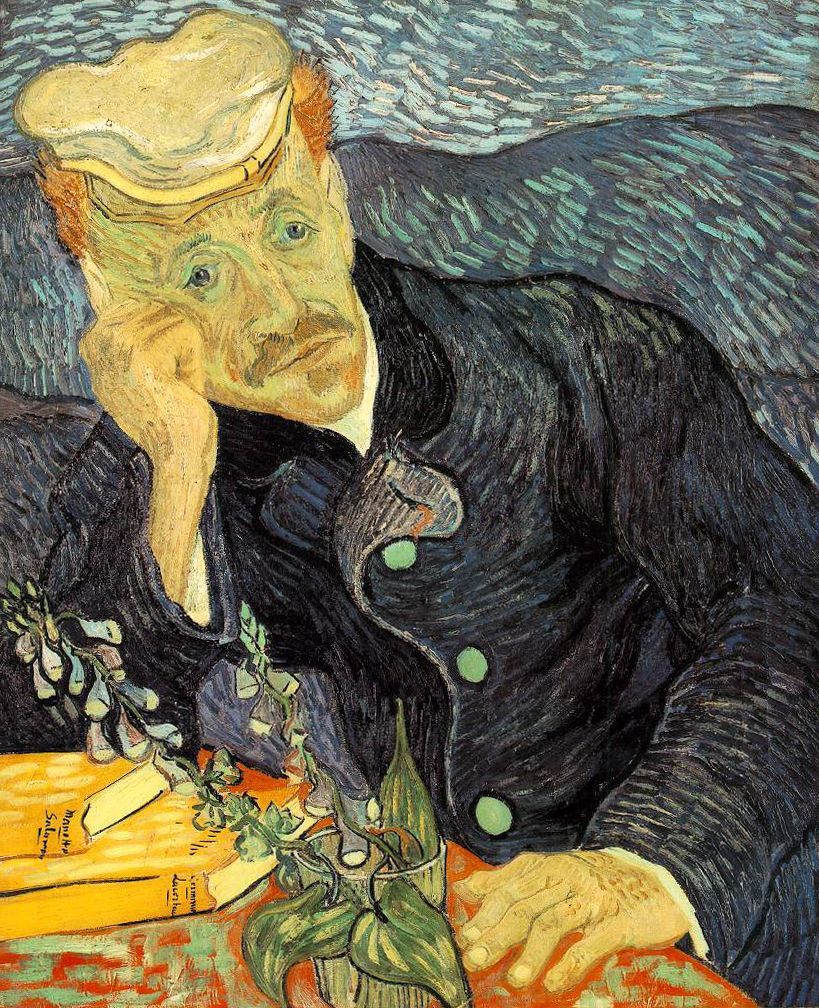
That July, van Gogh died. Exactly one hundred years later, in May 1990, another of his paintings came up at Christie’s in New York. Portrait of Dr. Gachet sold for $82,500,000 USD.[2] It was the highest price ever paid for a work of art at auction.
400 francs. $82.5 million. This article calculates how large that gap really is — and then immediately offers a counterexample: Picasso was already worth millions while he was still alive.
.jpg)
INPUT
Confirmed facts — sale prices and dates
Lifetime sale price
This figure is confirmed by the official records of the Van Gogh Museum (Amsterdam) and by van Gogh’s own letter to his brother Theo (#B17).[1] The buyer was Anna Boch, a fellow Impressionist painter and collector. What 400 francs actually meant in practical terms is the question this article sets out to answer.
Post-death auction price
Confirmed by Christie’s official lot record and Alan Riding’s New York Times report of May 16, 1990.[2][3] The buyer was Ryoei Saito, chairman of Daishowa Paper Manufacturing (Japan).
We use both the nominal (1990 USD) and real (2024 USD) figures for the auction price. According to the U.S. Bureau of Labor Statistics CPI-U annual average data, the inflation multiplier from 1990 to 2024 is approximately 2.40×.[4]
Conversion variables — three methods
Translating 400 francs into today’s money is not a single-answer problem. The right method depends on which question you’re asking.
| Method | Core question | Key variable | Reliability |
|---|---|---|---|
| A. Gold standard | What was the currency unit itself worth? | 1 franc = 0.2903 g gold (LMU rate)[5][6] | solid |
| B. CPI | How much did the same basket of goods cost? | France CPI 1890→2024 ≈ 50× [7] | needs-assumption |
| C. Wage-indexed | How many days of work did it represent? | 1890 French skilled wage ≈ 5 francs/day[8] | needs-assumption |
Method A (gold standard): The Latin Monetary Union (LMU, founded 1865) fixed 1 franc = 0.2903 g of fine gold.[5][6] The LBMA spot gold annual average for 2024 was approximately $2,300 USD per troy ounce.[9] The gold price is a slider in the interactive widget below.
Method B (CPI): Based on France’s INSEE long-run price index.[7] Between 1890 and 2024, the French franc passed through two World Wars, a 1960 currency reform (100 old francs = 1 new franc), and eventual conversion to the euro (1 EUR = 6.55957 FRF, fixed in 1999).[10] The estimated CPI multiplier across this complicated path is approximately 50×, but the uncertainty band is ±30% — the largest of the three methods. Method B consistently produces the lowest present-value estimate.
Method C (wage-indexed): Historical economic literature places the daily wage for skilled French laborers (masons, carpenters) in the late 19th century at 4–6 francs/day, with 5 francs/day as the central estimate.[8]
For US readers: the Bureau of Labor Statistics reports median hourly wages for construction trades in 2024 at approximately $34/hour, implying a skilled day-rate of roughly $272/day at eight hours (or $340+ for specialty trades such as electricians and carpenters). The calculation below uses ₩195,000/day — the South Korean Ministry of Employment and Labor’s 2024 benchmark for skilled construction day-laborers[11] — converted at USD/KRW ≈ 1,350, which gives ~$144/day. That lands toward the lower end of the US comparable range. Either way, the answer to “how many days did 400 francs represent?” is about 80, and the present-value window runs from roughly $11,500 to $27,000 depending on the wage benchmark.
FORMULA
Method A: Gold-standard conversion
Where:
- francs
- g/franc (LMU fixed rate)
- USD/troy oz
- g/troy oz (international standard)
Unit check: francs × (g/franc) × (USD/g) → USD
Substitution:
KRW equivalent (at USD/KRW = 1,350, as of 2024):
The counterintuitive result from Method A: Of the three methods, Method A produces a middle-range present value — yet it still comes out higher than the CPI estimate. Gold has appreciated far more than consumer prices over the 20th century. The first surprise this calculation serves up: valuing 400 francs in gold gives a higher present value than valuing it in purchasing power.
Method B: CPI conversion
Where:
- (France 1890→2024 price multiplier, estimated)
- (fixed franc-to-euro rate)[10]
- (2024 annual average EUR/USD)[16]
Unit check: francs × (dimensionless) ÷ (old francs/EUR) × (USD/EUR) → USD
Substitution:
KRW equivalent:
Limitations of Method B: The 50× multiplier draws on INSEE’s long-run price series, but how one handles the hyperinflation of the 1940s and the 1960 currency reform (100:1) pulls the estimate anywhere from 40× to 60×. Method B has the widest uncertainty of the three methods and consistently produces the lowest present value — which, paradoxically, makes the tragedy multiplier look the most dramatic.
Method C: Wage-indexed conversion
Step 1: How many days of work did 400 francs represent?
Step 2: Convert those working days into 2024 wages.
Using the Korean Ministry of Employment benchmark (₩195,000/day)[11]:
For reference using the U.S. BLS median construction skilled day-rate (~$272/day): 80 × $272 = ~$21,760. Either figure puts us in the range of five to eight months of a skilled tradesperson’s wages — meaningful money, not a fortune.
Note also that 400 francs was revenue, not profit. Van Gogh’s paints, canvas, and living expenses were funded by his brother Theo’s monthly allowances. The sale covered costs, at best.
Scenario comparison
| Conversion method | Present value of 400 fr. (USD) | KRW equivalent |
|---|---|---|
| A. Gold standard | ~$8,590 | ~₩11.6M |
| B. CPI | ~$3,293 | ~₩4.4M |
| C. Wage-indexed | ~$11,556 | ~₩15.6M |
The three methods disagree by a factor of 3.5×. That spread is itself the point. There is no single correct answer to “what was 400 francs worth today?”
The tragedy multiplier
The tragedy multiplier is the auction price divided by the present value of the lifetime sale price — expressing how many times over van Gogh’s work appreciated after his death.
Applying both the nominal ($82.5M, 1990 dollars) and real ($198M, 2024 dollars) auction price to each method:
Method C (wage-indexed, nominal):
Method B (CPI, nominal):
Method A (gold standard, nominal):
Full tragedy multiplier table:
| Method | Present value | Multiplier (nominal $82.5M) | Multiplier (real $198M) |
|---|---|---|---|
| A. Gold standard | $8,590 | 9,608× | 23,060× |
| B. CPI | $3,293 | 25,054× | 60,130× |
| C. Wage-indexed | $11,556 | 7,139× | 17,134× |
Regardless of method, the range is 7,100× to 60,000×.
Van Gogh was not alone
His tragedy multiplier is unusually large because he sold exactly one painting — not because he was the only master to sell for a pittance.
- Amedeo Modigliani traded canvases for the price of a drink or a meal and died in poverty in 1920. His Nu couché sold for $170.4 million at Christie’s in 2015.[17]
- Paul Gauguin abandoned a stockbroking career for art, lived in debt, and died ill on the Marquesas Islands in 1903. His Nafea Faa Ipoipo (When Will You Marry?) reportedly changed hands for roughly $200+ million in 2015 (reported figures vary).[18]
- Johannes Vermeer died bankrupt in 1675, leaving his widow with eleven children and heavy debts, and was then forgotten for nearly 200 years. His ~34 surviving works almost never reach the market — they are effectively beyond pricing.[19]
What they share is that their lifetime prices were so low that precise records barely exist. Van Gogh is not the exception to this pattern — he is its most extreme peak.
Counterexample: what did Picasso and Hirst earn while alive?
A quick check against the “starving artist” narrative.
Picasso (1881–1973)
Van Gogh died in 1890, when Picasso was nine years old. They did not compete in the same art market — this is a generation gap, not a contemporary rivalry. At Picasso’s death in April 1973, his estate was estimated at approximately $750 million (1973 dollars).[12] Works, cash, real estate, ceramics — all included. He was the most expensive living artist in the world and, by all accounts, knew it.
Damien Hirst (1965– )
Hirst is the structural inversion of van Gogh’s trajectory. In September 2008 — the very week Lehman Brothers filed for bankruptcy — he held a solo live auction at Sotheby’s London titled “Beautiful Inside My Head Forever.” Total hammer: £111.5 million (~$200M+).[13] He was alive. It took two days. His estimated net worth in 2024 is approximately $384 million.[14]
Salvador Dalí (1904–1989)
Dalí personally designed and operated the Teatre-Museu Dalí in Figueres during his lifetime. His estate at death was estimated at approximately $325 million, though this figure includes assets transferred to the Gala-Salvador Dalí Foundation and carries significant variance across sources.[15] Treated here as a supporting data point.
| Artist | Death / reference year | Estimated lifetime wealth | Notes |
|---|---|---|---|
| Van Gogh | 1890 | ≈ $0 | 1 painting sold, 400 francs |
| Picasso | 1973 | ~$750M | estate at death[12] |
| Dalí | 1989 | ~$325M | estimated, incl. foundation assets[15] |
| Hirst | 2024 (living) | ~$384M | estimated net worth[14] |
The “starving artist” archetype generalizes from a handful of tragedies — van Gogh, Modigliani — to an entire profession. Picasso and Hirst are the numerical counterargument.
OUTPUT

Summary of all three methods:
| Method | Lifetime present value | Tragedy multiplier (nominal) | Tragedy multiplier (real) |
|---|---|---|---|
| A. Gold standard | ~$8,590 / ~₩11.6M | 9,608× | 23,060× |
| B. CPI | ~$3,293 / ~₩4.4M | 25,054× | 60,130× |
| C. Wage-indexed | ~$11,556 / ~₩15.6M | 7,139× | 17,134× |
Depending on the conversion method, 400 francs was worth somewhere between $3,300 and $11,600 in today’s money. The tragedy multiplier spans 7,100× to 60,000×. The fact that these numbers cannot be pinned to a single value is, arguably, the most precise conclusion this calculation can offer.
One more thing worth sitting with. Method A (gold standard) returns a higher present value than Method B (CPI). Gold has simply appreciated far more than consumer prices over the 20th century — meaning that 400 francs, measured in gold, is more valuable today than 400 francs measured in purchasing power. The answer to “how poor was he?” changes depending on what unit of poverty you choose.
Picasso, Dalí, and Hirst demonstrate the other direction. “Artists are poor” takes a few extreme tragedies — van Gogh and Modigliani among them — and mistakes them for a professional baseline. The world’s most famous artists are a terrible statistical sample from which to generalize. Van Gogh was an exceptional tragedy — not a representative outcome.
The distance between a 400-franc canvas and an $82.5-million gavel cannot be precisely measured. That turns out to be the most honest number in this calculation.
References
[1]: Van Gogh Museum (Amsterdam). “The Red Vineyard.” Collection Online. https://www.vangoghmuseum.nl/en/collection/s0050V1962 — Sale record for The Red Vineyard: buyer Anna Boch, price 400 francs, Les XX exhibition, Brussels, February 1890.
[2]: Christie’s. “Vincent van Gogh, Portrait of Dr. Gachet.” Auction Lot Record, Sale 7172, May 15, 1990. https://www.christies.com — Hammer price $82,500,000; buyer Ryoei Saito (chairman, Daishowa Paper Manufacturing).
[3]: Riding, Alan. “Japan Buyer Pays $82.5 Million for a Van Gogh.” The New York Times, May 16, 1990. https://www.nytimes.com/1990/05/16/arts/japan-buyer-pays-82.5-million-for-a-van-gogh.html — News report on the auction; record price at the time.
[4]: U.S. Bureau of Labor Statistics (BLS). “CPI-U, All Urban Consumers, Not Seasonally Adjusted.” https://www.bls.gov/cpi/data.htm — Annual average CPI-U: 130.7 (1990), 313.7 (2024), multiplier 2.40×. Applied to compute the real auction price of $198M.
[5]: Flandreau, Marc. (2000). The Glitter of Gold: France, Bimetallism, and the Emergence of the International Gold Standard, 1848–1873. Oxford University Press. — LMU gold content standard: 1 franc = 0.2903 g fine gold.
[6]: Convention monétaire entre la France, la Belgique, l’Italie et la Suisse, 23 Décembre 1865 (founding treaty of the Latin Monetary Union). — Specifies 1 franc = 0.2903 g fine gold. Original held at the Archives nationales (France).
[7]: INSEE. “Indices des prix à la consommation, séries longues 1914–2024.” Institut national de la statistique et des études économiques. https://www.insee.fr — French long-run price index. The 1890→2024 multiplier of ~50× is cross-checked against the Maddison Project Database. Uncertainty band ±30% due to wartime hyperinflation and the 1960 currency reform (100:1).
[8]: Labrousse, Ernest et al. (1976–1982). Histoire économique et sociale de la France, Tome III–IV. Presses Universitaires de France. — Daily wages for skilled French workers (masons, carpenters, printers) in the 1880–1900 period: 4–6 francs/day. Central estimate: 5 francs/day.
[9]: London Bullion Market Association (LBMA). “Gold Price, Annual Statistics 2024.” https://www.lbma.org.uk/prices-and-data/precious-metal-prices — 2024 annual average gold spot price: ~$2,300 USD/troy oz.
[10]: European Central Bank. “Fixed Conversion Rates between the euro and the currencies of the Member States adopting the euro.” https://www.ecb.europa.eu — Euro introduction (1999) fixed rate: 1 EUR = 6.55957 FRF. The French franc ceased to be legal tender thereafter.
[11]: Ministry of Employment and Labor, Republic of Korea (2023). Survey on Wage Conditions by Occupation. Based on Korea Federation of Construction Contractors wage survey. — 2024 standard daily rate for skilled construction day-laborers: ₩195,000/day.
[12]: Reif, Rita. “Picasso Left Estate of About $750-Million.” The New York Times, April 9, 1973. https://www.nytimes.com — Estate estimate reported shortly after Picasso’s death (April 8, 1973). Includes works, cash, real estate, ceramics; figures in 1973 dollars.
[13]: Vogel, Carol. “Hirst Works Sell for $200 Million in Auction.” The New York Times, September 16, 2008. https://www.nytimes.com/2008/09/17/arts/design/17hirst.html — Sotheby’s “Beautiful Inside My Head Forever” live solo auction, September 2008. Total: £111.5M (~$200M+).
[14]: Forbes (2024). “Damien Hirst Net Worth.” https://www.forbes.com — Estimated net worth ~$384M (2024).
[15]: Fundació Gala-Salvador Dalí. Annual Report / Estate Records. https://www.salvador-dali.org — Estate estimate at Dalí’s death (January 23, 1989): ~$325M. Includes Teatre-Museu Dalí and foundation assets; figures vary across sources. Used here as a supporting data point only.
[16]: European Central Bank. “Euro foreign exchange reference rates — US dollar (USD).” https://www.ecb.europa.eu/stats/policy_and_exchange_rates/euro_reference_exchange_rates/html/eurofxref-graph-usd.en.html — 2024 annual average EUR/USD: ~1.08. Applied in Method B for euro-to-dollar conversion.
[17]: Christie’s. “Amedeo Modigliani, Nu couché.” Sale “The Artist’s Muse: A Curated Evening Sale,” New York, November 9, 2015, Lot 8A. https://www.christies.com — Price realized $170,405,000 (incl. premium); buyer Liu Yiqian. Modigliani’s habit of selling work for trivial sums during his lifetime is documented across multiple biographies.
[18]: When Will You Marry? (Nafea Faa Ipoipo, 1892), Paul Gauguin. Reportedly sold by the Staechelin family to Qatari buyers in 2015. Initially reported at ~$300M; 2017 testimony in a Basel court revised the figure to ~$210M — sources vary, hence “~$200+ million.” Sources: Gerlis, Melanie, “The $300m Gauguin?” The Art Newspaper, 2015; Reuters, “Gauguin sale price dispute,” 2017.
[19]: Montias, John Michael. (1989). Vermeer and His Milieu: A Web of Social History. Princeton University Press. — Records of Vermeer’s bankrupt estate at his death (1675) and his widow Catharina Bolnes’s debts. His 19th-century rediscovery by Théophile Thoré-Bürger and the count of ~34 surviving works are cross-checked against Rijksmuseum and National Gallery holdings.