Sunday evening, and a friend is soaking laundry in a basin in her studio-apartment bathroom. “I heard one machine cycle burns through 100 L of water. Isn’t this the frugal way?” She may be right. But nobody in this conversation has mentioned the dryer. A front-loading washer uses about 0.017 kWh of electricity to wash 1 kg (2.2 lb) of laundry. Drying that same 1 kg in a heat-pump dryer (one that recycles the heat of its hot air) takes about 0.15 kWh. The drying costs roughly nine times as much as the washing.
So the star of this article is not washing at all, but drying and travel. I compare a front-loading drum washer, a top-loading washer, hand-washing in a basin, and a self-service laundromat per kilogram of dry laundry, in water, energy, carbon and cost. There is also a calculator so you can change the conditions yourself.
INPUT
The unit of comparison and four methods
More laundry means more water and more electricity, so I fix one yardstick first: 1 kg (2.2 lb) of laundry, measured dry. Washer capacity ratings (in kg) are also dry weights, so the two line up. The four contestants are the front-loading drum washer (door on the front), the top-loader (clothes go in from the top; in Korea, “ordinary washer”), hand-washing, meaning scrubbing and rinsing in a basin, and the self-service laundromat, where you rent a large commercial machine. The laundromat adds a trip from home and back. The conditions are the load per cycle, the wash temperature (cold or 40°C), the drying method (air-drying, heat pump or electric-heater dryer), and the round-trip distance to the laundromat. Laundromat dryers are treated separately, gas versus electric.
Water and electricity of a washing machine
A half-empty machine uses almost the same water per cycle as a full one, so how full you load it largely decides the water per kilogram. The per-kg figure is therefore “consumption per cycle ÷ load.”
The closest real measurement is a 2020 test of five drum washers by the Korea Consumer Agency (a government-affiliated consumer-testing body). On the cold-water standard cycle, power was 66 to 120 Wh and water 73 to 88 L. On the 40°C standard cycle, power was 224 to 626 Wh and water 73 to 105 L.[1] The press coverage does not give the laundry weight, so I read it as a test with a large (21 kg, about 46 lb class) machine filled to capacity. This is an assumption.
Using that assumption, I built the water per cycle (L) as a function of the laundry mass (kg). For the drum it is , and for the top-loader . At 21 kg the drum comes to about 90 L, inside the measured range (73 to 105 L). No public measurement exists for the top-loader, so it is an author’s assumption, checked two ways. First, it does not exceed the top water limit for grade 1 in a draft government notice (18 L/kg for top-loaders of 13 to 25 kg, 10 L/kg for drums of 8 to 13 kg, and so on).[2] Second, it is more optimistic than the literature’s Korean washer average of about 35 L/kg; my model gives 17 L/kg for a 6 kg top-loader.[3]
For electricity I use 0.10 kWh per cold-water cycle, roughly the middle of the Consumer Agency’s cold-water measurements.[1] The test inlet water temperature is specified as (20±2)°C,[2] and winter tap water is colder than that.
Wash temperature: which water gets heated
How much water you heat changes the carbon a lot, so the rule comes first. In all four methods, only the “main wash” water is heated from 20°C to 40°C. Rinse water stays cold. The volume heated differs by method, but the rule is the same.
- Washing machine: the 40°C cycle uses 0.25 kWh more electricity per cycle than the cold cycle. The differences computed from the Consumer Agency measurements range from 0.10 to 0.56 kWh, and 0.25 is my pick from within that range.[1] It equals the energy to warm about 10.7 L of water by 20 K (warming 1 L by 20 K takes 0.0233 kWh). For fairness, the same value is used for top-loaders, which have no heater.
- Hand-washing: I assume the basin is filled three times (one main wash, two rinses). Only the main wash is heated, so one third of the water, using gas-boiler hot water.
- Laundromat: the same 0.25 kWh per cycle (electricity) as the washer is added. It is not used in the base case.
The case where rinse water is heated too is worked out separately in [FORMULA].
Hand-washing water: no one has measured it
Hand-washing water decides the water contest with the machine, and it is the weakest variable in this article. A study of six hand-washing households in Manila, Philippines, reports that “hand-washing used the least water on average.” But the sample is six households, and the laundry weight was estimated by respondents. The authors themselves flag large uncertainty, and the per-kg figures appear only in a chart that I could not read.[3] I found no study that measured hand-washing in Korean homes.
So I compute it from basin volume × number of fills ÷ laundry washed per batch.
is the basin volume (L), the number of rinses, and the laundry washed per basin batch (kg). The central values are L, , kg, giving L/kg. An 8 L basin with one rinse and 2 kg gives 8 L/kg; a 12 L basin with three rinses and 1.2 kg gives 40 L/kg. This range is an assumption, not a measurement.
Spin-dry and residual moisture
How much water the dryer must evaporate depends on how well the laundry was spun out. Let be the weight of water left in the laundry after spinning divided by the dry weight. means 0.5 kg of water remains per kg of dry laundry. Korean washer test reports have a “spin-dry” line item,[2] but I found no public figures. Every value below is an author’s assumption.
| Method | Residual water ratio |
|---|---|
| Drum | 0.50 |
| Top-loader | 0.60 |
| Hand-wrung | 0.90 |
| Laundromat (commercial) | 0.45 |
Drying: three heat sources
Drying is the largest item here, so I go through the assumptions one by one. Drying energy is “mass of water to evaporate × energy to evaporate 1 kg of water.” Call the second factor . The theoretical value is about 0.627 kWh/kg (2,257 kJ/kg),[4] and real machines use more. A heat-pump dryer recycles heat from the hot air, while an electric-heater dryer warms air with a heating element, uses it once and vents it. (In US terms, the electric-heater type is the familiar vented electric-resistance dryer.)
| Type | (kWh/kg of water) | Converted at (kWh per kg dry laundry) | Basis |
|---|---|---|---|
| Heat pump | 0.30 | 0.18 | Korean product 147.5 Wh/kg; European label sheets 187 to 238 Wh/kg[5][7] |
| Electric heater | 1.4 | 0.84 | Australian minimum-efficiency limit 1.36; measured electric heating 1.847[6][8] |
| Gas (laundromat) | 1.5 (+0.03 kWh/kg blower electricity) | 0.90 | Author’s assumption |
| Air-drying | 0 | 0 | Laundry in the sun |
Heat pumps vary by product: 0.15 to 0.24 kWh per kg of dry laundry (converted at r=0.6), with 0.18 as the center. A Samsung 20 kg dryer is rated at 147.5 Wh/kg,[5] and heat-pump dryers on European label sheets use 0.187 to 0.238 kWh/kg at full load.[7] I could not confirm whether the starting moisture of the test laundry is the same across those figures.
For the electric-heater type I found no Korean specifications and used foreign sources. Australia caps energy at 1.36 kWh per kg of water evaporated, and the policy summary calls this a “relatively weak requirement.”[6] The bibliographic record of one experimental paper cites 1.847 kWh/kg for electric heating.[8] The center is 1.4.
Gas drying is considered for laundromats only. Household gas dryers are rare in Korean homes and I found no reliable measurements, so they are left out. For laundromat gas drying I assumed a thermal efficiency of about 42% (0.627÷1.5). No Korean measurement exists.
The self-service laundromat
A laundromat’s per-kg figures depend on how much you carry in at once. I set that load to = 10 kg (about 22 lb). Water is (L per cycle), wash electricity is 0.02 kWh/kg, and spin-dry is . All of these are assumptions, because I found no measurements from Korean stores. Manila laundromats are cited at 19 to 26 L/kg and Australian commercial washing at 9 to 27 L/kg,[3] so my 10 L/kg is on the low side. Even at 20 L/kg, though, carbon would rise by only 2 g.
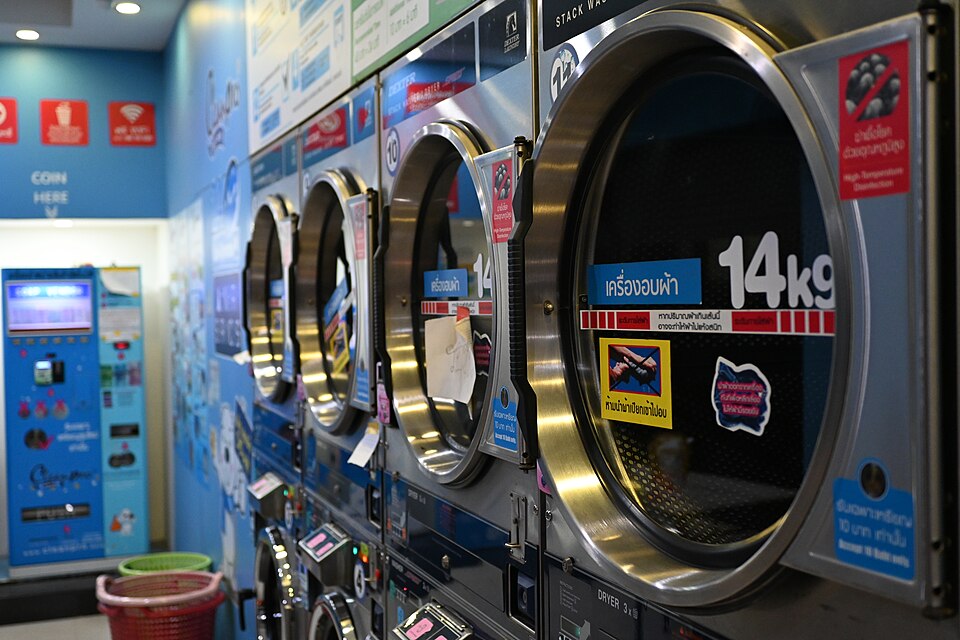

I could not confirm any Korean laundromat’s full price list or its dryer heat source. The only certain point is that stores differ. As one store’s example, the listing for Laundry24 Jongno (a store page on Daangn, a Korean neighborhood marketplace app, registered January 2024) shows large-machine washing at 5,000 to 6,000 KRW and large-machine drying from 5,000 KRW (32 minutes base, 500 KRW per extra 4 minutes).[9] Following that example, I fixed the price at 5,000 KRW wash + 5,000 KRW dry (10,000 KRW in total, about 7 USD at 1,400 KRW per dollar). The robustness check below tests whether the conclusion survives at half that price. Neither the store page nor the chain’s own description (“55°C hot air,” “about 1 hour”) states the dryer’s heat source.[10] So I take gas as the default and show electric alongside. I assumed there are no heat-pump dryers.
Travel
The round trip from home to the laundromat is the item that decides the carbon contest. Round-trip distance (km) is multiplied by 190 g/km for a passenger car. The 190 g/km is my conversion: about 2.3 kgCO₂/L of gasoline divided by a fuel economy of 12 km/L (about 28 mpg, or about 306 g/mi), and the fuel economy is an assumption.[11] For fuel cost I take the national average gasoline price from Opinet, the Korean state oil company’s price site: 1,855.66 KRW/L on October 27, 2026 (about $1.33/L, or about $5.02 per US gallon), divided by 12 km/L gives 154.6 KRW/km, rounded to 155 KRW/km (about $0.11/km, or $0.18 per mile).[12] Walking is zero. Parking fees, tolls and time are not counted.
Unit prices and emission factors
Costs and carbon are converted with the values below. These are the same values as in the dishwasher article, rechecked at publication.
| Item | Value | Note |
|---|---|---|
| Electricity emission factor | 0.4173 kgCO₂e/kWh | Finalized value for 2023[13] |
| City-gas emission factor | 0.2020 kgCO₂/kWh (heat) | 56.1 kg/GJ × 0.0036 GJ/kWh[14][19] |
| Electricity price | 260 KRW/kWh (≈ $0.19) | Estimated tier-2 marginal rate. Q4 2026 rates frozen, fuel-cost adjustment of +5 KRW kept[15] |
| City gas | 89.2 KRW/kWh (heat) (≈ $0.064) | Residential 22.5268 KRW/MJ (Oct 1, 2026 table) × 1.1 (VAT assumed) × 3.6[16] |
| Water and sewer | 0.99 KRW/L (≈ $0.0007) | Water 580 + sewer 410 KRW/m³[17] |
| Water supply and treatment electricity | 0.0005 kWh/L | Author’s estimate[18] |
| Specific heat of water | 4.186 kJ/(kg·K) | 1 L is treated as 1 kg[4] |
Currency note: all dollar figures in this article use an assumed rate of about 1,400 KRW per US dollar (October 2026) and are rounded. Korean prices are kept in won because they drive the calculation.
The gas tariff table does not say whether VAT is included, so adding 10% is an assumption.[16] That heating water takes far more energy than supplying it was already worked out in the dishwasher article. Detergent, the purchase price and manufacturing carbon of machines, clothing wear and time are left out. Bulky items such as comforters do not fit a per-kg basis.
A note for readers outside Korea
Korean prices and the Korean grid are the backbone of this calculation, so I kept them, but a few Korean specifics change how you should read the results. First, the drying rows. The “electric heater” dryer is the conventional kind, with a heating element warming the air that is then vented out. In EIA’s 2020 Residential Energy Consumption Survey, about 102 million US homes had a clothes dryer, and roughly 80% of those (82.2 million) were electric, against about 18% (18.9 million) on natural gas.[21] So a gas dryer is the minority case, but not a rare one. For a home gas dryer, the laundromat “gas” row (k = 1.5) is the nearest proxy, but I have no measurement behind it. I did not find a national share for heat-pump dryers in US homes, so I will not give a number, but if yours is one, the heat-pump rows are the ones to read. Second, the laundromat prices. The 10,000 KRW (about $7) price is a single Korean store, not an American one. I have no source for a typical US laundromat price, so check your local rates and put them against the “wash + dry” fee used here. Third, air-drying. In Korea, drying on a rack indoors is common. Wherever outdoor lines are not an option, the “air-dry” rows can mean an indoor rack, which is slower but costs the same zero kWh. Finally, electricity and gas prices and the grid’s carbon intensity differ by state, so treat the dollar figures and carbon here as a template for the direction of each effect, not a bill forecast.
FORMULA
① Hot-water heating and energy per liter of water
The heat to warm 1 L of water by . 1 kWh is 3,600 kJ.[19]
The units are kg × kJ/(kg·K) × K = kJ, and dividing kJ by kJ/kWh gives kWh.
② Base case: 6 kg drum (13 lb), cold water, heat-pump drying
Wash water and electricity:
Drying energy is the mass of water to evaporate times . The drum has and the heat pump .
The total is 0.1667 kWh/kg of electricity. Carbon and cost multiply the emission factor and unit price, then add the water-supply electricity .
(In the carbon formula, is taken as 417.3 in g/kWh. The units are g/kWh × kWh = g.)
Washing uses 8.4 L of water and, with drying, 0.167 kWh, 71 g and 52 KRW (about $0.037). This matches the calculator’s default values. Drying accounts for 90% of the electricity, 88% of the carbon and 75% of the cost.
③ Every scenario with the same formulas
Cold versus 40°C is just adding to the wash electricity. For 40°C hand-washing, only the main-wash water is heated, by gas.
If all 20 L, rinse water included, were heated, the heat would triple to kWh (heat), which is 0.547 kWh/kg of gas, and carbon would be g. Whether only the main wash is heated or the rinses too splits 41 g from 115 g. Heating the 40°C water in a 6 kg drum adds only 0.042 kWh/kg (17 g) of electricity.
For the laundromat, cost comes from the fee. This is gas drying, walking, kg.
The scenario results are below. All are per 1 kg of dry laundry, and energy is electricity in kWh plus gas heat in kWh. Costs are in KRW; at about 1,400 KRW per dollar, divide by 1,400 for dollars (52 KRW ≈ $0.037; 1,000 KRW ≈ $0.71).
| Scenario | Water (L) | Energy (kWh) | Cost (KRW) | Carbon (gCO₂e) |
|---|---|---|---|---|
| Drum 6 kg, cold, air-dry | 8.4 | 0.017 | 13 | 9 |
| Drum 6 kg, cold, heat pump | 8.4 | 0.167 | 52 | 71 |
| Drum 6 kg, 40°C, air-dry | 8.4 | 0.058 | 24 | 26 |
| Drum 6 kg, cold, electric heater | 8.4 | 0.717 | 195 | 301 |
| Drum 21 kg (full), cold, air-dry | 4.3 | 0.005 | 5 | 3 |
| Top-loader 6 kg, cold, air-dry | 17.0 | 0.017 | 21 | 11 |
| Top-loader 6 kg, cold, heat pump | 17.0 | 0.197 | 68 | 86 |
| Hand-wash 20 L/kg, cold, air-dry | 20 | 0 | 20 | 4 |
| Hand-wash 20 L/kg, 40°C (main wash only), air-dry | 20 | 0.182 | 36 | 41 |
| Hand-wash 20 L/kg, cold, heat pump | 20 | 0.270 | 90 | 117 |
| Laundromat 10 kg, gas drying, walking | 10 | 0.725 | 1,000 | 159 |
| Laundromat 10 kg, electric drying, walking | 10 | 0.650 | 1,000 | 273 |
| Laundromat 10 kg, gas drying, car 4 km (2.5 mi) | 10 | 0.725 | 1,062 | 235 |
The hand-wrung laundry put in a heat-pump dryer (117 g) costs 65% more than after drum spin-drying (71 g), because the water to evaporate rises from 0.5 kg to 0.9 kg.
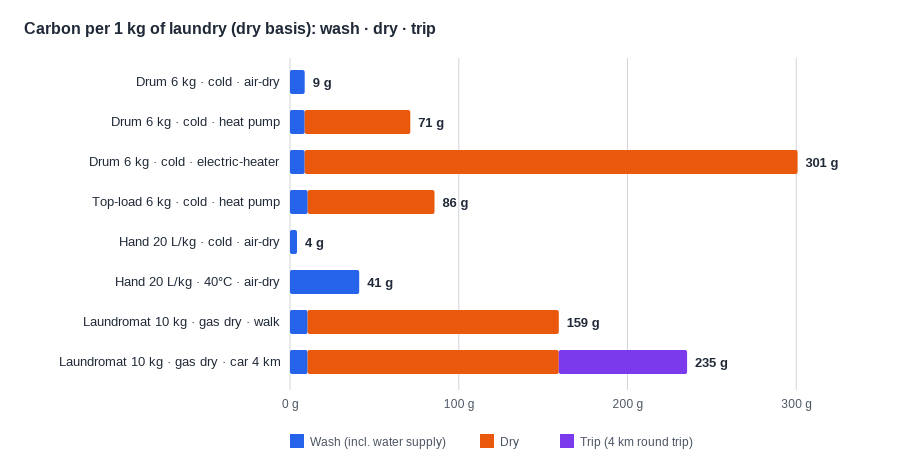
④ Contributions of washing, drying and travel
⑤ Break-even load for water
The load at which the machine’s water per kg drops below hand-washing comes from .
At hand-washing of 20 L/kg, kg and kg. At 8 L/kg the drum needs 6.5 kg (14 lb), and the top-loader would need 60 kg, so it effectively cannot win.
⑥ Laundromat break-even distance and the annual picture
The round-trip distance at which a laundromat ties the home on carbon:
The home has an electric-heater dryer (6 kg drum, 301 g), and the laundromat dries with gas (159 g excluding travel). If the laundromat dries with electricity, then km (0.9 mi). If the home has a heat pump (71 g), the laundromat cannot beat the home even with zero travel. On cost, it is 1,000 KRW versus 195 KRW (electric heater), so the laundromat loses at any distance.
Now the annual figures. That a four-person household washes 800 kg (1,760 lb) a year is an author’s assumption. I set it slightly below four times the single-person figure of 4 to 5 kg per week in an LG Electronics guide (no survey source given).[20] Annual values are the scenario values multiplied by 800 kg.
| Method | Carbon per year | Cost per year | Water per year |
|---|---|---|---|
| Drum 6 kg, cold, air-dry | 7 kg | 10,000 KRW (≈ $7) | 6.7 m³ |
| Drum 6 kg, cold, heat pump | 57 kg | 41,000 KRW (≈ $29) | 6.7 m³ |
| Drum 6 kg, cold, electric heater | 241 kg | 156,000 KRW (≈ $111) | 6.7 m³ |
| Hand-wash 20 L/kg, cold, air-dry | 3 kg | 16,000 KRW (≈ $11) | 16.0 m³ |
| Laundromat, gas drying, walking | 127 kg | 800,000 KRW (≈ $571) | 8.0 m³ |
| Laundromat, gas drying, car 4 km | 188 kg | 850,000 KRW (≈ $607) | 8.0 m³ |
⑦ Robustness check: does the conclusion survive when the assumptions are pushed to the ends of their ranges?
There are three headline conclusions. (a) The contest is decided by drying, not by washing method. (b) Water is governed by how full the machine is loaded. © The laundromat does not beat the home on money, and does not beat a home heat-pump dryer on carbon. I pushed the six weakest assumptions to the ends of their ranges and recalculated. Ranges follow the evidence where there is any, and are the author’s choice otherwise.
| Assumption shaken | Range | Key recalculation | Holds? |
|---|---|---|---|
| Hand-washing water | 8 to 40 L/kg | Cold hand-wash 2 to 8 g, 40°C 16 to 82 g | Partly reversed (see below) |
| Laundromat heat source | Gas / electric | 159 g / 273 g (home heat pump 71 g) | Holds |
| Electric-heater | 1.36 to 1.847 | Home 293 to 394 g | Holds |
| Heat-pump | 0.25 to 0.40 | Drum 6 kg: 61 to 92 g | Holds |
| Laundromat price | 5,000 to 10,000 KRW total | 500 to 1,000 KRW/kg (home 52 to 253) | Holds |
| Residual moisture | Drum 0.4 to 0.6, etc. | Drying effect 50 to 75 g | Holds |
In the same calculation, the break-even distance against a gas laundromat is 7.0 to 12.4 km (4.3 to 7.7 mi) across the electric-heater range.[6][8] For the laundromat to match a home heat pump on cost, the 10 kg total fee would have to be 517 KRW (about $0.37). The ranges for (drum 0.4 to 0.6, top-loader 0.5 to 0.7, hand 0.6 to 1.0, laundromat 0.35 to 0.55) have no public figures and were set by the author. The hand upper limit of 1.0 is a soaked state beyond the wet-laundry reference of the Australian dryer test (90% starting moisture).[6]
Here is where it breaks, without hiding it.
- If hand-washing water falls below 8.4 L/kg, the 6 kg drum loses to hand-washing on water. Below 12.7 L/kg, 40°C hand-washing has lower carbon than a 40°C washing machine (26 to 28 g).
- If hand-washing water is about 35 L/kg or more and the main wash is heated to 40°C, the claim that “drying decides it” breaks. The gap between washing methods (+73 g against the cold drum’s 9 g) becomes larger than the drying effect (+63 g). Between washing machines, or against cold-water hand-washing, the claim holds at every point in the range.
- Stacking the three least favorable assumptions makes the laundromat tie the home heat pump. With laundromat = 0.35 it comes to 129 g, and for a home 6 kg top-loader with heat-pump = 0.40 and = 0.7 it comes to 127 g. At the same extreme, the drum is still lower at 109 g.
Calculator
OUTPUT
The base case, a 6 kg drum with cold water and heat-pump drying, comes to 8.4 L of water, 0.167 kWh, 71 g of carbon and 52 KRW (about $0.04) per kilogram of dry laundry. Drying takes 90% of that electricity. Switch to air-drying and carbon drops from 71 g to 9 g, an eighth; switch to an electric-heater dryer and it rises to 301 g, more than four times. Changing the washer from drum to top-loader, or the water from cold to 40°C, makes a difference (+15 g and +17 g, respectively) of less than a third of the +62 g you get from going from air-drying to a heat pump.
| Question | Answer |
|---|---|
| Method using the least water | A full drum (4.3 L/kg). Even frugal hand-washing at 8 L/kg loses on water to a drum loaded to 6.5 kg or more |
| Method with the least carbon | Cold-water washing with no dryer. Hand-washing (4 g) and a full drum (3 g) are within the margin of error |
| When hand-washing loses to the machine | When hot water is used. Heating only the main wash gives 41 g, more than the 40°C machine (26 to 28 g), and heating the rinses too gives 115 g. If hand-washing water is below 12.7 L/kg, that order flips |
| When the laundromat wins on carbon | When the home dryer is an electric-heater type, the laundromat dries with gas, and the round trip is within 7 km (4.6 mi) |
| When the laundromat wins on money | Never within this range of assumptions. 500 to 1,000 KRW/kg (about $0.36 to $0.71) against 5 to 253 KRW/kg at home |
One asymmetry in that comparison: the home figures are only electricity, gas and water, with the purchase price of the washer and dryer left out, while the laundromat’s price already has its machines built in. Counting purchase costs would narrow the gap, and this article does not calculate by how much. Of the laundromat’s 1,000 KRW per kg, the energy cost is about 83 KRW. I can only guess that the rest, over nine tenths, goes to rent, machines and labor; the real cost structure is unknown to me. The Manila study also reports that laundromats use far more energy because of their dryers, so the direction agrees.[3] Pushing the assumptions to the ends of their ranges, the conclusion that drying decides the contest remained standing. What does shake is only the fine win-loss record between hand-washing and the machine. Dryer or drying rack makes a bigger difference than machine or basin.
A drying rack uses 0 kWh of electricity and takes a corner of your living room instead. That rent is not in the table.
References
[1]: Korea Consumer Agency, comparison test of five drum washers, December 2020 (cold standard cycle 66 to 120 Wh and 73 to 88 L; 40°C standard cycle 224 to 626 Wh and 73 to 105 L; checked through press coverage rather than the agency’s original; Korean-language pages), Dailian https://m.dailian.co.kr/news/view/943794 and Kyeonggi Ilbo https://kyeonggi.com/article/202012071148254
[2]: Ministry of Trade, Industry and Energy Notice No. 2018-180, draft amendment of the “Energy Efficiency Management Equipment Operating Regulations” (administrative notice of 2018-03-27, with the WTO TBT notification attached; test inlet water temperature (20±2)°C, per-kg water limits by grade for drum and ordinary washers, report item “spin-dry”; the table mixes current and amended columns, so only values that read the same in both columns are used; Korean-language document), https://members.wto.org/crnattachments/2018/TBT/KOR/18_2718_00_x.pdf
[3]: Retamal, M., Schandl, H., “Dirty Laundry in Manila: Comparing Resource Consumption Practices for Individual and Shared Laundering”, Journal of Industrial Ecology 22(6), 1389-1401 (2018). Comparison of hand-washing in six Manila households, washing machines and laundromats (hand-washing used the least water; laundromats the most energy because of dryers); Korean average of 35 L/kg (converted from Pakula & Stamminger 2010 data assuming 4 kg per cycle), laundromats 19 to 26 L/kg, and commercial washing 9 to 27 L/kg (citing Brown 2009), confirmed in the full-text PDF. The original Pakula & Stamminger paper (Energy Efficiency, DOI 10.1007/s12053-009-9072-8) was not accessible. https://doi.org/10.1111/jiec.12696
[4]: NIST Chemistry WebBook, Water (liquid specific heat 4.186 kJ/(kg·K), enthalpy of vaporization about 40.7 kJ/mol ≈ 2,257 kJ/kg), https://webbook.nist.gov/cgi/cbook.cgi?ID=C7732185
[5]: Samsung Electronics Newsroom (Korea), “Samsung Bespoke AI Combo achieves both drying performance and energy efficiency” (2024-03-26; 20 kg dryer 1,989.1 Wh per cycle, 147.5 Wh per kg, citing the Korea Energy Agency; manufacturer material; Korean-language page), https://news.samsung.com/kr/tag/소비전력량/feed
[6]: IEA 4E, “Australia Laundry Dryers” policy summary (minimum efficiency 1.36 kWh per kg of water evaporated; test starting moisture 90%, final 6%), https://iea-4e.org/wp-content/uploads/publications/2011/03/LD_AUS.pdf
[7]: European energy label (Regulation EU 392/2012) product information sheets. Fisher & Paykel DH9060P2 heat-pump dryer, 9 kg full load 1.68 kWh, https://dam.fisherpaykel.com/KZ3PKN00/at/3sfcvspgwxq87rtgn9mbx6/heat-pump-clothes-dryer-product-information-sheet-DH9060P2-428362A.pdf ; BSH WT45H200GB 8 kg full load 1.90 kWh, https://media3.bsh-group.com/Documents/specsheet/en-IE/WT45H200GB.pdf
[8]: Yuan, Ouyang, “Experimental study of a new heat-pump clothes dryer”, Frío Calor Aire acondicionado 42(474), International Institute of Refrigeration (IIR) bibliographic record (heat pump 1.22 kWh/kg, electric heating 1.847 kWh/kg; checked from the abstract record), https://iifiir.org/en/fridoc/experimental-study-of-a-new-heat-pump-clothes-dryer-29516
[9]: Laundry24 Jongno store listing (Daangn store page, registered January 2024; small-machine washing from 4,000 KRW, large-machine washing 5,000 to 6,000 KRW, large-machine drying from 5,000 KRW with 32 minutes base and 500 KRW per extra 4 minutes; a single store, with no heat source stated; Korean-language page), https://daangn.com/kr/local-profile/런드리24-종로점-m9v7r2py6gbd/
[10]: Sidae (sidae.com) report introducing Cleantopia + Coin Wash (2017-01-17; 55°C hot-air drying, about 1 hour from wash to dry; dryer heat source not stated; Korean-language page), https://www.sidae.com/article/2017011511108048972
[11]: Author’s conversion. Gasoline combustion of about 2.3 kgCO₂/L ÷ fuel economy of 12 km/L ≈ 192 g/km, rounded to 190 g/km. I could not confirm the average fuel economy of Korean passenger cars, so 12 km/L is an assumption. For reference, the European new-car average in 2024 was about 107 g/km (EEA), https://www.eea.europa.eu/en/newsroom/news/average-co2-emissions-from-new-cars-and-new-vans
[12]: Korea National Oil Corporation Opinet, average selling price lookup (national regular gasoline 1,855.66 KRW/L as of 2026-10-27; Korean-language page), https://www.opinet.co.kr/user/dopospdrg/dopOsPdrgSelect.do
[13]: Kukinews, “National electricity emission factor for 2023 finalized” (Ministry of Climate, Energy and Environment, 2025-12-18, 0.4173 tCO₂eq/MWh; Korean-language page), https://www.kukinews.com/article/view/kuk202512180131
[14]: Natural-gas CO₂ emission factor of 56.1 kg/GJ (Korean table, IPCC default), https://zenodo.org/records/7540262/files/Table7_KOR.csv ; IPCC, 2006 IPCC Guidelines Vol. 2 Ch. 2 Stationary Combustion, https://www.ipcc-nggip.iges.or.jp/public/2006gl/pdf/2_Volume2/V2_2_Ch2_Stationary_Combustion.pdf. The 0.2020 kg/kWh is the author’s conversion (56.1 × 0.0036)
[15]: Summary of residential electricity rate tiers (tier 2 at 214.6 KRW/kWh etc.; official tariff text not checked; Korean-language page) https://wikidocs.net/blog/@goodhosup/27591/ and a report on the Q4 2026 electricity rate freeze and the +5 KRW fuel-cost adjustment kept (MTN, 2026-09-21; Korean-language page) https://news.mtn.co.kr/news-detail/2026092111090432619. The marginal rate of 260 KRW is the author’s calculation: 214.6 + 9 (climate-environment) + 5 (fuel-cost adjustment), then adding the 3.7% fund and 10% VAT
[16]: Seoul City Gas, rate table (residential cooking and heating 22.5268 KRW/MJ, table of October 1, 2026; whether VAT is included is not stated, and the 10% addition is the author’s assumption; Korean-language page), https://www.seoulgas.co.kr/mobile/payment/gasPayTable
[17]: Money Today, “Seoul sewer rates to rise 9.5% a year for five years; progressive residential tiers abolished” (sewer 410 KRW/m³; Korean-language page), https://www.mt.co.kr/estate/2025/06/05/2025060517372939901 ; summary of the Seoul water rate of 580 KRW/m³ (unofficial; official tariff not checked; Korean-language page), https://glasswallet.com/calculate/water-bill/rate-structure
[18]: Author’s estimate. Electricity for tap-water production and supply plus sewage treatment was taken as 0.3 to 0.7 kWh/m³, with 0.5 as the center; I could not confirm an official Korean unit figure.
[19]: NIST Special Publication 811, guide on unit conversion (1 kWh = 3,600 kJ), https://www.nist.gov/pml/special-publication-811
[20]: LG Electronics care-solutions product FAQ (“a single-person household’s weekly laundry is about 4 to 5 kg”; a manufacturer’s guidance with no survey source given, so it is a reference rather than evidence; Korean-language page), https://www.lge.co.kr/product/care-solutions/washing_machines/fx24wn-kw
[21]: U.S. Energy Information Administration, 2020 Residential Energy Consumption Survey, Table HC3.1 “Appliances in U.S. homes, by housing unit type” (homes with a clothes dryer 102.32 million: electricity 82.21 million, natural gas 18.89 million, propane 1.22 million), https://www.eia.gov/consumption/residential/data/2020/hc/pdf/HC 3.1.pdf