It is 6:40 p.m., you have no umbrella, and the bus stop is 100 m (328 ft, about 109 yards) from the awning you are huddled under. One friend says, “Just run. You’ll get less wet than if you walk.” Another replies, “But then you run into more rain head-on. It all comes out the same.”
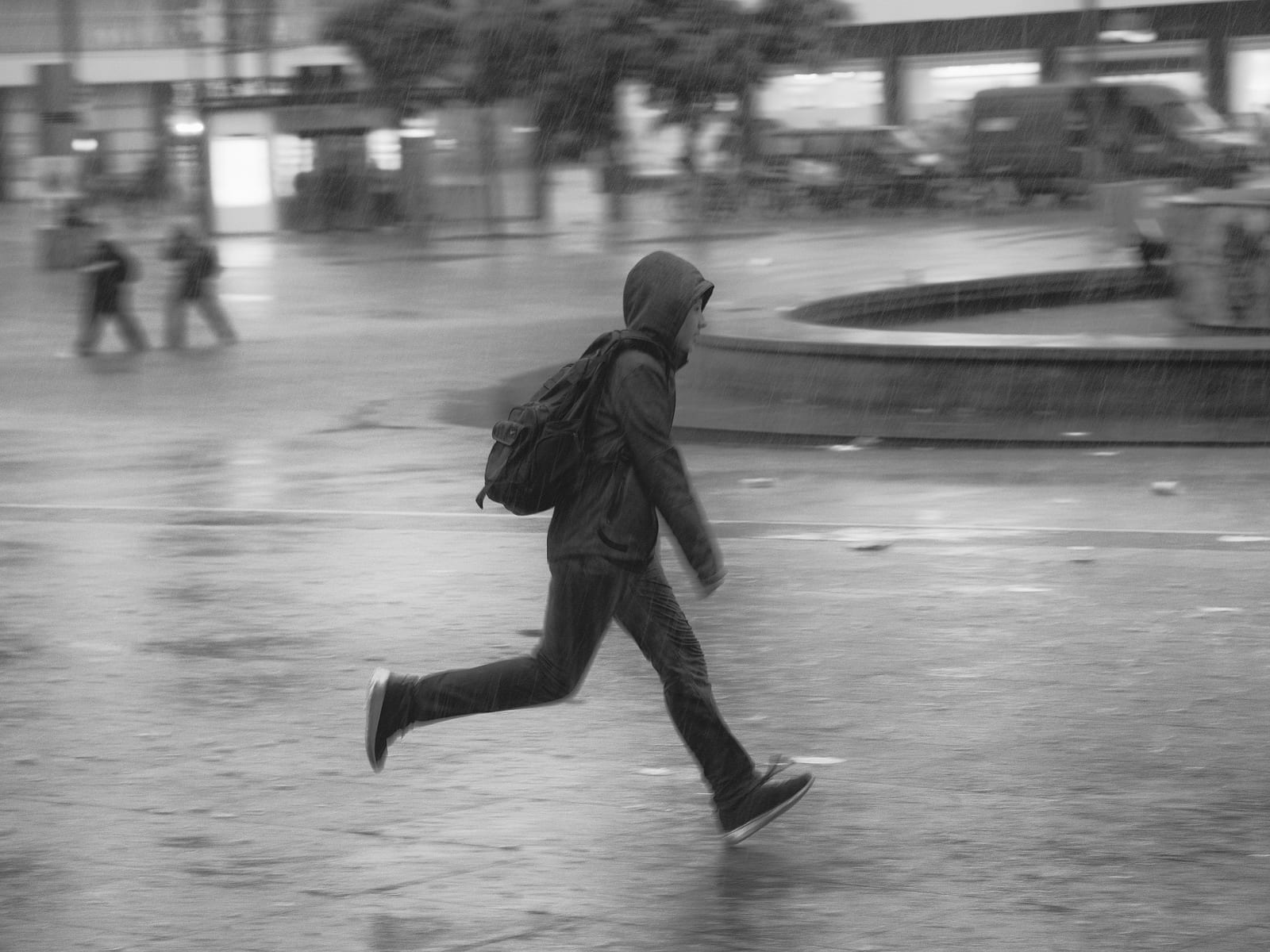

Both have a point. This article calculates how much water actually lands on you, in milliliters (mL). Here is the counterintuitive part up front: over 100 m, the rain hitting your front is almost the same whether you walk or run. Only the rain falling on your head and shoulders shrinks. So “how much less wet” depends on your height, how hard it is raining, the wind, and above all on whether you fix the distance or fix the time.
INPUT
Rain intensity R
The Korea Meteorological Administration (KMA) sorts rain by hourly rate: 1 to under 3 mm/h (0.04 to 0.12 in/h) is light, 3 to under 15 mm/h (0.12 to 0.59 in/h) is moderate, 15 to under 30 mm/h (0.59 to 1.18 in/h) is heavy, and 30 mm/h (1.18 in/h) or more is very heavy.[1] For a US reader, the nearest everyday scale is the one US forecasters and radar maps use: moderate rain is about 0.11 to 0.30 in/h (2.8 to 7.6 mm/h), and heavy rain is above 0.30 in/h (7.6 mm/h).[14] The two scales are not aligned. The default in this article, 10 mm/h (0.39 in/h), is “moderate” by the KMA scale and already “heavy” by the US one.
A rainfall of 1 mm means water 1 mm deep over flat ground, which is 1 L (1,000 mL) per m².[2] At 10 mm/h, that is mL falling on each m² every second. (In US units, 1 in of rain is about 0.62 gallons per square foot.) The default is 10 mm/h (central value). The KMA guidance says that from 15 mm/h puddles form on uneven roads and clothes start to soak through even under an umbrella,[3] so 10 mm/h is the kind of rain where you wish you had an umbrella but not an emergency.
Raindrop fall speed
A moving body sweeps through raindrops hanging in the air, so we need to know how many mL of rain are suspended in 1 m³ of air. That equals the rain intensity (volume falling per m² per second) divided by the speed at which the drops fall. Drops differ in size and speed, so we need a fall speed averaged by water volume. Three ingredients:
- Drop-size distribution: the Marshall–Palmer distribution. The number of drops of diameter mm per m³ of air is , with and .[4][5]
- Fall speed by drop size: the Gunn & Kinzer (1949) measurements,[6] fitted over diameters of 0.5 to 5 mm by m/s (Atlas and Ulbrich, 1977).[7][8]
- Average the two, weighting by water mass (proportional to the cube of the diameter).
The integral closes in terms of the gamma function:
Substituting gives , so the approximation is
Numerically: 3.6 m/s (8.1 mph) at 1 mm/h, 4.2 m/s at 3 mm/h, 5.0 m/s (11 mph) at 10 mm/h, 5.8 m/s at 30 mm/h, and 6.9 m/s at 100 mm/h. Heavier rain has bigger drops, and bigger drops fall faster. The Marshall–Palmer distribution is an average for mid-latitude stratiform rain,[5] and the choice of distribution parameters and fall-speed fit moves the value by a few percent, so treat 5.0 m/s as a central value.
Body size and speed
| Symbol | Meaning | Value | Stance | Basis |
|---|---|---|---|---|
| Top area (head and shoulders seen from above) | 0.1 m² (1.1 ft²) | Central | Model assumption: shoulder width about 0.4 m × body depth about 0.25 m | |
| Front area (seen from the front) | = 0.7 m² (7.5 ft²) for height = 1.75 m (5 ft 9 in) | Central | Model assumption: average body width including arms and legs of about 0.4 m. Average adult heights in Korea are 172.5 cm (5 ft 8 in) for men and 159.6 cm (5 ft 3 in) for women[9] | |
| Walking speed | 1.4 m/s (3.1 mph) | Central | Mean comfortable walking speeds across age and sex groups range from 1.27 to 1.46 m/s[10] | |
| Running speed | 5 m/s (11 mph) | Aggressive | 100 m in 20 s, a fast run (a 5:22 mile pace) | |
| Distance | 100 m (328 ft) | Central | Assumption |
The Korean height data are used as is. A height of 1.75 m (5 ft 9 in) also falls within the ordinary range of US adult heights, and, since only the front area depends on height, the conclusions hold at any realistic height (see step 4).
Top and front areas treat the body as a box, so they are rough values that vary with build. Changing the top area from 0.07 to 0.14 m² changes the amount saved by running to between 10 and 20 mL (see step 2), and the front area does not affect that amount at all. More detailed body models exist (Bocci, 2012); we compare conclusions below.[11]
Scenario variables
- Height: a child at 1.2 m (3 ft 11 in), an adult at 1.75 m (5 ft 9 in), a basketball player at 2.1 m (6 ft 11 in). The top area is held at 0.1 m², and only the front area scales with height (0.48 m² for the child, 0.84 m² for the player).
- Wind : the component along your direction of travel. Tailwind is +, headwind is −, and we look at ±3 m/s (about ±6.7 mph) as examples.
- What is held fixed: either the distance, 100 m, or the time it takes to walk it, 71 s.
FORMULA
Step 1: split the rain into a top share and a front share
The rain that reaches your body has two sources.
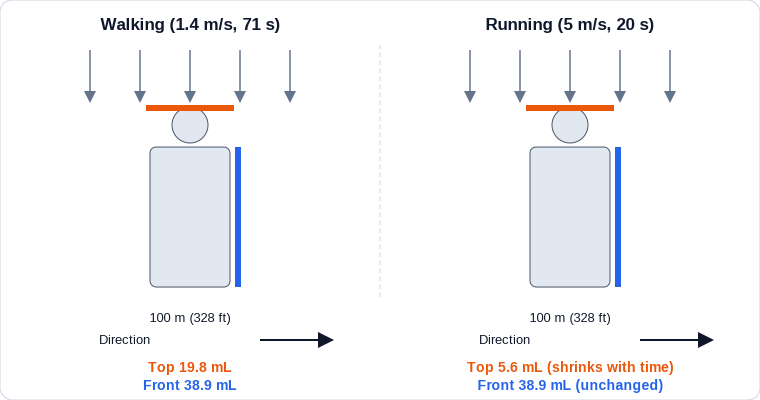
The top share is rain falling on your head and shoulders. An area facing up receives mL/m² per second, so the total is proportional to the time you are exposed.
The front share is rain hitting your front as you push through the drops hanging in the air. The rain in 1 m³ of air is mL. A front area moving at speed for seconds sweeps through a volume of air , and since , the speed drops out.
Checking the units for : , and multiplying by m² and m gives mL.
At the defaults and m/s, we get mL/m³. One US shot glass (1.5 fl oz, about 44 mL)[12][13] of rain is spread through about 80 m³ of air (roughly 2,800 ft³, a small living room’s worth). Rain in the air is that dilute.
Step 2: fix the distance and the runner is less wet
Walking 100 m takes s. Running takes s.
(That is 2.0 fl oz walking and 1.5 fl oz running.)
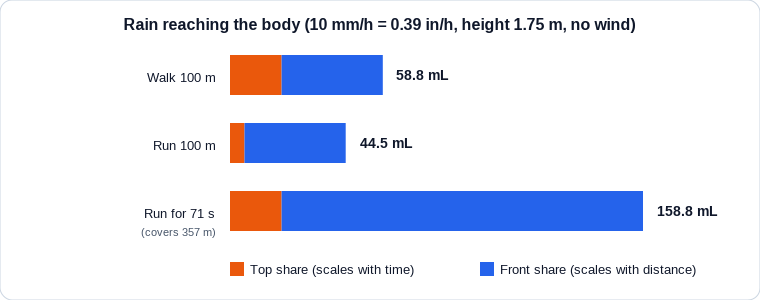
The reduction is mL, or . Because the saving comes only from the top share, it simplifies to:
Notice that does not appear. The amount saved by running does not depend on height.
Step 3: fix the time and the runner is wetter
Now suppose both of you stay outside for the same 71.4 s. The walker covers 100 m and stops. The runner at 5 m/s covers 357 m (1,171 ft, about 0.22 mi) in 71.4 s.
That is 2.7 times the walker’s 58.8 mL (5.4 fl oz versus 2.0 fl oz), because the runner cut through more air in the same time.
Step 4: how height changes things
Keep the top area at 0.1 m² and scale only the front area as . The table is for 100 m, no wind, 10 mm/h.
| Height | Front area | Walking | Running | Saved | Saved (%) |
|---|---|---|---|---|---|
| Child, 1.2 m (3 ft 11 in) | 0.48 m² | 46.5 mL | 32.2 mL | 14.3 mL | 30.7% |
| Adult, 1.75 m (5 ft 9 in) | 0.70 m² | 58.8 mL | 44.5 mL | 14.3 mL | 24.3% |
| Basketball player, 2.1 m (6 ft 11 in) | 0.84 m² | 66.5 mL | 52.3 mL | 14.3 mL | 21.5% |
A taller body takes in more total rain, but the amount saved by running stays at 14.3 mL. Only the percentage shrinks a little. Tall people also get less wet by running. (If you scale the whole body proportionally, so that both areas grow with the square of height, the ratio of the two shares stays put and so does the percentage.)
Step 5: how rain intensity changes things
| (mm/h) | (in/h) | (m/s) | Walking (mL) | Running (mL) | Saved (%) |
|---|---|---|---|---|---|
| 1 | 0.04 | 3.6 | 7.4 | 5.9 | 19.4% |
| 3 | 0.12 | 4.2 | 19.8 | 15.5 | 21.7% |
| 10 | 0.39 | 5.0 | 58.8 | 44.5 | 24.3% |
| 30 | 1.18 | 5.8 | 159.6 | 116.8 | 26.8% |
| 60 | 2.36 | 6.4 | 300.7 | 215.0 | 28.5% |
In heavier rain the drops fall faster, so the front share gets smaller and the top share counts for more. The percentage saved therefore creeps upward, but only in a gentle range from 19% to 29%.
Step 6: when there is wind
If the raindrops have a horizontal velocity along your direction of travel, the relative speed of the rain hitting your front becomes . The top share sees only vertical fall and is unchanged.
- Headwind ( m/s): 142.1 mL walking, 67.8 mL running, so running cuts the total by 52%. In a headwind, faster is always less wet.
- Tailwind ( m/s): 64.3 mL walking, 21.1 mL running at 5 m/s, and 9.3 mL if you move at the wind’s own 3 m/s.
In a tailwind, drops start hitting you from the front as soon as you outrun the wind. Fixing the distance and writing out the range gives:
If the numerator of the first term in brackets is positive, going faster reduces the total. If it is negative, going faster increases it. The reference wind speed where it hits zero is:
For a tailwind stronger than 0.71 m/s, the least wet speed is . The front share drops to zero and only the top share remains.
This agrees with the academic literature. Bocci (2012), in Italy, modeled the body with several simple shapes and found that the best way to move depends on the shape and posture of the body and on the direction and strength of the wind. For some shapes the best choice is to move as fast as possible, and for others there is a specific best speed.[11] The box model here, where matching a strong tailwind’s speed is best, is a result of the same type.
What this model leaves out
Leaning forward enlarges your top area and shrinks your front area. Water splashing up from the ground as you run, water absorbed by clothing, and umbrellas are not in the model. These factors change how wet you actually get, but the top-versus-front framework holds. The estimate above is “the amount of rain that reaches your body,” not “how soaked your clothes are.”
OUTPUT
Walking 100 m puts about 59 mL (1.3 shot glasses, 2.0 fl oz) of rain on you, and running puts about 44 mL (1.0 shot glass, 1.5 fl oz). The saving from running is 14 mL, about a third of a shot glass. If you fix the time instead, the runner takes 158.8 mL (3.6 shot glasses, 5.4 fl oz), 2.7 times the walker’s amount.
| Question | Answer |
|---|---|
| If you have to cover 100 m | Running gets you less wet. Walking takes 58.8 mL and running takes 44.5 mL, which is 24% less. |
| If you stay out for the same length of time | Running gets you wetter. In the same 71 s, running takes 158.8 mL, 2.7 times the walking amount (while covering 357 m). |
| If you are very tall | Running still gets you less wet. The saving stays at 14.3 mL, and only the percentage shrinks slightly: 31% for a child, 24% for an adult, 22% for a basketball player. |
| If there is a 3 m/s tailwind | Moving at the wind’s own speed gets you least wet. That is 9.3 mL, about one-seventh of the 64.3 mL you take walking. |
| If there is a 3 m/s headwind | Running gets you much less wet. Walking takes 142.1 mL and running takes 67.8 mL, which is 52% less. |
Sprinting the full 100 m saves less rain than a third of a shot of whiskey. What you buy instead is time: 71 seconds in the rain become 20. For most people the real payoff of running is that you get to the bus stop sooner, not that you are drier.
References
[1]: Korea Meteorological Administration (KMA), forecast terminology guide (hourly rainfall thresholds by rain intensity), https://www.weather.go.kr/kma/biz/forecast05.jsp
[2]: KMA / e-Nara Index, rainfall trends (definition of rainfall as depth in mm), https://www.index.go.kr/unify/idx-info.do?idxCd=1401
[3]: KMA Weather Nuri, rainfall intensity video guide (puddles on roads and clothes soaking through under an umbrella at 15 mm/h and above), https://www.weather.go.kr/w/forecast/guide/prec-video.do
[4]: Marshall, J. S. and Palmer, W. McK., “The distribution of raindrops with size”, Journal of Meteorology 5(4), 165–166 (1948), https://doi.org/10.1175/1520-0469(1948)005<0165:TDORWS>2.0.CO;2
[5]: “Raindrop size distribution”, Wikipedia (summary of the Marshall–Palmer parameters and ), https://en.wikipedia.org/wiki/Raindrop_size_distribution
[6]: Gunn, R. and Kinzer, G. D., “The terminal velocity of fall for water droplets in stagnant air”, Journal of Meteorology 6(4), 243–248 (1949), https://doi.org/10.1175/1520-0469(1949)006<0243:TTVOFF>2.0.CO;2
[7]: Atlas, D. and Ulbrich, C. W., “Path- and area-integrated rainfall measurement by microwave attenuation in the 1–3 cm band”, Journal of Applied Meteorology 16, 1322–1331 (1977), https://ntrs.nasa.gov/citations/19780038711
[8]: Uijlenhoet, R., “Raindrop size distributions and radar reflectivity–rain rate relationships for radar hydrology”, Hydrology and Earth System Sciences 5(4), 615–628 (2001) (the Atlas–Ulbrich approximation used together with the Marshall–Palmer and ), https://hess.copernicus.org/articles/5/615/2001/
[9]: Korean Agency for Technology and Standards, 8th Size Korea national body measurement survey (2020–2021), as reported by Financial News (Korean), 2022-03-30, https://www.fnnews.com/news/202203301811045858
[10]: Bohannon, R. W., “Comfortable and maximum walking speed of adults aged 20–79 years: reference values and determinants”, Age and Ageing 26(1), 15–19 (1997), https://doi.org/10.1093/ageing/26.1.15
[11]: Bocci, F., “Whether or not to run in the rain”, European Journal of Physics 33(5), 1321–1332 (2012), https://doi.org/10.1088/0143-0807/33/5/1321
[12]: NIAAA (US National Institute on Alcohol Abuse and Alcoholism), “What Is A Standard Drink?” (a shot of distilled spirits is 1.5 fl oz). Used here only as a comparison unit. https://www.niaaa.nih.gov/alcohols-effects-health/what-standard-drink
[13]: NIST, Guide to the SI, Appendix B.8, conversion factors (1 US fluid ounce = 29.57353 mL), https://www.nist.gov/pml/special-publication-811/nist-guide-si-appendix-b-conversion-factors/nist-guide-si-appendix-b8
[14]: UW–Madison SSEC, “What is considered heavy rain?” (2026-09-14): moderate rain 0.11 to 0.3 in/h, and heavy rain at about 0.30 in/h and above, the cutoff used by the American Meteorological Society. https://wxguys.ssec.wisc.edu/2026/09/14/heavy-rain/